Archive
Chocolate maker with a passion
Aspen — It’s been a week or so since the Food & Wine Classic in Aspen and I’m just about recovered. But there are several stories still to tell, and one of those is about chocolatier Art Pollard.
Art and business partner Clark Goble own Amano Chocolate, based in Orem, Utah, just outside of Salt Lake City.
You really should meet Art and get a taste of his passion for making world-class artisan chocolate.
And taste his chocolate, while you’re at it.
I ran into Art during one of the Grand Tastings, him standing behind his table, tie askew and this mile-wide grin splitting his face, barely containing the enthusiasm he feels for great chocolate.
A simple question from me turned into a fascinating 15-minute introduction into chocolate making and how Pollard, while the rest of his business-school classmates at Brigham Young University were investigating such heavy topics as the international space shuttle and particle accelerators, was figuring that his future might lie in chocolate.
Chocolate took a bit of a back role for a few years as Art built his software business but soon he was writing software in one room while cooking chocolate in a backroom using a machine he made himself. It must have been the best-smelling software company ever.
All the while, he was traveling the world, learning from the Old Masters in Europe and Mexico and seeking out sources of hard-to-find cacao beans.
He soon discovered that the old machines – some of his are more than 100 years old -, are still the best for chocolate making. “I get way better flavors that way,” he said. “It’s not that hard to make bad chocolate but it’s really hard to make good chocolate.”
The photo below shows Art nex to his 70-year old chocolate melangeur, a vintage chocolate grinding machine. The two giant revolving granite rollers on top of a revolving granite slab grind the roasted cocoa to a thick oily paste and finally a thick liquid. This liquid is called cocoa “liquor” and is over 50 percent fat. It is either used at this stage for cocoa butter pressing or is mixed and re-ground with sugar in the Melangeur to make chocolate.
You can see more of his prized machinery on his Web site.
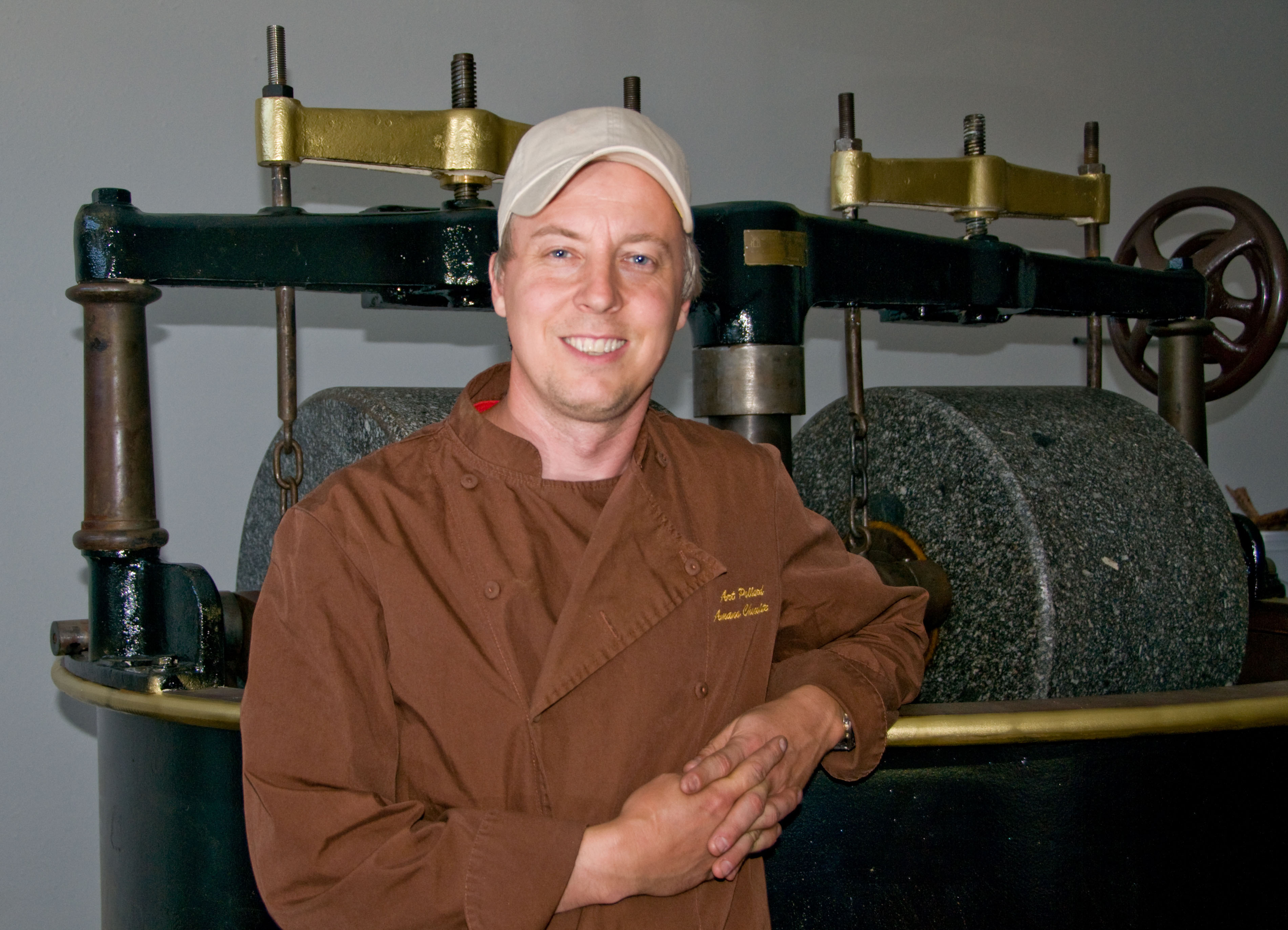
His timing (2006) in introducing his chocolate to the world wasn’t the best, he admits.
“I got started just as everything was collapsing,” he said, and now can laugh at his timing. “I lost a lot of sleep.”
Today, Amano (Pollard says it means both “by hand” and “with love” in Italian, reflection of his commitment to artisan chocolate) makes a chocolate rivaling the best I’ve had from Europe and elsewhere. One style, the Dos Rios, smells and tastes of blood orange, bergamot and rose petals.
“Those flavors come the bean, isn’t that wild?” Art asked, his grin even bigger. He said cocao beans can have fruity flavors or vegetal or the deepest chocolate, all depending on where they come from. It’s their terroir, in wine speak.
What’s interesting, too, is in many of the isolated places he finds great coca, the locals use the beans for cooking, not making chocolate.
During a recent trip to Venezuela, he took a farmer some chocolate made from his own beans.
“You have to understand these farmers are totally isolated, and they’ve never seen finished chocolate made from their beans,” Art said. “I gave him a taste of the chocolate and he just looked at me, amazed.”
“He said, ‘The tastes in this are like a river, they take you on a long journey.’
“That really touched my soul.”
Riesling the world’s greatest wine – Paul Grieco
My last morning at the Food & Wine Classic in Aspen was spent watching part of the Quickfire Cookoff between Rick Bayless of Frontera in Chicago and Michael Voltaggio of The Langham in Pasadena, Cal. and being entertained and educated by Riesling fan extraordinaire Paul Grieco.
This final morning of the Classic traditionally is the quietest of the three-day event, as many people are thinking about heading home while there also are plenty of Saturday-night hangovers being nursed.
Grieco is co-owner of Hearth restaurant and Terroir
wine bar in NYC and such a devoted fan of the Riesling he was sporting for the weekend a big, bold, black “Riesling” tattoo.
Grieco (rhymes with echo) offered a seminar called “Riesling: A World Tour,” and after three days of the Classic, a Sunday morning seminar is unlikely to be very crowded, as he noted.
“People are either too hungover to get up or are over at the St. Regis watching the show,” Grieco offered. “So that means you (in the audience) are either lost or in love with Riesling.
“I’ll be bold enough to presume it’s the latter.”
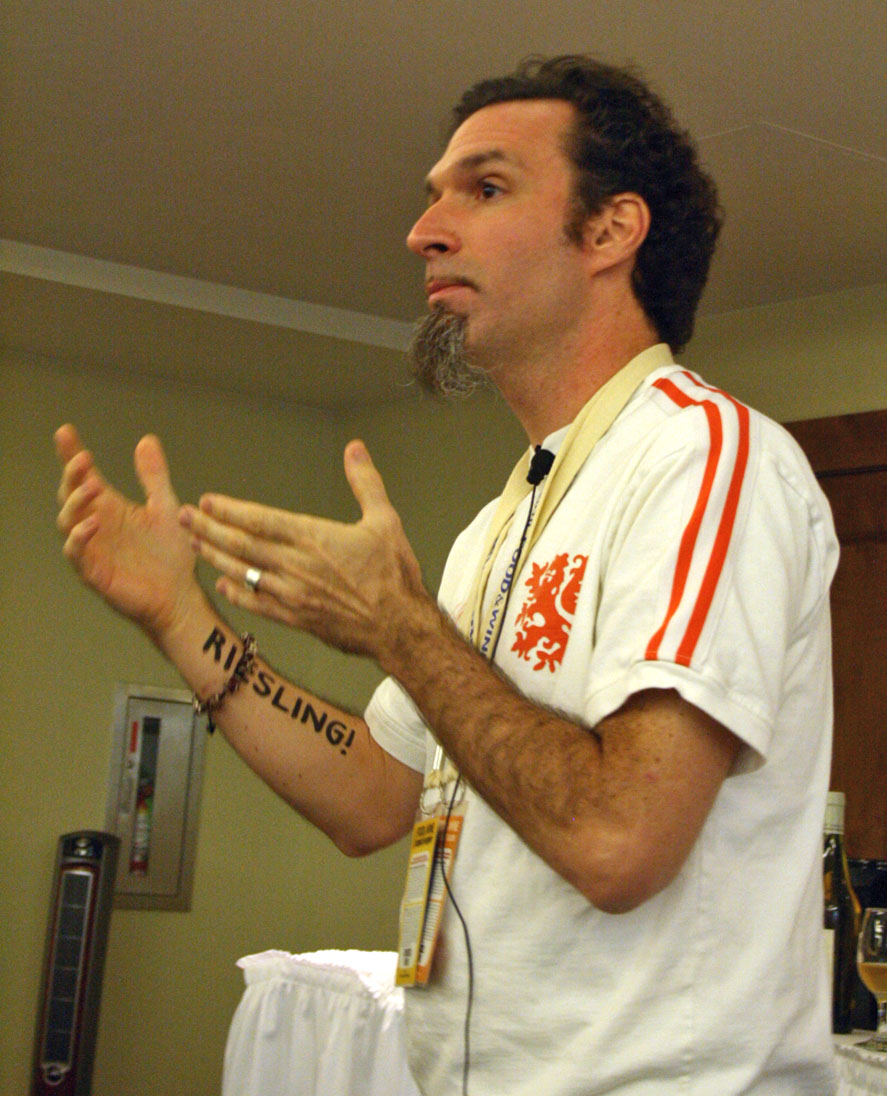
Paul Grieco wears his love for Riesling where everyone can see it.
“Finesse, harmony, complexity, longevity, all these add up,” he said, running his hand through his unruly mane of black hair, flashing the big, bold “Riesling” printed on his forearm.
But it’s terroir, and the ability to communicate terroir, that makes a wine truly great, he said.
“What do I mean by terroir?” he asked. “It’s more than just the soil or the landscape or the weather. It’s a sense of place, it’s what you grow and where you grow it and even the history of the land.”
Riesling, said Grieco, speaks of place like no other grape.
“Riesling is the greatest grape and produces the greatest wines on the planet,” he said. “Riesling is totally transparent, it gives absolute voice to the place it’s grown.”
He was also wearing a T-shirt announcing “The Summer of Riesling,” a Riesling-phile program offered at his wine bar, Terroir. Thirty wines, all Rieslings and all by the glass, comprise the bar’s white-wine menu.
“No chardonnay, no pinot gris, no sauvignon blanc, just Riesling,” Grieco explained. “We want people to experience and get to know Riesling.”
The six Rieslings he had us sample during his 45-minute included the 2007 Von Kesselstatt Riesling Trocken Josephshofer from the Mosel-Saar-Ruwer region of Germany.
“The measure of greatness in a Riesling isn’t the level of sugar, it’s the acidity to give it balance,” Grieco said. “The area along the Mosel is the perfect place to create wines with that balance.”
He laughed about the tattoo on his forearm, and noted we, too, could have one.
“If you love Riesling as much as I do, you’d do this, too,” he said, lifting the arm for all to see. “And so I’ve given you all the opportunity to have a Riesling tattoo.”
It’s not a real tattoo, of course, but rather a temporary water-based mark, and there at our seats were similar wet-and-press-on tattoo kits.
In spite of the hour, and any remaining hangovers, very few of the audience left without their Riesling tattoo.
Other Rieslings in Paul Grieco’s “Riesling: A World Tour:”
– 2008 Johannes Hirsch Zobinger Heiligenstein Riesling, Kamptal, Austria
– 2005 Josmeyer Les Pierrets Riesling, Alsace, France
– 2007 Herman J. Wiemer Magdalena Vineyard Riesling, Finger Lakes, N.Y.
– 2006 Cave Spring Cellars CSV Riesling, Niagara Peninsula, Can.
– 2009 Craggy Range Fletcher Family Vineyard Riesling, Marlborough, N.Z.
Saturday at Aspen Food & Wine means new tastes
The last full day of the Aspen Food & Classic means being adventurous, going a bit more out of the comfort zone to try something new.
The day began with superstar chef Mario Batali and family cruising the expanded and entertaining Aspen Farmers Market. It’s Batali’s morning off, a few hours with his family before back into the hubbub.
But he loves visiting these local markets.
“This all impresses me,” he said. “Anything that’s homemade and local impresses me.”
Then it was off to listen to Paul Grieco of Hearth Restaurant in NYC on “Wines from the Edge.”
“Drop all your preconceptions, all your ideas of what wines should be, you might not like any of these,” he warned as he took us on a jouney of wines from such iconoclastic wine makers as Ales Kristancic of Movia (Slovenia, writer Ray Isle has a profile here), Abe Schoener of the Scholium Project in California and Josko Gravner of Friuli, who ages his wines in clay amphora, just as the Greeks once did.
Shoener’s project once was described by New York Times wine writer Eric Asimov as “No winery in California is more unconventional, experimental or even radical than Scholium.”
Grieco says wines such as these, with minimal intervention (Kristancic puts his in barrels, caps them and leaves them alone to make wine with natural yeasts) reflect perfectly the “place of the grape.”
“Grapes give voice to the sense of place,” he said. “A winemaker’s role is to step back and let that voice ring.”
These are intense, multi layered wines, wines that come alive, but only if you let them guide you, not the other way around.
Before selling you one of these wines in his restaurant, Grieco will converse with you, making sure you understand just what you’re getting.
“They aren’t for everyone,” he warns.
The next adventure was listening to author and chef Jennifer McLagan and charcutier Michael Sullivan of Blackberry Farm in the Smoky Mountains of east Tennessee regale us with the importance of fat, specifically animal fat, for flavors in our food and health in our diet.
“Fat is what makes things taste good,” Jennifer said. “A little fat goes a long ways.”
Too many people mistakenly shun animal fats, especially butter, and lose the flavors it delivers, Sullivan said.
“Fat carries flavor,” he said.
Good fat, meaning from animals raised on natural feeds, not the grain-fed mass produced hogs and beef commonly seen in our stores and restaurants.
“Fat can be an expression of the terroir, with subtle flavors and nuances,” said Sullivan. “We have to demand better animals, better husbandry.”
And on it went into the night, where at the New Chefs Dinner the crowd was served such intricate delicacies as Sepia Noodles (Michael Sheerin of Blackbird, Chicago), Chego Meatball wrapped in Sesame Leaf (Roy Choi of Kogi, Los Angeles), Hearts of Walla Walla Onion (Matt Lightner o Castagne, Portland,) and the crowd’s favorite (determined by tweets), Fromage Blanc Raviolini by Jonathon Sawyer of the Greenhouse Tavern in Cleveland.
A day full of exciting flavors and fascinating lessons in winemaking and food.
The video has clips of Claudine as Julia Childs; Paul and Ales talking about his wines and the disgorging of Ales’ unfiltered sparkling wine; and the opening of the New Chefs Dinner.
Day 2 at Aspen and the wines are flowing
Day 2 at the Food & Wine Classic always is a test. It’s the first day of seminars and Grand Tastings plus whatever private or reserve events you’ve arranged, all of which makes it a long day. And then there’s the parties and media events set for tonight, many of which run until WAY past my bedtime, anyway.
I’ll post another video, this one with shots of winemakers and chefs from Chile, Spain and the Pacific Northwest, talking of everything from Oscar Salas of Terra Andina on the influence of the ocean to Matt Lightner of the restaurant Castagna in Portland and one of this year’s Food & Wine 10 Best New Chefs, on foraging for local wild edibles.
Also some shots of how the event changes when the gates open and the crowds pour in.
Had some delicious wines at 10 a.m. while Laura Werlin, the Cheese Lady and author of “Great Grilled Cheese”and other award-winning cheese books, talked up grilled cheese sandwiches.
An entertaining and authorative speaker, Laura told the crowd the bigger the wine, the smaller the window of cheese that will pair with it.
“Big wines go better with cheddar-style cheeses,”she said.
She paired a grilled Silver Mountain Clothbound Cheddar from Bravo Farms, on sourdough with butter, parmesan and garlic, with Madeira, the fortified Portuguese wine. She recounted the story of Madeira and how it was exposed to heat, high humidity and lots of rolling ship action, and she drew a great laugh when she called it the “S&M of wines.”
“Did I really say that?” she laughed to a delighted audience.
Good stuff, too, from winemaker Howard Rossbach of Firesteed, the winery he started in 92 because “no one was making an affordable, fruit-forward, low alchohol Pinot Noir.”
Firesteed still produces affordable pinot noirs, its value-priced and delicious Willamette Valley pinot noirs under $15.
And for a lesson in pronouncing “Willamette,’ we leave you with these words from Eric Mclaughlin of Willamette Valley Vineyards.
“It’s Willamette,dammit.”
First night and it’s really Aspen
It’s getting late in Aspen but there’s always something to write about.
The first night crowds at the 28th annual Food & Wine Classic in Aspen were begging for more from Top Chef winner Michael Voltaggio (The Dining Room, Pasadena, Cal.) and from José Andrés (famed for, among so many other things, cafe atlantico and bringing the Spanish concept of small plate dining) but for such different reasons.
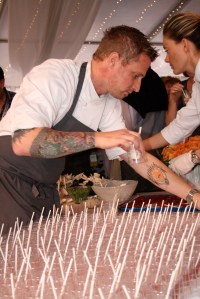
Michael Voltaggio working hard on his modern version of the BLT
Both very modern yet so different, and the blend of results amazed the crowds.
It was the Voltaggio duo of brothers, Michael and Bryan, working the crowds at the opening reception Thursday at the St. Regis Hotel. The crowd came fashionably late but grew loud and funny with the fantastic food and the wines from the Trinchero Family.
Meanwhile, east of Aspen at the foot of Independence Pass, Andrés’ mastery of the pit was enough to wow even Jacques Pepin, who couldn’t get over the taste of the well-cooked pork skin served him by Andrés.
“Did you taste that pork skin?” Pepin was asking everyone around him.”I couldn’t believe it, it was marvelous.”
Just another cook-out in Aspen.
More tomorrow.
Off to Aspen for a weekend of wine
It’s the weekend thousands of well-heeled wine and food lovers anticipate all year, the three-day Food & Wine Classic in Aspen. This year is the 28th annual and I’ll be among all the hundreds of wordsmiths and photographers covering this unique event that features who-knows-how-many wines from around the world and dozens of wine seminars, cooking demonstrations and special tastings of wines you probably won’t may never see again.
You’ll find daily updates, photos and videos on this blog, just as soon as I figure out downloading videos and photos.
Here’s a sample of what goes on each day: Thirty-three 45-minute seminars are scheduled on Friday and Saturday, beginning at 10 a.m. and going until 4:15 p.m. Eleven of the seminars run simultaneously, so the hardest part is deciding whether you want to learn about caviar from Jacques and Claudine Pepin, take a world tour of Riesling with Paul Grieco, discover Argentina’s best-kept wine secrets or learn about great grilled cheese with Laura Werlin. And that’s only part of the Thursday morning offering!
In addition, there are two two-hour Grand Tastings each day, under the huge white tents where winemakers show off their latest and greatest. Name a country and you’ll probably find something. Well, maybe not Dubai, although there likely will be some Dubai money floating around Aspen this weekend.
It really is a busy weekend, although I’ll miss all the private parties and probably again won’t see the inside of the veddy-exclusive Caribou Club, which is even more exclusive this week. Such is life.
There still is a lot to do, and I’ll share as much as possible.

Kelly Liken
After graduating No. 1 in her class at the Culinary Institute of America in Hyde Park, N.J., Liken worked at several establishments and eventually turned down a couple of enticing offers and opted to open her eponymous restaurant in Vail, where she builds on Colorado’s abundant resources.
“Colorado has an amazing selection of ingredients you can’t get at the local farmer’s market including bison, elk, wild porcini mushrooms grown on the local hillsides, or turnips and potatoes grown at 8,300 feet above sea level that are truly divine,” Liken said.
Something ‘unremarkable’ after a similar week
It’s 92 in Grand Junction and only 3 p.m., which means it may reach 95 or so before the sun sets.
I was reading posts by Susannah Gold and Charles Scicolone on a PR tasting they attended (n in NYC, of course) for Soave, an under-appreciated white wine from the Veneto region.
And those posts got me to thinking of a cool Italian white to savor after work, which brings me to the Frascati I have in the fridge. Frascati is a blend of Malvasia bianca (50 percent or more), Malvasia del Lazio and several other varietals including Greco, Trebbiano Giallo and other local (local to Rome, that is) white varietals.
But the wine itself doesn’t get much respect, with most reviews I’ve found calling it “serviceable” and “unremarkable.”
It doesn’t sound like much but maybe that’s about all I need on a steamy Friday, something serviceable and unremarkable.
Not sure what to pair it with, all the reviewers suggesting “unremarkable” foods like seafood cocktail. Seafood cocktail? Not sure I even remember what that is.
But maybe it will give me something to ponder other than the disaster in the Gulf, and the memories of the friends and family who make their living on and near the waters of Louisiana.
It’s been a tough spring for them, and there are going to be many tough weeks and months to come.
But as a bumper sticker said during the dark days following the Exxon pull-out in 1982 that left thousands of people jobless in western Colorado: tough times don’t last, tough people do.
My heart goes out to the tough people of Louisiana.
And I’ll get back to you on this here Frascati.
Buon weekend, y’all, as Alfonso would offer.
New wine blog from Rivetto a welcome addition
After listening for several hours last February to a panel discuss the impact social media such as blogging, Twitter and Facebook are having in today’s wine-marketing world VINO 2010 in New York City, and then recently reading The Italian Wine Guy and his comments on a similar panel at VinItaly, I was pleased to receive a new blog from Azienda Agricola Rivetto in Italy’s Piemonte.
Italian winemakers have long been pushing to get more of the U.S. market, and after hearing comments at VINO 2010 and VinItaly that younger Italians aren’t drinking as much wine as past generations, it’s seem now more than ever those Italian producers are looking to fill that gap through the U.S. wine market. But until the Rivetto blog, the only Italian winemaker I know with a blog is Susanna Crociani from Montepulciano.
Susanna is a delightful person and very talented winemaker, as you’ll discover by reading this blog by our good friend, well-known wine blogger and Italian wine lover Susannah at Avvinare. Susanna Crociani said during VINO 2010 that her blog helped increase her business noticeably. Not only her wine business but here agriturismo, as well.
I also read Franco Ziliani’s Vino Al Vino blog but I feel that it’s more news oriented, not necessarily something written from the heart and eyes of a winemaker, as are the blogs by Susanna Crociani and Enrico Rivetto.
So why don’t more Italian winemakers post on blog sites? Maybe, for one, it’s time consuming and there’s never much rest in the winemaking or grape growing business, as you’ll also find out by reading Enrico Rivertto’s blog entries. But also by reading Enrico’s posts, you get a real idea of who he and his family are and what they are doing.
It was interesting, too, to discover his blog was presented to an international journalism audience at a conference in Perugia and was described as “an example of wine marketing best practice.” Enrico also engages the world through Facebook, Twitter, Flickr and YouTube.
Enrico’s comments: “Wine producers with blogs in Italy are really few, I think you could count them on one hand; I believe it’s a good way to bring the consumer closer to the complicated world of wine, making it easier for them to understand what lays behind and inside the glass.”
Those comments really hit home for many wine lovers. And winemakers, too, who want their customers to know what goes on in the vineyard and the winery. That’s probably every Italian winemaker I’ve ever met, and after hearing how blogging helped Susanna’s business, it’s almost a given for any winemaker who wants to get their name out to the public.
My feeling is, if any producer, whether it’s wine, cars or legislation, tries to hide the process, there probably is something wrong with the final product. It’s fun and refreshing to read blogs from Susanna Crociani and Enrico Rivetto. Let’s hope more Italian winemakers join the social media world.
VinItaly is coming and I’m still here
The economy is softer than a three-minute egg and it’s reflected in my travel budget. That’s why I’m staying home this week instead of flying to Italy and spending a few days at Vinitaly, the immense week-long wine fair in the lovely city of Verona. It’s a lifetime of Italian wine in a single setting, although to say that still can’t share how truly large and enthusiastic the week is.
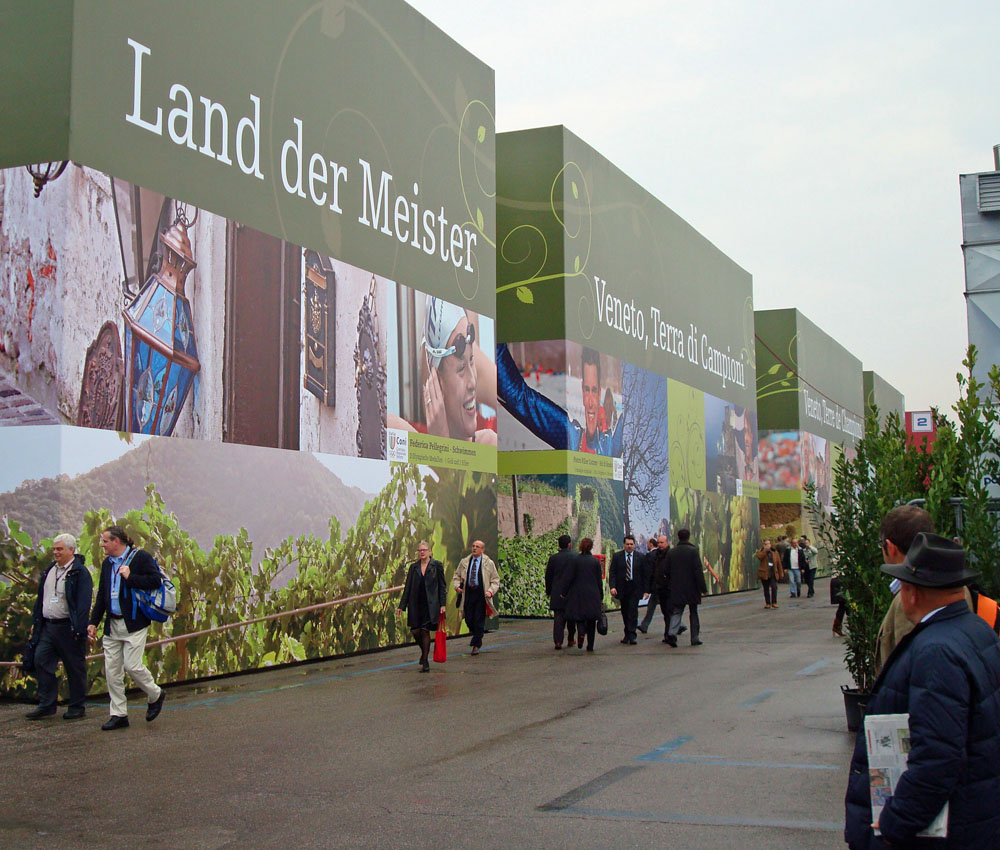
Taking in the size of the Veneto Pavilion at VinItaly
As you might be able to tell from the gray skies in the photo, last year’s VinItaly was particularly rainy, and only a friendly bus driver saved me a long, wet walk back to my hotel after I missed the day’s last train to San Bonafacio. He asked me if I wanted “le stazione” and so he dropped me off at the bus station (le stazione delle corriere), which was long-closed, and not the train station (le stazione ferroviaria), which was very close to my hotel.
When he saw me walking along in the rain, he stopped his bus (I was the last passenger on his route) and gave me a ride to my hotel. All of this done with my poor Italian and his total lack of English. Beautiful international politics on a personal level.
Anyway, there will be plenty of good blogging from Verona, and as I read interesting posts I’ll link to them here.
One winemaker who I’d love to talk at length with is Ricardo ‘Ricci’ Curbastro, the knowledgeable and very approachable producer of methode champenoise wines Franciacorta. Susannah Gold on her blog Avvinare has a fascinating interview with Ricci, a followup of her meeting with him during the recent VINO 2010 festivities in New York City.
If you’d like to read more about VINO 2010, Charles Scicolone has an entertaining post here.
Stellar lineup for Food & Wine Classic in Aspen
I just received the lineup for the 2010 (and 28th annual) Food & Wine Magazine Classic in Aspen (June 18-20) and the list of chefs includes Mario, Jacques, Giada, Thomas Keller, David Chang and other great names. And that’s just the chefs.
Hundreds of winemakers and thousands of wines to try make the Grand Tastings almost too much to handle. But only almost.
The deadline for early tickets has passed but you can still find tickets (all three days, $1,185, includes seminars, demos and Grand Tastings) on the Web site here. That’s a lot of money in this economy – heck, it’s a lot of money in any economy – but the experience, just once in your life if your a food or wine lover, is unforgettable.
 Wine Openers