Archive
Salt this away: Boulder bistro big on Colorado wines
The wrap-up of an intense three-day workshop in Boulder found several of us searching for a dinner place open on Sunday night, a task that can be fearsome in early closing Grand Junction but one that offered many entertaining options in Boulder. We ended at Salt the Bistro on the east end of the famed Pearl Street Mall. One of our small group recommended Salt, in the former Tom’s Tavern building, and we weren’t disappointed in the reasonable prices, wonderful food and a well-rounded and well-priced wine list.
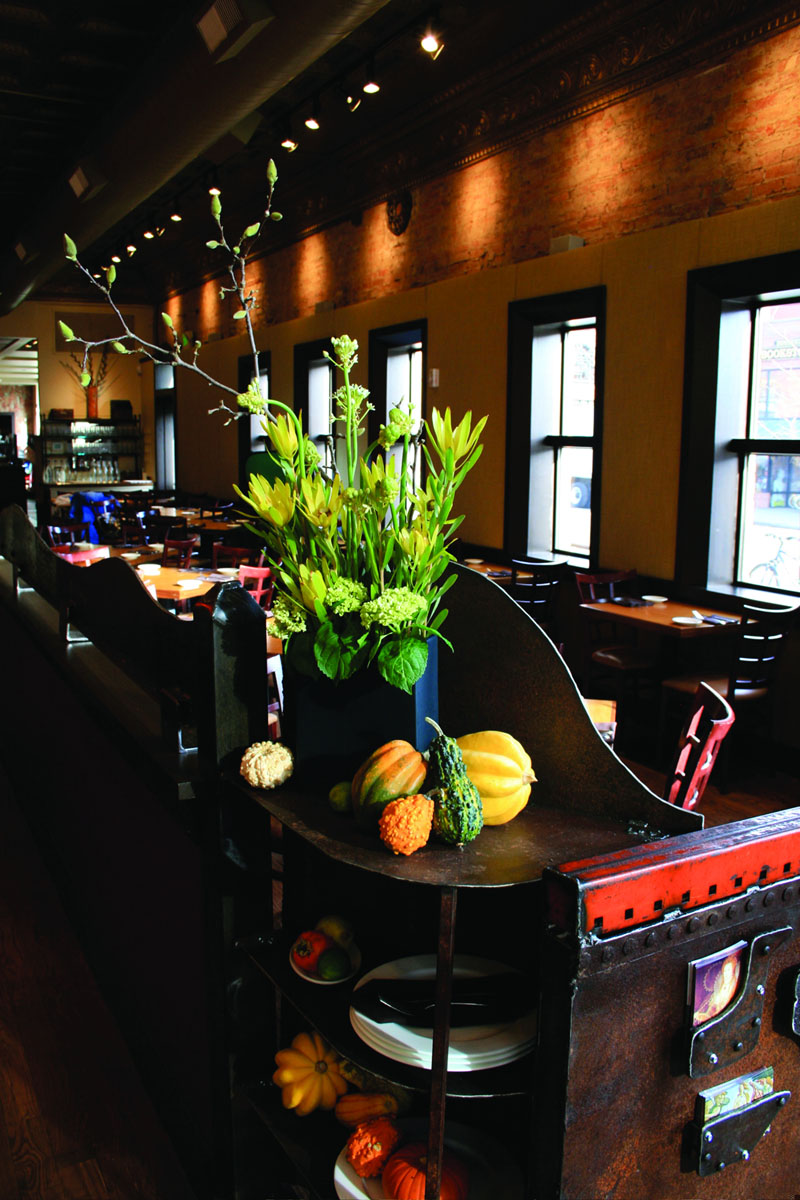
A media shot of the dining room at Salt the Bistro
Our wine preferences were eclectic but on this sultry night after a day of thunderstorms we decided on a medium-bodied red. We were pleasantly surprised to find on the wine list the heading “Local Reds,” featuring a delightful selection of Colorado wines including the Reeder Mesa 2009 Petite Verdot. Reeder Mesa Winery is a few miles outside of Grand Junction and it turns out Salt is one of the few restaurants in Colorado featuring a Colorado-only section on the wine list.
“We sell a lot of Colorado wine,” acknowledged our server, Joey Burton, who doubled as our wine steward. “I think they’ve come a long way in the last five or six years and I don’t know if it’s the vines finally are getting some age on them or the winemakers are learning which blends and varietals work best for them.”
It was refreshing that Burton showed a strong interest in and knowledge of Colorado wines and we talked a little about the continuing progress of Colorado winemakers but cut it short because even Sunday can be a busy night for Salt.
When we finally ordered the Petite Verdot, Burton smiled and nodded in appreciation.
“That’s a great wine but it’s pretty much a hand-sell since not many people understand Petite Verdot,” he said. “Once I get people to try it, they really like it.”
As did our table. Dense, rich and dark but not overly so, with a great nose of blackberries and dark fruit, the wine paired well with our entrees of roast beet salad, wild sea bass and sweet pea ravioli. Reeder Mesa Winery owner and winemaker Doug Vogel said the wine has won three gold medals in various competitions as well as Best of Show at the Mesa County Fair.
“It’s 100 percent Palisade-grown Petite Verdot,” he said. “I made about 150 cases of it, there just isn’t much (Petite Verdot) around.”
Vogel (pictured) said he crushes the grapes and then removes the seeds after three days to avoid the heavy tannins common to many Petite Verdots.
“That makes it drinkable much earlier,” he said. The wine spends 18 months in French oak barrels prior to release. He said 2009 was his first attempt at Petite Verdot and we’re all hoping for similar results from the seven barrels of the 2010 vintage sitting in his aging room.
The biggest surprise was to find the wine priced at $34, only a few dollars above the $28 price at the winery, something you rarely see with any wine, anywhere. Most restaurants mark up wines anywhere from 150 to 300 percent, a move that discourages many wine drinkers from tackling anything that’s different from the usual. When I spoke a few days later with Salt beverage director Evan Faber, I made sure to ask if the restaurant’s wine pricing was aimed at getting more people to have wine with a meal or to spark an interest different wines.
“It’s a little of both,” Faber said. “Not many people know about Colorado wines and we’re trying to educate them as much as possible. By keeping our margins low, we can introduce them to some wonderful wines they might not otherwise try.”
Those are words, I’m sure you’ll agree, every Colorado winemaker will love to hear. It’s unfortunate more restaurants don’t follow the lead of Salt.
According the Salt PR person Kuvy Ax, the Boulder restaurant has more Colorado wines on its list than any other place in the state.
“Which means any other restaurant in the world,” she said, laughing. “They are really passionate about Colorado wines. Everything on their list from out of state is on the ‘imported wine’ list.”
I had forgotten this when we were eating at Salt but Faber reminded me that he and Salt executive chef Kevin Kidd will be the headliners at the Colorado Mountain Winefest in Palisade Sept. 15-18.
They both are justifiably proud about serving Colorado wines and being a Farm to Table restaurant emphasizing local food sources.
Driving in to the Land of Priorat
Our Spanish wine roads, courtesy of Freixenet, led us from the Ribera del Duero to Rioja (named after the Rio Oja) to the Priorat, a land reminiscent of where I live in western Colorado. That is, dry, rolling hills, with generally poor rocky soils and scattered vegetation where water is available, cold winters and short, hot summers. Of course, with the Mediterranean Sea “right over those mountains,” it has a maritime climate, which makes a huge difference in growing seasons.
Priorat also is a Denominacion de Origen Calificada (D.O.C.), one of only two in the entire country (Rioja is the other).
This means the DOC wines are subject to more-strenuous regulations and winemaking standards than non DOC wines. The Priorat is in the southwest part of Catalonia and its language, Catalan, is vastly different from Spanish, which made it impossible to understand to this novice Spanish student.

The soils of the Priorat are volcanic in origin and contain some slate and quartz mica. Irrigation is allowed in a limited way.
The Catalonians are justly proud of their separate identities and culture, and the name “Priorat,” which appears on wine bottles, is the Catalan spelling while “Priorato” is the Spanish. Garnacha (elsewhere known as Grenache) becomes the primary red grape here, with supporting roles played by Cariñena, Cabernet Sauvignon, Merlot and Syrah.
Our first stop was the remote (we switched to a smaller bus just to make the narrow road) bodega of Viticultores del Priorat where associate winemaker Maria-Jose Bajon led us a on quick hike up the hill and a view of much of Priorat, a fairly small region – about 20,000 hectares or less than 50,000 acres, of which about 1,800 hectares are vineyards.

Associate winemaker (enologa) Maria-Jose Bajon of Viticultors del Priorat with Priorat behind her.
She told us the wines often reflect the unique “licorecella” soil, comprised of black slate and quartz mica outcropping, both of which influence the wines. In addition to the Morlanda red (a 50/50 blend of Garnacha and Caiñena) the winery makes a very interesting Morlanda white (Morlanda is the name of the small peak on whose slopes the winery was built) made of Garnacha Blanca, which Maria-Jose told us almost went extinct before the winery “rediscovered” it and a small percentage of Macabeo.
“We are not a trendy winery,” she warned us, her dark eyes flashing as if we would dare make such a proposal. “We want to make wines that are true to the traditional (grape) strains we cultivate.”
The vines mostly range in age from 25-40 years old although I thought (Hey, my Spanish isn’t nearly as good as her Catalan) Maria-Jose said there were some nearly 60. She also gave much credit to earlier efforts more than 30 years ago by pioneering winemakers Rene Barbier and Alvaro Palacios in establishing the Priorat as a winemaking region.
My tasting notes recall the 2007 Morlanda red (the most recent vintage released) as being quite delightful, having dark cherry flavors and some notes of licorice and dark chocolate. The Morlanda white had hints of white peaches, citrus and fresh apple and crisp acidity.
A remote winery with distinctive wines and an associate winemaker conveying a hawk-like intensity in being true to the land and the grapes it produces.
Day two Freixenet 2011 Spain
Wednesday, July 13 — Even though we arrived in Madrid on Monday and now it’s Wednesday, most of the 13 of us on this trip (most of whom are Freixenet employees getting a feel for the home company) consider Monday a day lost to travel, jet lag and a whirlwind introduction to Spain.
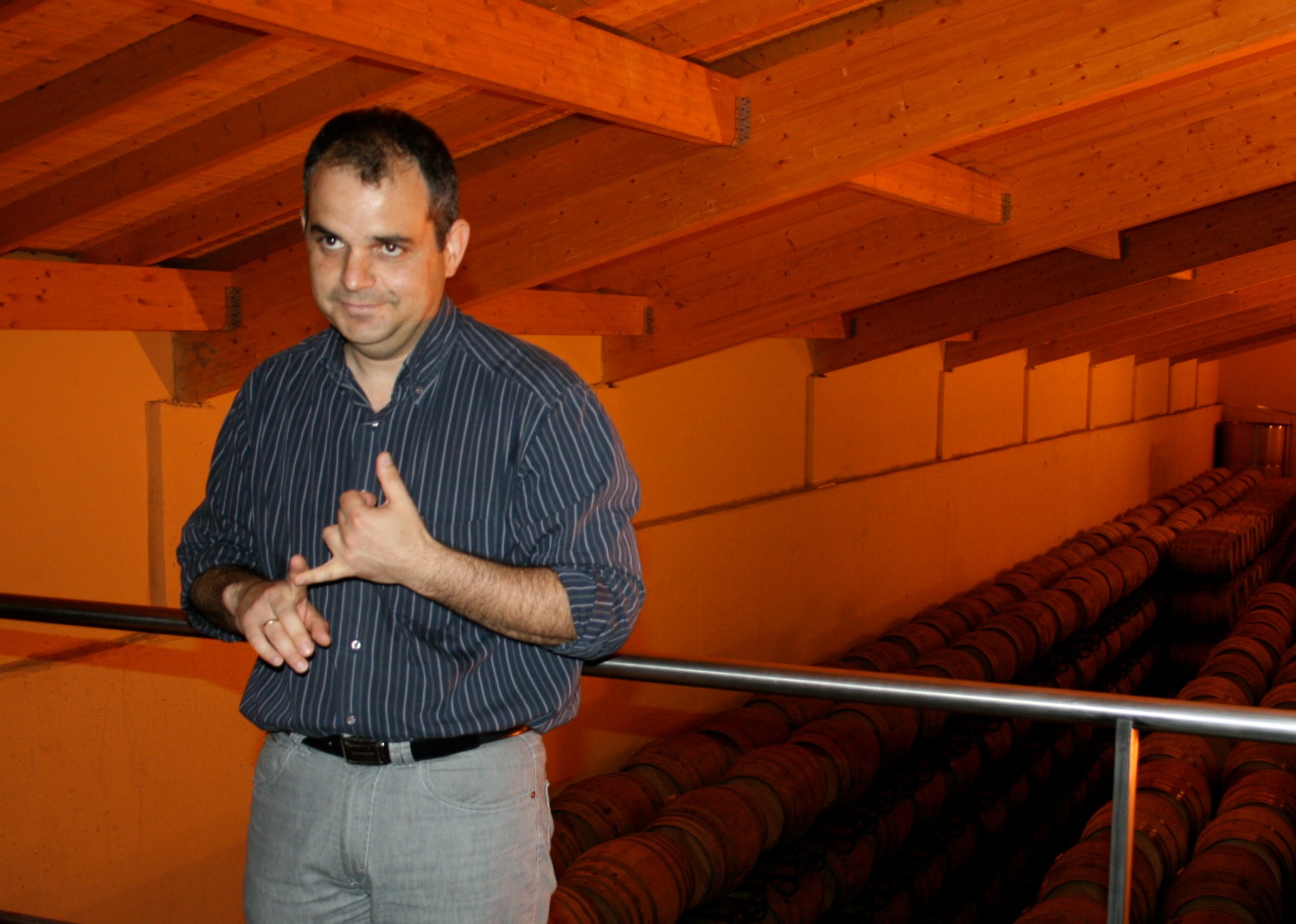
Javier Aladra, winemaker at Valdubon
A little more about yesterday’s post on Valdubon and winemaker Javier Aladra, who on Tuesday tasted us on his Tempranillo, including the Cosecha, Crianza and his 2006 Riserva. I’ll try not to repeat this several times in these posts but Tempranillo has four styles: Cosecha (or Joven) – young wines ready in their first or second years; Crianza – required by the D.O rules to have two years aging, at least one in oak; Riserva – 3 years aging with at least one in oak; Gran Riserva – exceptional vintages with 5 years aging, minimum 2 years in oak.
Tempranillo, like Sangiovese, is a grape of many faces. Also known locally as Tinto del Pais and Tinto Fino, it can be a light-red, cherry-rich quaffer, a picnic table sort of wine, or it can be rich, deep and highly structured, a serious wine in anyone’s book.
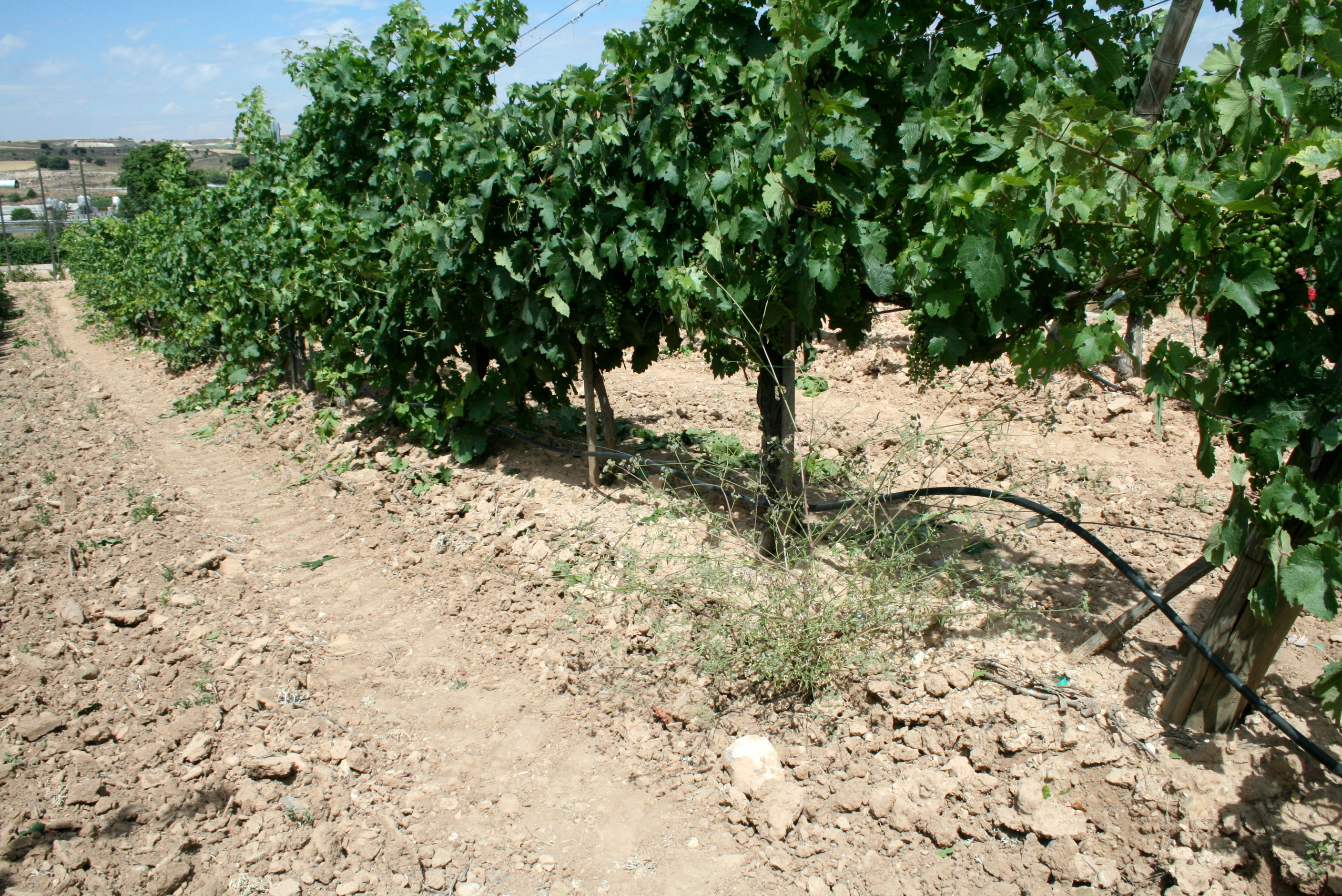
The soils of Valdubon in the Ribera del Duero are low in organic material but produce magnificent Tempranillo wines.
Aladra everyday faces vineyards of near-barren soil; soil he describes as “very poor” and “with very little organic material.” That doesn’t mean it won’t produce fantastic wines but it does mean the winemaker has to work a bit harder at his art and have, perhaps,some knowledge of grape growing and wine-development not required of other growers in more benign climates and richer soils.
What really surprised most of us was when Aladra, a quiet, unassuming type more at home in the winery than speaking to tour groups, told us he finds it harder to make the young Cosecha wines rather than the bigger, richer and more-defined Crianza and Riserva.
“In the (Ribera del) Duero a young wine is the most difficult wine,” Aladra said, listing the hot growing conditions that lead to fast-ripening, and if you’re not careful, too much ripening. “We use the youngest grapes for our Cosecha.”
It’s all stainless fermentation – no oak on this wine – no more than a week long and soon it’s in the bottle and ready for the consumer.
Aladra grows 50 percent of his grapes, the rest coming from 150 smaller growers with long-term contracts to ensure stability in the supply and quality of grapes. He said Valdubon has 114 hectares (about 281 acres) of grapes and there’s only 23,000 hectares of vines in the entire Ribera del Duero. However, a press kit on Valdubon said there’s 13,500 hectares of vines there, which would be more than 33,300 acres, a big discrepancy and not something I could get immediately answered. But it LOOKED like 114 hectares.
The region is remindful of the wine areas in the Grand Valley of western Colorado. In fact most of the areas we visited in northeast Spain, except for the Mediterranean Sea, reminded me of home. High altitude (Ribera is around 800 meters, about 2,400 feet), cold winters, hot days/cool summer nights and a short growing season. Aladra joked there area has but two seasons – winter and two months of summer. Our group, by the way is comprised of several writers and some of the Freixenet regional reps from the U.S., none of whom had previously visited this part of Spain so it was an education for all us.
Now, back in the bus and off to Logroño in the Rioja.
From Basque country by train
Day 3, on the train to Tarragona – We leave the somber clouds of north Spain and head to the sunny cast of Tarragon and Barcelona. By the time el tren reaches Tarragona, with a few unexpected delays, we arrive at this Mediterranean beachside resort well into the evening and discover another hotel without the convenience of full-time WiFi or Internet. Through most of northern Spain Internet connections were few, which meant traveling in the 21st century relying on 18th century technology.
It’s too easy in the U.S., where we expect every convenience and rely on them so much we forget how to communicate without the electronic technology taken for granted.
But all is well this morning, the password works and there’s another 20 minutes or so left on this account.
The first part of the day was spent at the Solar Viejo winery in La Guardia, 30 minutes north of Logroño and well into the country of the Basques or Pais Vasco. This is Rioja Alebada, the upper Rioja heavy with Basque and Arabic influences of many years past. Which is why here it’s pronounced “La Huardia”, not the Americanized “La (hard-g) Guardia.”
Solar Viejo has been around since 1937 but only within the last 7 has it been associated with Freixenet. This also is tempranillo country, with a smaller mix of garnacha, masuelo and graciano to round out the D.O. red blends.
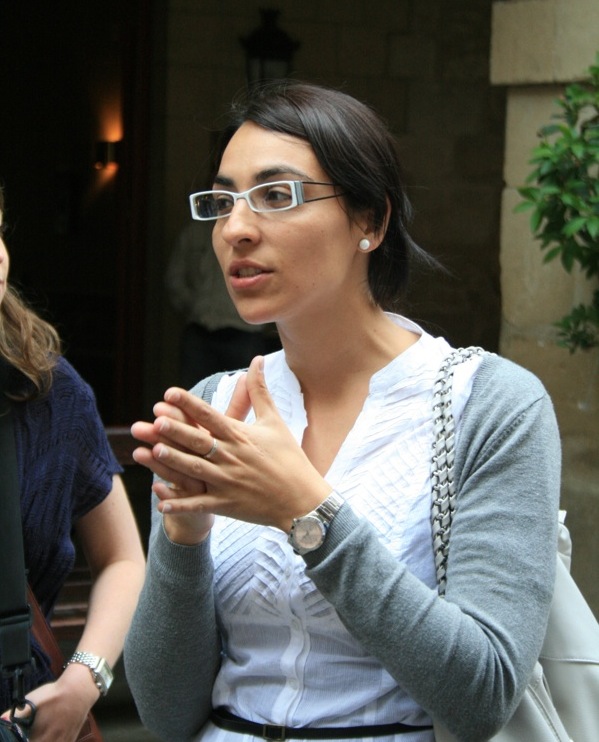
Vanessa Domingues of Solar Viejo shares her passion for Tempranillo in several languages.
PR director Vanesa Dominguez led us through the town and showed us the caves winding under the city, hand-carved through solid rock, underground passages used in millennia past to hide the locals avoiding invaders. Now used in part as natural, perfect temp and humidity wine cellars.
We walked past the old church, looked across the Ebro River valley toward the Sierra de Catabria mountains protecting this part of Spain from the cold north Atlantic, and ate, ate and sipped at wine.
Tempranillo has four styles:
Cosecha (or Joven) young wines ready in their first or second years; Crianza – required to have two yera agin, at least one in oak; Riserva – 3 years aging,one in oak; Gran Riserva – exceptional vinatges with 5 years aging, minimum 2 in oak.
We tried the Vaza Cosecha, the young red with its deep cherry red/purple color and equally fresh flavors; the Vaza Crianza, much darker red color, a hint of the oak with round tannins and long finish; and the Riserva (not yet available in the U.S. but we tasted it to educate the Friexenet team) with its more oak, hints of tobacco and licorice, a deeply structured wine with great elegance.
My time on the Internet is about up, there’s more words and photos for later. We still have wines and miles to go.
ciao for now.
Rainy day 1 (or is it two?) in Rioja
Not much time right now before meeting the rest of the Freixenet 2011 team for dinner in Logroño. We blew into this Rioja town on the edge of a major storm scraping its way across north Spain, the line of clouds (we’re about 80 kilometers from the Bay of Biscay, North Atlantic) curiously marking the break point between Basque territories and Rioja, with multiple rainbows ushering us along the way.
The morning was hot and sunny and was spent at Valdubon near Milagro, a tiny town in the Ribera del Duero tasting winemaker Javier Aladra’s rich Tempranillos (Tinta del Pais clone).
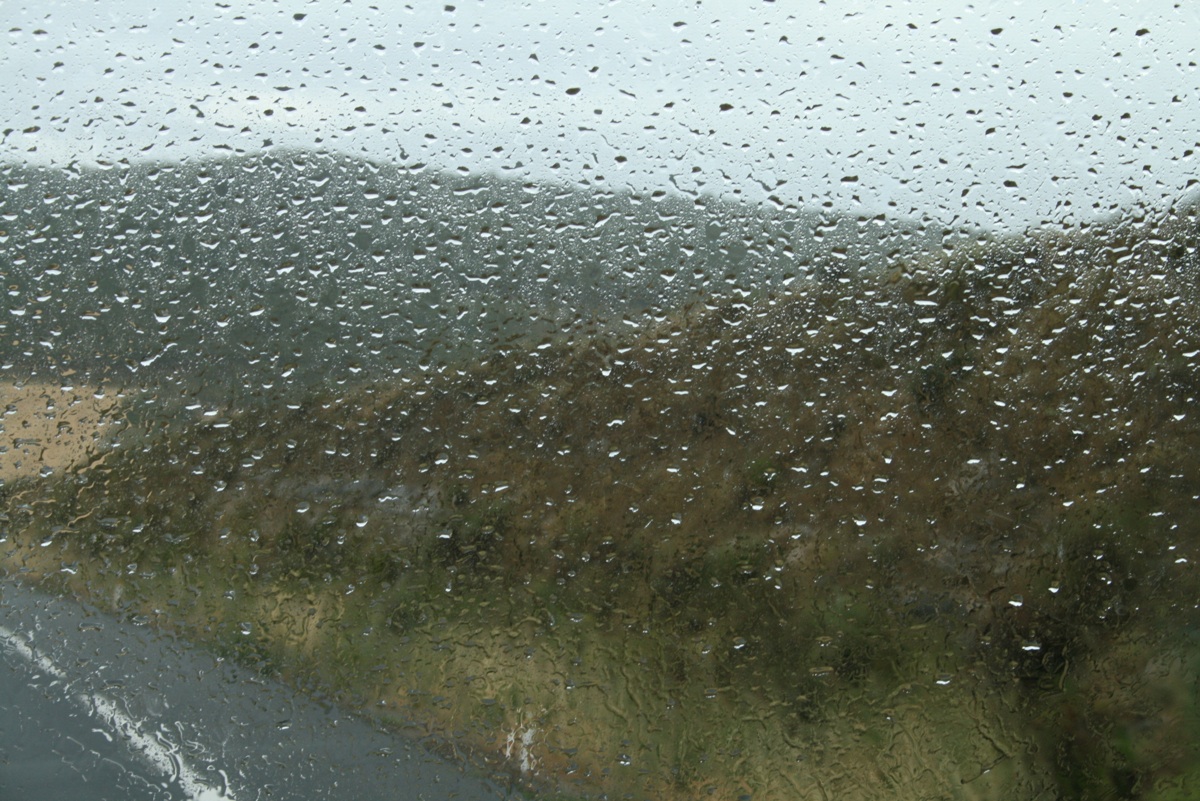
By noon, the rains came, an immense thunderstorm streching across all of northern Spain.
By noon, though, the weather changed and we walked out into a storm that continued the 220 kilometers or so from Valdubon to Logroño.
More soon.
Back on the wine road – Madrid
July 10 and waiting in the Grand Junction airport for the first of my four legs of flight to Madrid while the fly boys from the naval air base in Fallon, Nevada buzz the airport at Mach 2.
It’s a press trip, and the disclaimer is it’s being subsidized by Freixenet, which claims to be the world’s leaders in making methode champenoise sparkling wines.
It’s not like I doubt they’re No. 3, considering how much sparkling and still wine has their name on it, since Freixenet has wineries in Spain (3 cavas, 8 still), Mexico, Italy, California, France, Australia and Argentina. Whew. This week I hope to find out just how much Freixenet puts in the bottle.
Getting out of fly-over country ain’t easy, pardner. I’m meeting several other wine writers in Madrid along with Megan Duran of the PR firm Janet Kafka and associates. It’s Megan’s daunting task to keep herd on the cats.
Except for Megan (Dallas), most of the others are coming from the East Coast, which means like one or at the most two flights from home to Madrid.
My itinerary reads like this: GJ to Denver; Denver to Franfurt; Frankfurt to Madrid. Elapsed time: about 13 hours, given that Madrid is about 8 hours ahead of home.
And those occasional trips to Vinitaly add another couple of hours of driving from Milan to Verona.
That’s life in the mid-country. Not complainin’, just sayin’.
Here’s the skinny on the trip.
Today (and most of tomorrow), arrive in Madrid (2045 hours on the 11th), late dinner, later bed.
12th – 800 hrs, desayuno (that’s breakfast, might as well get into the spirit now, eh?); 900 hrs, bus to Ribera del Duero and Freixenet’s Valdubon winery, meet with the winemaker, almuerzo (lunch), bus to Lagroño (Rioja), late dinner.
13th – Late breakfast, bus to Solar Viejo winery, lunch, catch the train to Tarragona, check into hotel, late dinnner (It’s Europe, dinner always is late);
14th – late breakfast, bus to Falset (Priorat) and the Morlanda winery, 1700 depart (bus) for Barcelona, wander around Barcelona (fantastic architecture) until bed time;
15th: Head to the Freixenet and Segua Viuda wineries for tours and tasting, farwell dinner (business dress) and one more late bedtime.
16th: Home again, this time the trip is cool, leave Barcelona on Sunday and get home on Sunday. Harry Potter would approve.
And Freixenet is pronounced fresh-eh-net, just in case you were wondering.
Nos vemos en Madrid (See you in Madrid).
Gavi Perlante, the lighter bubbles
“Oh, that’s yummy,” she said, the first truly expressive thing she’s said about the wines I’ve brought to dinner. While there’s not been a week she and her husband haven’t enjoyed the wines that are my share of the meal, tonight the delicate fruit and a sparkling acidity of the Gavi 2009 Principessa Perlante evoked a new response.
“That’s really nice, what did you say this was?” she asked, her dinner, straight out of Alice Waters’ “The Art of Simple Food,” forgotten for a minute. “I really like this.”
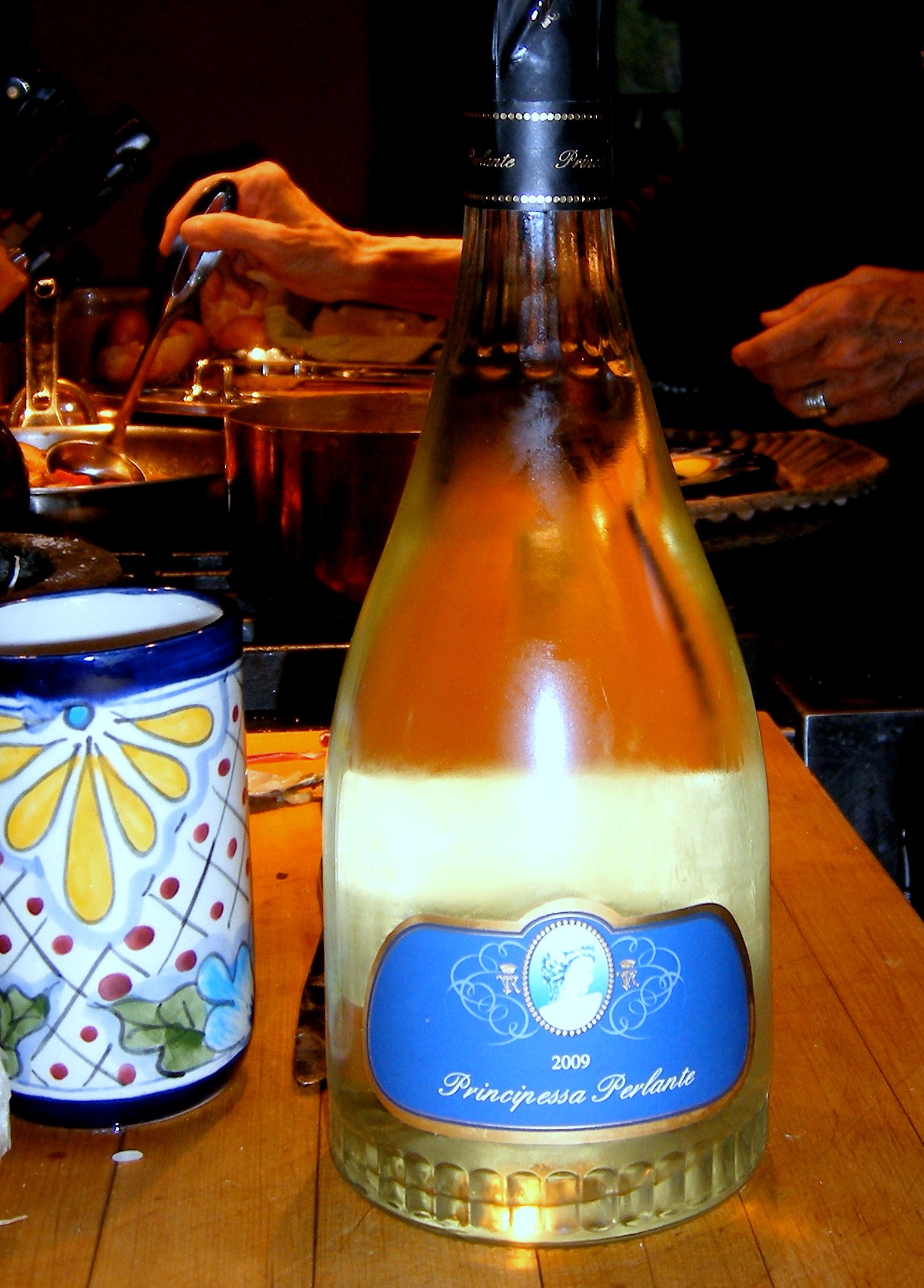
2009 Principessa Perlante
The Principessa Perlante ($13-$18) has great fruitiness but it’s super-dry with only 12.5 percent alcohol, both attribute my hostess looks for in a wine. My once-a-week hostess/chef loves dry whites (her husband drinks it all but prefers Italian reds) and last week we all gladly sipped the Principessa Gavia Gavi, the still version of Italy’s wonderful white grape, the Cortese di Gavi from Piemonte.
The wines are very pale straw in color, with a nose of pineapple and apples and a plate hinting of green apple and tropical fruits, perfect for these warm summer nights and lighter meals. Both wines are produced by Vigne Regali, an 18th-centure winery in Strevi, Italy, now owned and operated by the importers Banfi Vintners. The grapes are sourced a few kilomters away at the Banfi’s Prinicipessa Gavia Gavi estate, which exclusively grows the Cortese di Gavi grape.
“Perlante” signifies the light perlage (the ribbon of bubbles from the bottom of the glass), and while I’ve read the Principessa Perlante described as a “frizzante” (compared to the heavier ribbons of bubbles in a spumante), the Principessa seems lighter and more delicate than a frizzante. Even the bottle, a heavy, slope-shouldered version of a classic sparkling wine bottle, evokes the pleasurable anticipation of something special.
Rieslings dry and sweet are a hit at pool party
Summer fun inevitably means friends getting together enjoying light meals and similar wines. So when a vegetarian friend announced a pool party built around the theme of spicy Mediterranean-based cuisine, the challenge was set.
Baba ganoush, hummus, tomato-and-jalapeño salsa, pita bread and lots of fresh veggies to slip into a yoghurt and dill dip. And spicy?

Montinore Riesling Sweet Reserve
It’s not the searing hot of Thai or Vietnamese food but there were plenty of tongue and lip-warming spices and peppers to liven up the meal.
Thanks to having recently listened to Mark Oldman, author of “Oldman’s Brave New World of Wine, talk about pairing wines with hot and spicy food during the Food & Wine Classic in Aspen, I was ready for the challenge. Spicy food calls for a low-alcohol wine with little or no tannin, said Oldman, recommending sparkling wines and still whites (Reisling, Gewurztraminer, Torrontes) and lighter reds such as pinot noir and carmenere.
“You want something a little bit sweet or sweet seeming,” Oldman told his appreciative audience. “Think in the terms of heat. Not too much alcohol or tannins and certainly nothing too expensive.”
By coincidence, I had just opened a box of wines from the good folks at Montinore Estate, the Forest-Grove, Ore., winery of Rudy Marchesi and found a selection of white wines perfect for the evening. There’s a fascinating story behind how Marchesi, the grandson of Italian immigrants, took over Montinore and built it up using biodynamic farming techniques to one of the stellar bio vineyards in the Willamette Valley and on the Left Coast. There’s a fine story about Marchesi in the Portland Oregonian here.
Among his white wines are the 2010 Almost Dry Riesling ($14, SRP); 2009 Pinot Gris ($16) and the 2009 Riesling Sweet Reserve ($16). The last one, because of its high residual sugar level (75 grams per liter), is found on the Montinore website under the heading “Dessert Wines” although it’s not as sweet as many dessert-type wines which may.
Oldman’s suggestion was to match sweet or “sweet-seeming” wines with spicy food, the sweetness in the wines off-setting the spiciness in the food. But he cautioned a sweet wine can become undrinkable without sufficient acidity to balance all the residual sugar and clear the palate.
Both the Almost Dry Riesling, with its slightest touch of sweetness and a citrusy, Granny Smith apple fruitiness, and the Pinot Gris, with highlights of melon, pear and apple, stood up well to the assortment of tantalizing dishes. They both had the body and the finish to marry well with the meal and both bottles disappeared well before their time.
The Sweet Reserve, though, was the crowd’s favorite, both during the meal and for sipping later around the pool as the moon rose. Dessert wines, as was noted, can be tricky to pull off, but Montinore white-wine maker Stephen Webber has managed to capture the essence of white flowers with flavors of tropical fruit and orange peel, well balanced by enough acidity to sparkle on the palate.
The fact it’s only 9.7-percent alcohol (the Almost Dry Riesling is 11 percent) makes it driver-friendly, too.
Taking the dry side of Riesling
ASPEN – Still here and still kicking, after 72 hours of the 2011 Food & Wine Classic in Aspen, aka Glitter Gulch.
Spending a hour Sunday while restaurant owner and beverage director (“I don’t consider myself a sommelier”) Paul Grieco of New York City’s Hearth, Terroir and Terroir Tribeca restaurant explained the whys of dry Riesling was another lesson in my ever-continuing wine education.
I first heard Grieco share his love for Riesling at an earlier F&W Classic and again this year he shared the same fervor for this lovely grape, which he celebrates at his restaurants and wine bar, selling 150 Rieslings by the bottle and 30 different Rieslings by the glass. He also is a key player in the International Riesling Foundation and this summer is celebrating the 2011 Summer of Reisling.
There are restaurants all over the country participating but only one in Colorado, the Pappadeaux Seafood Kitchen in Greenwood Village. Too bad there is nothing local, since the Grand Valley and the North Fork Valley produce the best Rieslings in Colorado.
But on to Paul Grieco, who this year decided to approach dry Rieslings, maybe the least understood of the Rieslings.
“Our problem with getting people to drink Riesling is we always give them an out,” said Grieco, meaning beverage directors and somms tend to offer other whites, notably Chardonnay, to customers initially hesitant to order a Riesling.
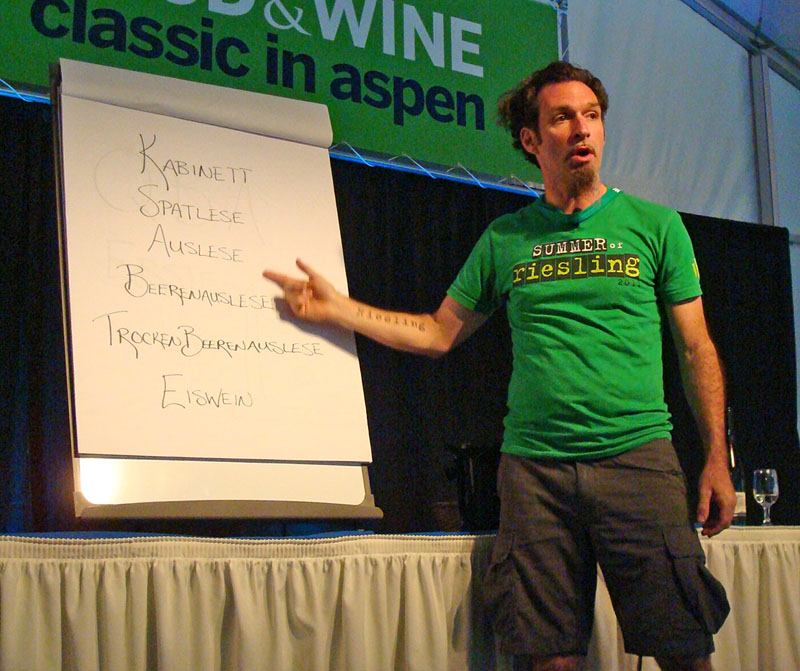
Paul Grieco, co-owner and beverage director (sommelier) at the Hearth, Terroir and Terroir Tribeca restaurants in New York City, explains the finer points of a German wine label during his seminar Sunday on dry Rieslings during the 2011 Food & Wine Classic in Aspen. Check out the 'Riesling" tattoo on his arm.
“I don’t want to give you an out,” he said, flashing his right forearm where the world “Riesling” was tattooed (don’t worry, it’s a wash-off tattoo). “At my restaurant, I don’t give you a choice, you drink Riesling.”
During his all-too-brief seminar Sunday titled “Riesling: The Dry Side,” Grieco said a wine needs several properties to be a great wine. The list includes complexity, balance, delicacy, longevity, a sense of place and, well, “yummy.”
“Does it make you smile?” he asked. “A great wine should bring a smile to your face when you drink it.”
A sense of place, which the French and others label as terroir, is particularly evident in great Rieslings because the grape is so “transparent,” Grieco said. “Nothing obscures the vineyard from coming through in the glass.”
Pouring samples from Germany, Alsace and Austria, Grieco talked us through the different regions and explained the complexities of a German wine label, which turn out to be surprisingly easy to read.
“German labels are perfect, you know exactly what’s in the bottle,” Grieco had us repeating to ourselves.
As his was a seminar on the finer points of dry Rieslings (those with 8 grams or less per liter of residual sugar), Grieco immediately made it clear that balance between acidity and sweetness was key to any Riesling’s greatness. That’s why semi-sweet (also called off-dry) or sweet Rieslings aren’t too cloying or syrupy if the acid/RS level is in balance.
Just in case you forgot, residual sugar refers to the sugar left in the wine after fermentation. Knowing this, you can judge how sweet a wine will be. Jeff Siegel (Wine Curmudgeon) has an interesting post here.
“Are Rieslings inherently sweet?” he asked. “Of course not. Ninety percent of Rieslings are dry. But we often taste sweetness and forget to taste the acidity.”
Grieco said that while growing up in Canada, one of his childhood dreams was of someday driving the ice-clearing Zamboni machine used during breaks in a hockey match to smooth and resurface the rink.
“Acidity in wine is like a Zamboni,” Grieco affirmed. “It clears the palate, leaving a clean sheet.”
The wines we tasted, all of which had the needed characteristics to be considered great, included:
– Dr. F Weins-Prum 2009 Riesling Spatlese Trocken, Mosel, Germany;
– Leitz 2009 Riesling Trocken Rudesheimer Berg Schlossberg “Alte Reben,” Rheingau, Germ.;
– Rebholz 2007 Okonomierat Riesling Spatlese Trocken :Vom Muschelkalk,” Pfalz, Germ.
– Nikolaihof 1999 Riesling Steinriesler, Wachau, Austria;
– Hugel 2005 Riesling “Hugel” Jubilee, Alsace;
– Henschke 2007 Riesling, Julius, Eden Valley Australia.
First notes from the 2011 Food & Wine Classic in Aspen
ASPEN – The reporter’s notebook runneth over after the 29th annual Food & Wine Magazine Classic in Aspen.
And for good reason, since this year’s Classic was much more exuberant than the 2010 version. Nothing wrong with 2010, of course, but many people still were hurting from the recession and with that there apparently was some reluctance to spend extravagantly, even when the spending was justified by years of hard work (or even better, great genes).
This year’s version, however, was vibrant and lively, once again nearly full of the joi de vivre that has long marked this week of celebrating great wine and food in Aspen.
Curiously, more than one person on the industry side of the market (meaning someone who makes, sells or markets wine) noted this year’s Classic attracted nearly twice as many industry people (about 3,200) as it did general consumers (around 1,800). These numbers haven’t been substantiated by anyone from Food & Wine but just walking through the Grand Tasting tents it appeared there were more booths this year than last highlighting distributors, wineries and spirits.
“It’s more like what the Classic used to be, an industry show before it turned into a wine-sippers get-together,” said one long-time (29 years) attendee and fine-wine distributor.

Mark Oldman, aka 'Dirk Diggler,' holds up a bottle of Mulderbosch 2004 Sauvignon Blanc Oldman purchased from the collection forfeited by former investment banker Bernie Madoff.
Second, in the past few years, as the recession caused many wineries and distributors to scale back their attendance, an ever-growing number of spirits makers (vodka, brandy, whisky and other liquors) started paying more attention to the Classic, discovering the same people who spend money on fine wine also spend money on fine spirits.
“And those are the people who had the money even in the recession,” my friend said.
A few of the many highlights:
Joshua Wesson, founder of the Best Cellars wine chain (nothing over $20 last we checked) and the 2009 Wine Enthusiast magazine Retailer of the Year, kicking off the Classic Friday by touting himself as the “Iron Sommelier” and daring others to dethrone him during his raucously entertaining seminar.
His challengers included Master Sommelier and wine writer Mark Oldman; M.S. Laura DePasquale of Palm Bay International; and M.S.-in-training Vilma Mazaite of Aspen’s Little Nell.
The audience was the judge in this food-and-wine pairing competition and in the end it was locals’ favorite Mazaite becoming the newest Iron Sommelier, pairing a Rannato Ratti 2010 Dolcetto d’Alba with Mario Batali’s Orrechiette with Sweet Sausage and Broccoli.
Oldman, who adopted a fake mustache and several pounds of (faux) gold chains for his weekend costume as porn star Dirk Diggler from the movie “Boogie Nights,” later told his own seminar (“Beat the Heat: Wines for Hot and Spicy Food”) it was time to “drink like a burglar.”
In happens that Oldman, (his newest book is “Oldman’s Brave New World of Wine”) was brought into the Bernie Madoff case to assess the value of Madoff’s wine cellar, as part of Madoff’s retribution to his clients.
Oldman also bid on, and won, some of Madoff’s wines and Oldman shared a couple of bottles with his Aspen audience.
“Only about 10 percent of his wines were good stuff,” Oldman said, holding up a bottle of the 2004 Mulderbosch Sauvignon Blanc, straight from Madoff’s cellar, complete with the red FBI warning label.
“Drink bravely,” Oldman urged.
Spicy food calls for a low-alcohol wine with little or no tannin, said Oldman, recommending sparkling wines and still whites (Reisling, Gewurztraminer, Torrontes) and lighter reds such as pinot noir and carmenere.
“You want something a little bit sweet or sweet seeming,” Oldman said. “Think in the terms of heat. Not too much alcohol or tannins and certainly nothing too expensive.”
And finally, we all know about the underground Classic, including the lineup of exclusive parties and dinners that happen with little or no fanfare.
Finally, however, there really is a truly underground Classic.
Former Grand Valley winemaker Ben Parsons and his Infinite Monkey Theorem Winery, based in Denver’s Santa Fe Arts District, hosted a subterranean Wine at the Mine bash Saturday night at the Smuggler Mine, where in 1894 the world’s largest silver nugget (2,054 pounds) was found.
The unusual setting (hard hats a must) included great food and music, memorable tours of Aspen’s past glories and some of Parsons’ distinctive urban-winery wines, including a canned Black Muscat
Parsons, whose under-earthly delights party was loudly acclaimed as the best social event of the weekend, said the lightly carbonated Black Muscat in-a-can should be available in stores by September.
 Wine Openers