Archive
Tapping a few barrels on a rainy spring weekend
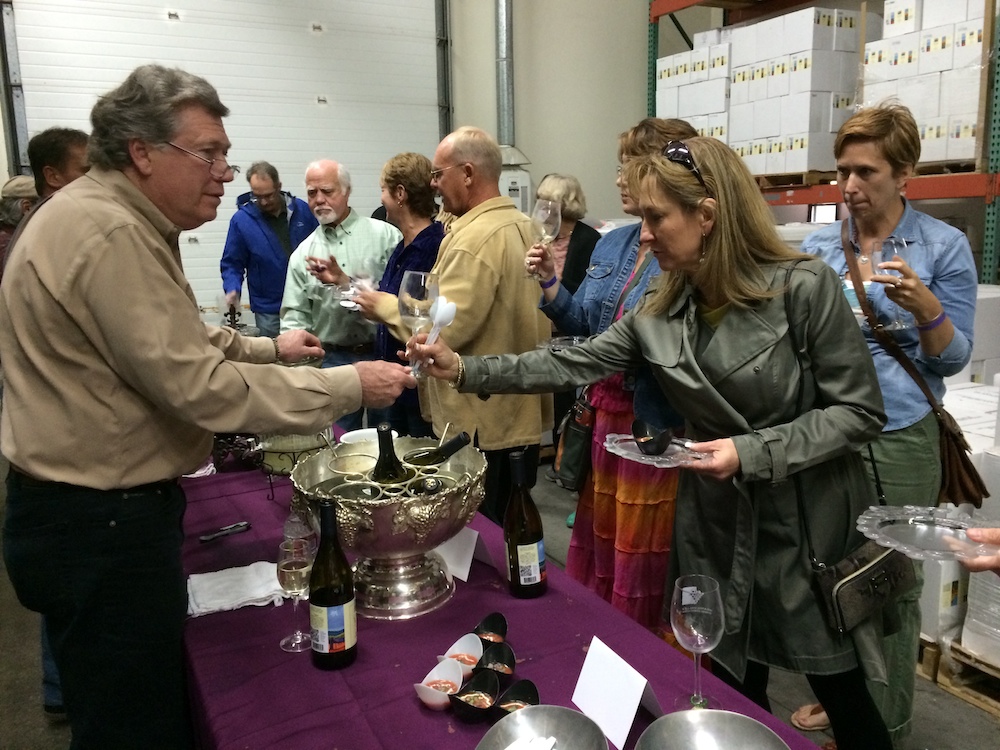
Steve Smith of Grande River Vineyards serves some of his 2011 Viognier to Kassie Breshears of Palisade during Saturday’s Spring Barrel Tasting event sponsored by the Grand Valley Winery Association.
A decidedly chilly weekend saw the first installment of the two-part 2014 Barrel into Spring wine tasting, which wrapped up Sunday with one more weekend set for May 17-18.
This is the season opener for the eight wineries belonging to the Grand Valley Winery Association, a vestige from the time when this valley had only eight wineries (it’s double that number, now).
More than 275 wine enthusiasts were out Saturday in spite of the occasional rain in the east part of the valley, and I know that because Steve Smith of Grande River Vineyards bothered to count.
“I like to say we get between 250 and 275 people on the first day,” said Smith, late Saturday afternoon. “I just looked at the numbers and we’ve had 281 today.”
It probably was closer to 290 by the time the event was done at 4 p.m.
Tickets are limited to 400 each weekend and as usual this event sold out in February, with a waiting list for the second weekend.
“We were pretty swamped (Saturday morning) but today it’s still pretty quiet,” said Sue Phillips, owner of Plum Creek Cellars, in the firsthour or so of Sunday’s open house. “But Sunday always starts slow.”
The wine event is developing a foodie side to match the interesting wines each winemaker decides to highlight.

Chef Jill Peters brought a Thai-style approach to the menu she matched with Grande River Winery wines during the first weekend of the 2014 Spring Barrel Tasting event.
There’s a sense each year the wineries are taking their food pairings up a notch, and this weekend was particularly good.
Chef Jill Peters (daughter of Naomi and Steve Smith at Grande River) has been preparing food pairings for Grande River for 11 years and this year, among her selections, she went with a Thai-inspired watermelon-miso soup to pair with the viognier the winery was pouring.
She matched the winery’s 2011 Malbec with a smoked duck breast Banh Mi sandwich and the 2009 late-harvest Viognier with a lemongrass galangal (a type of Thai ginger) soup.
Over at Plum Creek, Sue Phillips did all the cooking.
“I just grabbed a recipe out of the Julie Childs cookbook,” she said with laugh. “Then, I made ‘Whatever Sue likes.'”
Apparently Sue Phillips like such things as sun-dried tomato tapenade on ciabatta wedge (paired with Plum Creek’s 2011 Merlot); pistachio paté (2012 Chardonnay); and Duck a L’Orange on a buttermilk polenta pancake (2011 Cabernet Franc).
By the time I waddled over to Carlson Vineyards for the marinated Colorado lamb grilled by Brunella Gualerzi of il Bistro Italiano, there wasn’t much room or time left.
“We come back here every year, just for the lamb,” said a woman heading off to the tasting table with a plate in one hand and wine glass in the other.
Gaulerzi, who’s had her restaurant in downtown Grand Junction for 16 years, just smiled and pulled her coat collar a little higher to ward off the unseasonably chill wind.
“What are the other wineries doing?” she asked a visitor. “I never get to the other wineries because I’m here all the time.”
I’ll cover some of the notable wines in the next post.
The other wineries belonging to the Grand Valley Winery Association are Canyon Wind Cellars, DeBeque Canyon Winery, Garfield Estates Winery, Graystone Winery and Two Rivers Winery and Chateau.
Spring in Magré – Elegant wines in a 17th Century Palazzo
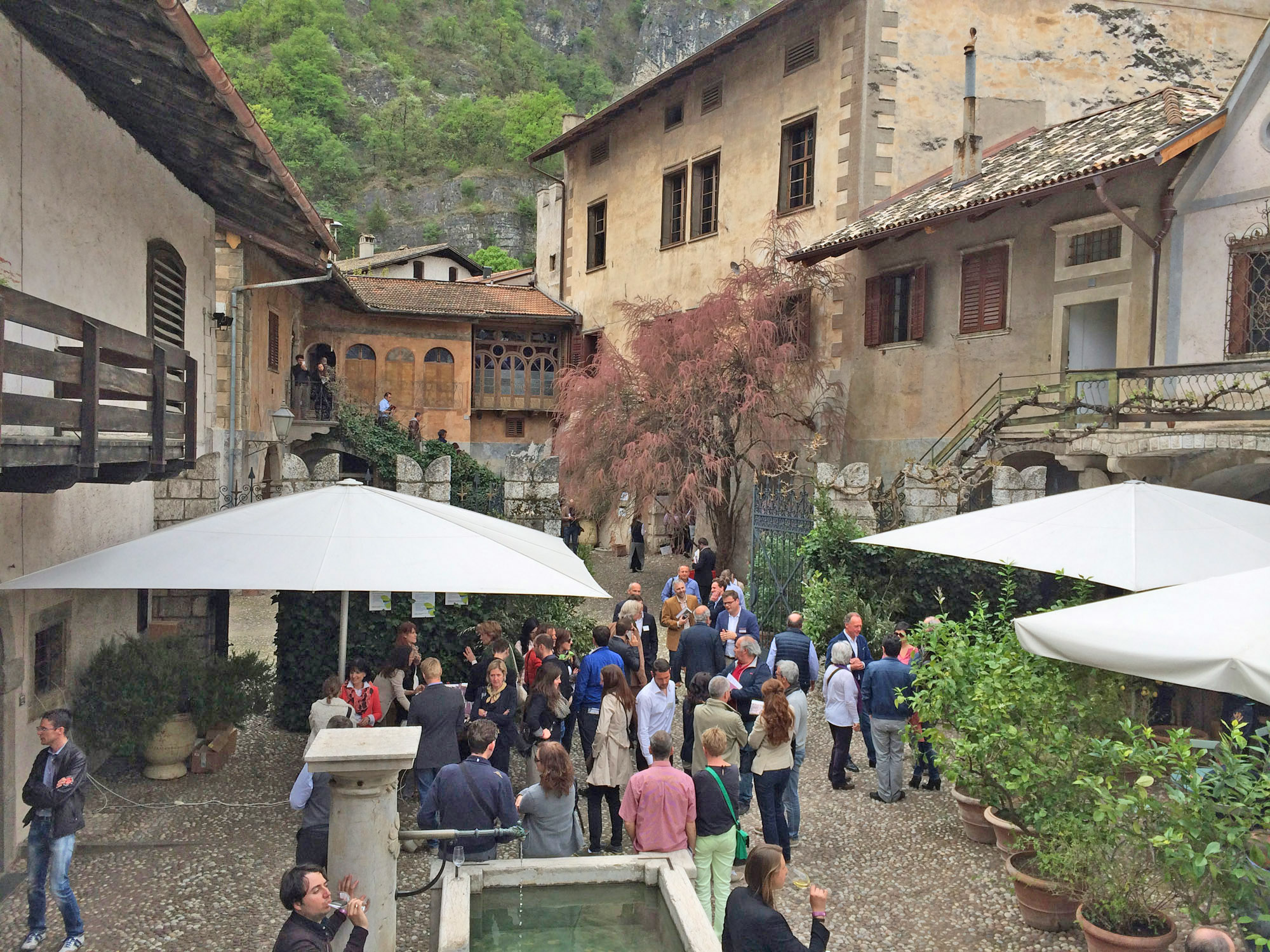
Participants at Summa 2014, held earlier this month at the 17th-Century palazzo of winemaker Alois Lageder in Magré, enjoy the surroundings of Casòn Hirschprunn.
Magré, BZ, Italy – Spring comes reluctantly to this northern-most part of Italy, hard by the snow-covered Dolomites and the crystal-clear headwaters of the Fiume Adige, which we English speakers call the Adige River.
This is a land of contrasts, as is most of the Italian wine-country landscape, you might argue.
But here, a few miles south of where Brenner Pass drops sinuously into Austria and where snowy peaks backlight lemon trees and olive trees growing in a understated Mediterranean climate, the contrasts are perhaps more noticeable.
This is the Südtirol/Alto Adige/South Tyrol, where road signs are in German and Italian and the flaxen-haired waitress (her German counterpart is Kelnerin while it’s cameriera in Italian) may address you in either language.
Or, quickly recognizing you as the tourist you are, speaks in lightly accented English.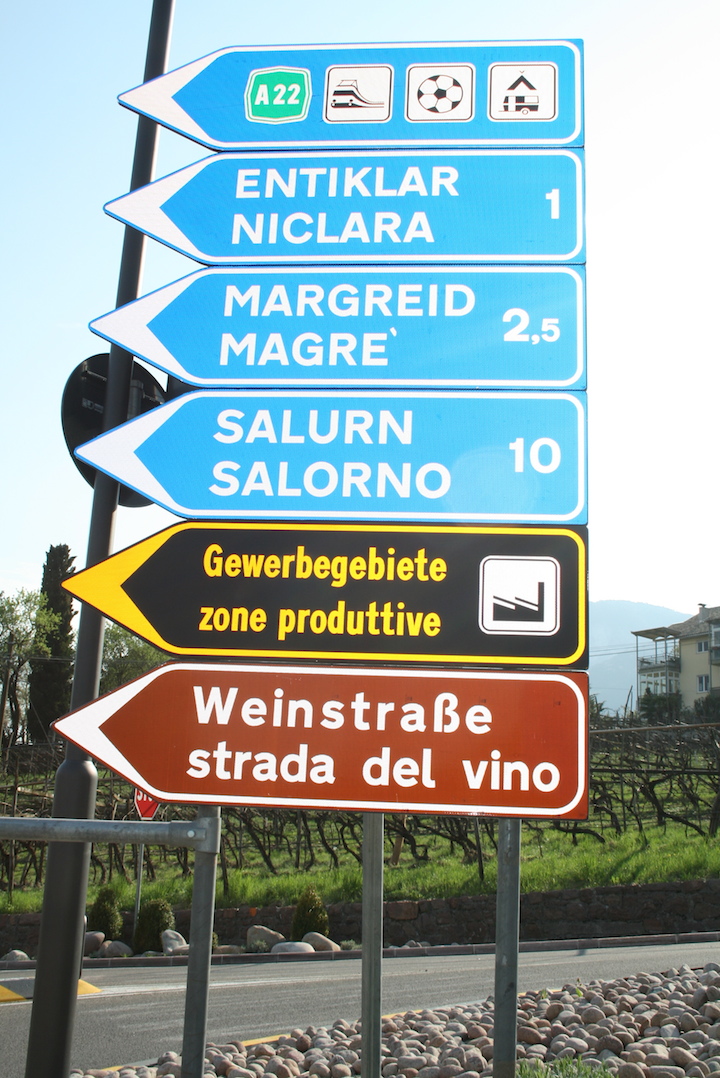
The Italy-Austria connection is strong, since this part of Italy was Austrian until the international borders shifted after World War I.
In fact, a shopkeeper in Bolzano insisted his city was the southern-most Austrian city in the world, and who was I to argue?
The contrasts also lay in the land, where miles of grapevines reach into the laps of the surrounding peaks bearing a mantle of white.
Because of the area’s history and its location, you find varieties of wine grapes – Müller-Thurgau, Lagrein and Gewurtztraminer among them – not common elsewhere in Italy.
You’ll also find many talented winemakers, perhaps none more talented than Alois Lageder, the fifth generation of his family to grow grapes and make wine here.
This spring, as he has the previous 13, Lageder invited to Magré a handpicked assortment of winemakers from Italy, German, Austria, France and elsewhere to participate in his two-day Summa at Casòn Hirshprunn, the family’s 17th-Century palazzo.
All of Lageder’s wines are made in close concordance with the biodynamic practices developed by Rudolph Steiner in the 1920s, a philosophy relying on a particular regimen of treating soil, plants and livestock.
While Steiner’s practices have long been popular in Europe (Germany has 45 percent of the world’s biodynamic acreage), it’s slower to take hold in the U.S.
This year’s Summa 2014 had its focus on biodynamic wines, an effort, according to the winery, to “show that biodynamic means forward-looking and has the answers to the issues that currently face both ecological agriculture and society in general.”
As Lageder says in the notes accompanying the Summa guidebook, to make the best wines possible “one also needs something more than healthy, fully-ripened grapes from the best vineyard sites. There is also a need for the right philosophy and for true human commitment.”
This commitment was reflected in the 60 or so winemakers, offering finely crafted white and red wines, as well as producers of select olive oils, cheeses and salume.
Winemakers were set up in the ancient, granite-walled granary as well as on several floors of the Palazzo, and the hardest decision was when and how often to stop, swirl and sip the proffered wines.
One stop in the granary was at Gut Hermannsberg of Nahe, Germany, which produces world-class Rieslings.
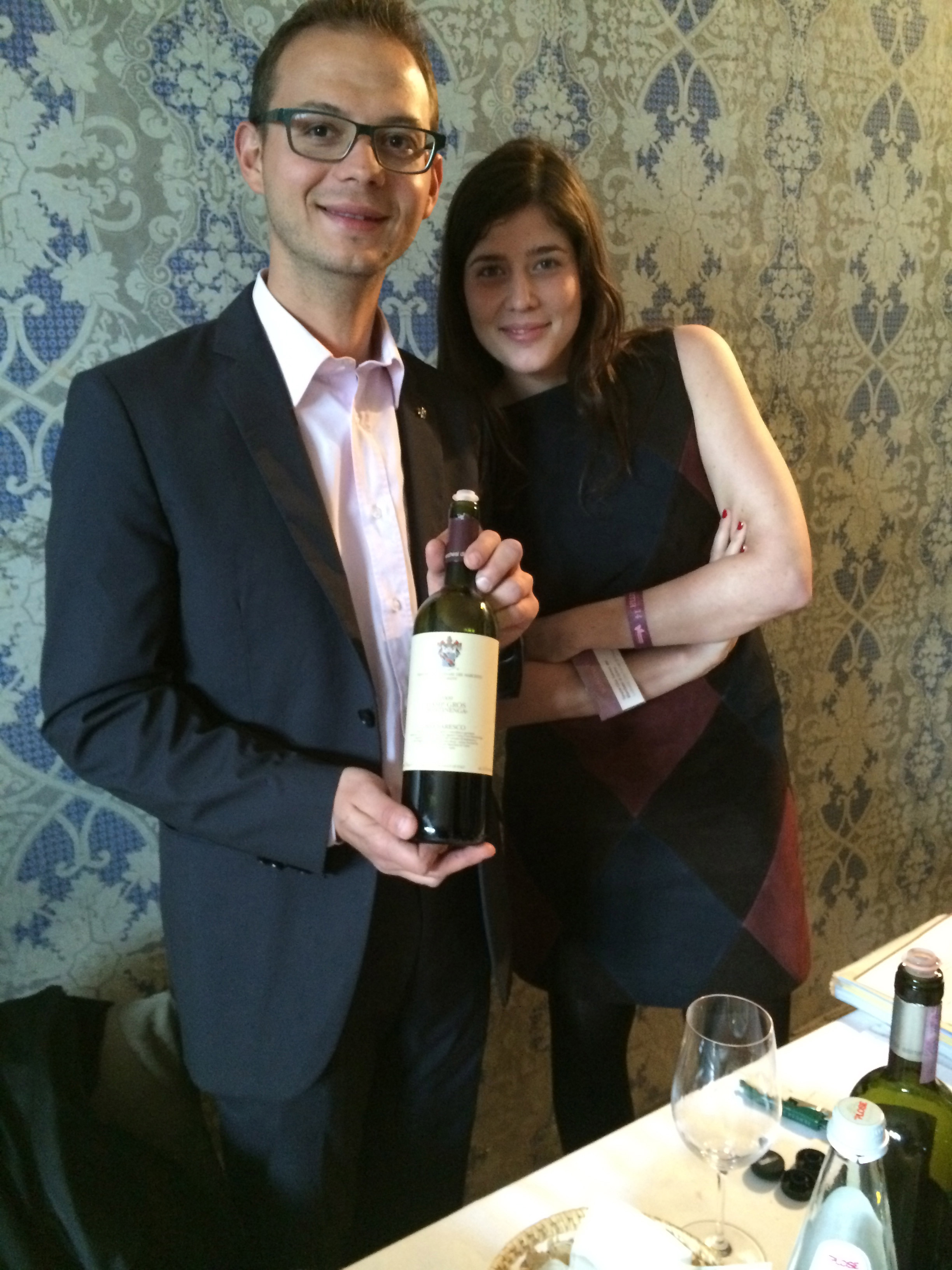
Winemaker Matteo Sasso and Ludovica Cisa Asinari dei Marchesi di Gresy show off their 2009 Tenute Cisa Asinari dei Marchesi di Gresy Barbaresco DOCG during Summa 2014.
Spokesman Christoph Freidrich opened a coffee table-sized book to a map of the Nahe region and showed how the landscape and the geology contributes to the stone-and-mineral, citrus-forward elegance of the wines.
“The land gives us the perfect opportunity to make delicious wines,” Friedrich said.
Across the stone plaza and up a flight of limestone stairs, young (23) winemaker Matteo Sasso, accompanied by Ludovica Cisa Asinari dei Marchesi di Gresy, gladly shared the 2009 Camp Gros Mattinenga Barbaresca DOCG from Tenute Cisa Asinari dei Marchesi di Gresy.
The di Gresy estate dates from 1797 and has vineyards in the Langhe and the Monferrato areas of Italy’s Piedmont region, home to Nebbiolo and some of the world’s greatest red wines.
The Barbaresco was bright and fresh, with a bouquet of roses and fresh herbs and a faint hint of red licorice on the finish.
And, of course, it’s all biodynamic, as Matteo noted.
“I want to do something good for the soil, the wines and for myself,” he said. “Doing this (biodynamic) allows me to feel good about everything I do, and to make these delicious wines.”
45 years and still in good hands
VERONA – One of my many “Instant Italian” lessons while at VinItaly last week turned up when my cellphone didn’t. Looked in pockets, bags, hats, suitcase and even the bag with my brioche from the panificio. No luck.
Finally thought of looking in the car, which meant repeating a 10-minute walk but no big deal, because that’s where I left the phone.
Gloria Giovara, wife and business partner of good friend Patrick Casely of Trevignano, laughed when I explained my short absence and said, “Now you know how to say, ‘Ho lasciato il mio telefono in la macchina.'”
We were headed around to explore several of the immense pavilions comprising VinItaly, each of them the site of a different Italian wine region. Patrick and Gloria, ever working in the beehive-busy culture of the world’s largest wine fair, were seeing clients and I was tagging along, hoping to absorb some of their encyclopedic knowledge of Italy and the Italian wine world and maybe meet someone interesting.
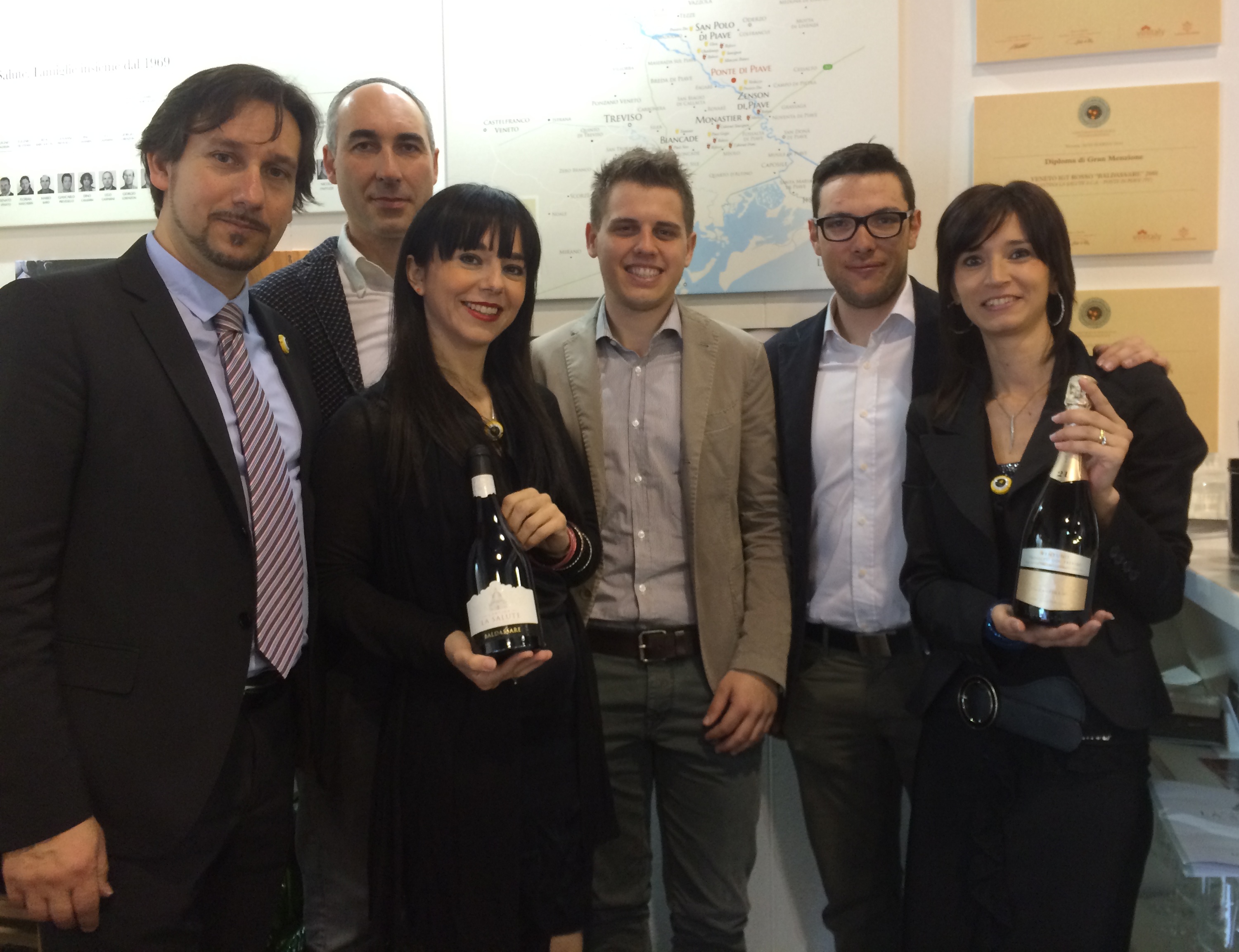
This handsome sextet from Cantina La Salute in the Piave River Valley are representative of the future of Italian wines.
As if that was any problem.
The trans-generation crossing is something every winemaking region worries about. Who is going to take over when the first (or fourth or more, in many cases here in Italy) generation gets tired and starts looking around for the next generation of winemakers? But in my days at Vinitaly, I was fortunate to meet several young winemakers eager to take over, or at least eager to accept the reins when handed to them.
Among the notable are the attractive six young people in the accompanying photo who comprise the future of Cantina La Salute, which is a cooperative formed in 1969 when 11 farmers in the Piave River valley near Treviso, feeling threatened by encroaching “big business,” came together to ensure the continuation of their lifestyle.
If I understood correctly, today the cooperative acts like a consortium, maintaining the quality of the wines while making a line of wines from the grapes produced by the various members of the cooperative. The winemaker for the cooperative is Antonio Cocca (second from left) and the president of La Salute is Nicola Fantuzzi (third from right). The others in the photo include (from left) Allessandro Milan, Cocca, Elena Rossi, Fantuzzi, Enrico Prisson and Serena Lessi.
The sextet in the photo are among the current generation of winemakers and viticulturists, although many of the original winemakers still are actively involved in the day-to-day operations of their individual aziendas and vineyards. The cooperative today produces a variety of wines, including a delightful Raboso and a millesimato spumante designated “21,” a number relating to Feb. 21, 1969, the founding of the coop, and Nov. 21, the day of the Feast of Our Lady of Health and the day the cuvée selections are made. The wines have been awarded many medals and honors, including several Gran Menziones at this year’s Vinitaly.
Wine of the Week: Ca’ Lojera Lugana DOC
Fresh from VinItaly and before that Summa 2014 in Magré and sure that no one is going to believe me having only one Wine of the Week.
It’s one week at a time, since it will take a year to talk about all the wines I tasted and the winemakers I met, but among the memorable were the Lugana white wines from Ca’ Lojera and other members of the Lugana DOC.
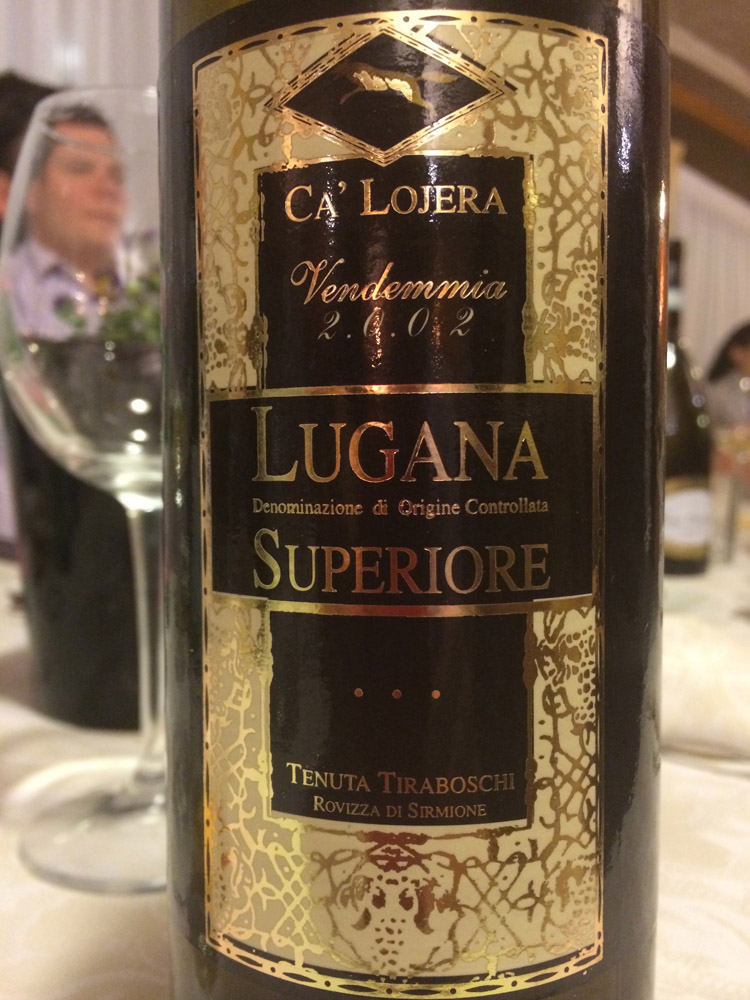
A well-kept 2002 Lugana Superiore from Ca’ Lojera
It came on my first night of a too-quick tour of the Lugana DOC , which lies at the southern end of Lake Garda and roughly midway between Brescia and Verona. The DOC was one of the first such designations (1967) in Italy and today remains one of the smallest DOCs, according to the Lugana Consorzio, which actively promotes and protects the uniqueness of this wine.
Our group, led by Francesca Goffi of the Lugana Consorzio, was welcomed at Ca’ Lojera by Ambra Tiraboschi, historian, delightful hostess and wife of winemaker Franco Tiraboschi. She poured us several iterations of Lugana, including their top-tier Riserva Lugana del Lupo, all made from the Turbiana grape. Once known at Trebbiano di Lugana, the local consorzio changed the name of the grape to the local name “Turbiana” to differentiate the Lugana wine from Trebbiano di Soave, Trebbiano d’Abruzzo and the other numerous Trebbiano wines grown in 80 of the country’s wine regions.
According to Ambra, the winery’s name (Ca’ Lojera translates to House of the Wolves) is drawn from the days centuries ago when bandits (pirates) from up north would slip down to the south end of Lago del Garda and hide their contraband in local warehouses, including one that sits a few yards from the modern Ca’ Lojera winery.
According to local lore, the hideouts were guarded by wolves (lupo in Italian). The only wolf we saw was on the label, while the wine inside was all bright fruit and good acidity, with hints of green apple, spice and the characteristic minerality for which Lugana DOC wines are famed.
This 2002 Lugana Superiore was particularly enticing, not only because it’s commonly held that Trebbiano/Turbiana wines won’t age but also because this wine had held its years beautifully, the past 12 years adding a gold color and a hint of almonds or hazelnuts to the finish.
Ca’ Lojera wines are imported by Worldwine Cellars (Fridaly, Minn.), Wine House Ltd. (San Francisco) and others.
Lugana wines tied to the soil, culture and heritage
DECENZANO DEL GARDA, BS, Italy – The grand expanse of Lake Garda, all 51.6 kilometers (about 32 miles) of it, laps gently at its southern end where it surrounds on three sides the peninsula of Sirmione, a finger of land just east of Decenzano del Garda.
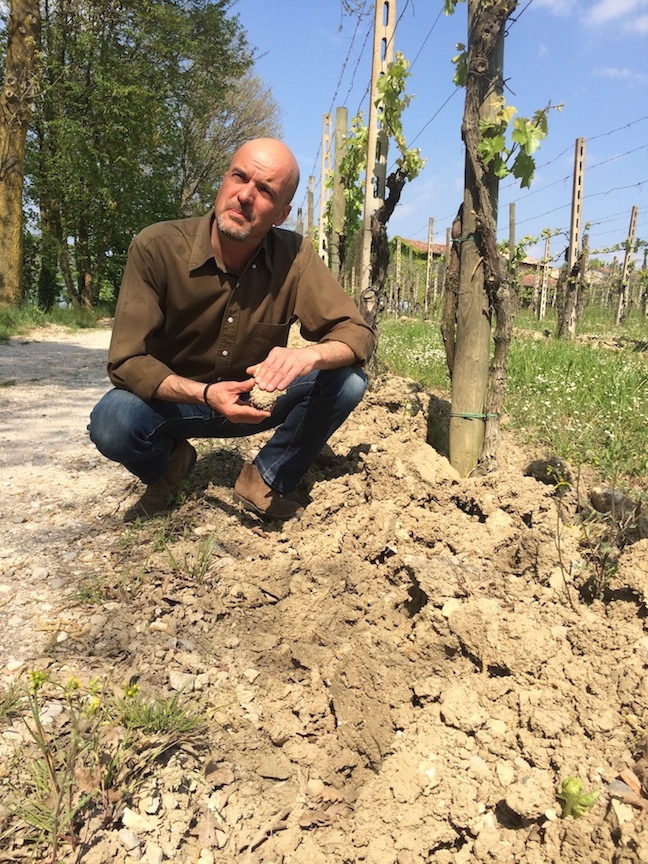
Luca Formentini of Podere Selva Capuzze in Brescia shows a visitor how difficult to work are the clay-rich soils in the region at the south end of Lake Garda.
Formed by glaciers during the last Ice Age, the lake not only moderates the Mediterranean climate of the region but also provides a near-constant breeze, warming in winter and cooling in summer, which makes a key difference if you’re one of the 120 or so members of the Consorzio of Lugana winemakers.
“Look around and see, we are 110 meters above the lake,” said Luca Formentini, whose father bought the farm that now is Podere Selva Capuzza 40 kilometers south of the lake. “”We get the benefit of the wind, which is good when it’s warm and rainy and not so good when it is hot and rainy.
“But last year, when it was so rainy, we spent only seven days (fighting mold and mildew) in the vineyards while my neighbors spent 14.”
The Lugana white wine, by DOC rules made of 100 percent Terbiana (an “invented” name to differentiate Trebbiano of Lugana from Trebbiano of Soave, Trebbiano d’Abruzzo and the other 78 Italian DOCs in which Trebbiano is vinified) is mild and pleasant, with lemon and traipical fruit and a bit of bitter almond on the finish. It also had good acidity and a surprising ability to improve with age.
I recently had the 2002 from Podere Selva and found it rich, with layers of white peach and apricot and that almond-like finish, bright acidity and the wine’s characteristic minerality and what they call sapidity and we’d call salinity.
The distinctive salinity and minerality comes from the earth, Luca said, formed when the glacial seas retreated and left the Lugana area layered in clay-rich soils.
“Look at this, he said, kneeling along one of the rows in the 50 hectares (123 acres) of vines the family grows. “When it’s dry, it’s almost unbreakable and when it’s wet, you can’t walk on it. But there are many minerals here, left by the sea and the vineyards take them up.”
Later that night, while sitting at dinner next to Cesare Materossi, the fourth generation winemaker at Az. Agr. Monte Cocigna, he told me the minerality, which usually signifies a stony soil, comes from ancient salts dissolved by the glacial seas.
“Those give the wine a bright edge and it’s ability to age,” he said. “Lugana is tied to the place it comes from. It’s more than the winery, it’s a sign of the culture and the heritage.”
Eleven generations and going strong
The photo of young (23) Franz Haas may be a bit blurred but it’s not just the light; this eighth-generation Franz Haas is running to keep up with his famous father, winemaker par excellence Franz Haas (VII).
Since 1896 a Franz Haas has been making wines commercially in the Sudtirol, that part of Italy’s Alto Adige where German and Italian blend into one. And there were three generations making family wines prior.
Like the land, Franz Haas VIII is a man of many cultures.
“My mother is Italian and my father is German,” said the personable Franz the 8th in his well-spoken English ( he also is fluent in Spanish). “Until I was 5, I spoke Italian to my mother and German to my father.”
He laughed unassumingly when he told a visitor to “Put a ‘V’ in there, then the III.”
It wasn’t so hard being a two-language family, he offered to a curious visitor.
“When you are young, it’s much easier to learn different languages, and speaking two languages was natural for me.”
I met these multi-generational winemakers on the final day of VinItaly 2014, a day when the crowds are lighter and it’s speed-tasting at booths you missed earlier in the week.
My friend and winemaker Susanna Crociani urged to visit the Franz Haas, assuring me I’d regret not tasting thier wines.
Franz Haas may be best known for his Pinot Nero, and he makes a light-bodied wine with deep red fruit flavors and the smooth acidity of a well-balanced version of Pinot Noir in the Alsatian style, although he suredly would say it’s really the Sudtirol style.
The winery had 13 wines at VinItaly, many of them from grapes considered very difficult to grow but none perhaps as difficult as Pinot Nero.They also offer a delightful Pinot Nero dry Rosé and a Moscato Rosa, with a breath-taking 136 grams of RS but the sweetness is tightly balanced by the wine’s high acidity.
Finding the right medicine in the vineyard
VERONA, Italy – One of the better habits one picks up at the massive wine fair that is VinItaly is learning to look past the many big producers and their show-stopping, two-story booths with starlets and politicians and exclusively formal atmosphere.

Claudio and Sylvia Monaci of Cantina Piancornello in Tuscany, producers of Brunello di Montalcino.
They’re not wrong, and for them it’s the right presentation. But there always is something more right around the corner.
And that’s where I found Claudio and Sylvia Monaci, sitting quietly, patiently waiting for whatever or whomever came next to their little booth, tucked away in the immense Tuscany pavilion, which is about double the size of the other pavilions.
The Monacis own and operate Cantina Piancornello, due south of Florence and 45 kilometers from the climate-controlling Mediteranean Sea, which they founded in 1991 after deciding they really wanted to be winemakers and bought an an existing vineyard.
Any life-changing experience can be traumatic but Claudio knew it would be more traumatic to ignore his heart’s calling.
“I was studying to be a doctor but I knew I wanted to make wine,” he said. Now, his Brunello di Montalcino consistently get high marks from customers and critics and he’s quite happy to be away from medicine and making a minimal-intervention wine.
“I’m trying to do something good for my family and good for the grapes,” he said. Actually, Sylvia said this, as she was translating Claudio’s words for the sake of a visitor.
They were pouring their latest vintages – 2008 and 2009 Brunello di Montalcino DOCG, 2012 Rosso di Montalcino, 2013 Campo della Macchia and the 2011 Podere del Visciolo – and when asked, started talking about aging wines. More accurately, about how many people do not age their wines.
“This one,” said Claudio, holding the 2008 Brunello di Montalcino, “is drinking very nicely but still a baby. It may last for 15-20 years. But no one wants to wait that long.”
For the impatient, the Monacis produce their Rosso di Montalcino and their Campo della Macchia IGT, wines ready to drink almost as soon as it’s relesed.
“But please, wait, maybe at least an hour, after opening it,” said Claudio. “It will be much better.”
Sylvia laughed and noted how different were even the 2008 and 2009 Brunello di Montalcino DOCG.
“It’s very different, what can come from the same vineyard,” she mused. “Like children from the same parents.These are our children, and they are very different.”
The opening salvo – Rain to lemons in Italy
CAMPEGINE, RE, Italy – Maybe this should carry the dateline Nocetolo because that’s where I stayed the first two days of my visit to northern Italy but, hey, you’ll have trouble enough finding Campegine on the map, much less Nocetolo, a commune of a half-dozen farmhouses and at least one raucous rooster a few kilometers to the north.
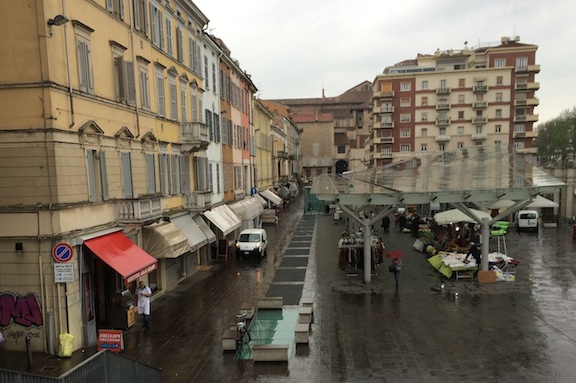
The rain this week kept buyers, and sellers away from the outdoor market in Parma.
I stopped here, about midway between Milan and Bologna, for two days prior to VinItaly, the immense wine fair in Verona April 6-9. I was staying a La Rocca B-n-B and, following the advice of my generous and gracious hostess Giovana Cavalca, I discovered Il Piccolo Oceano, a restaurant in Campegine specializing in seafood. It’s a popular place, as much for the selection of fresh seafood (the Adriatic Ocean is only 100 or so kilometers to the east) but because it’s also the best to eat place in town.
Spring in this part of Reggio Emilia is wet and cool, reflective of the Mediterannean climate across much of Italy. It’s not quite green but the early blossoms, including apricots and cherries, are ablaze right now. It’s very remindful of western Colorado, ‘cept it rains here on a regular basis.
And speaking of the rain, that’s what it did all Thursday, which I spent slogging around Parma (photo above) visiting the museums where the extensive archaeological history of the region is on display, including a human mummy and a cat mummy.
I was soaked at the end of the day but I learned a new word. It’s “inzuppato,” which means soaked, and the Italian word for soup is “zuppa,” and to me that makes perfect sense.
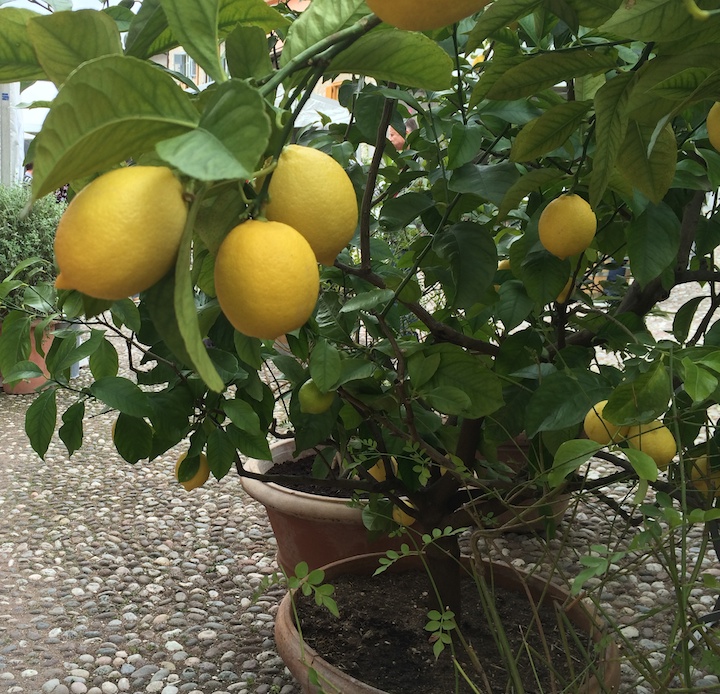
Lemon trees grow in large pots in the courtyard of Cason Hirschprunn
So Mediterranean is the climate that winemaker Alois Lageder of Magré, a hamlet right at the “pie” in the piemonte of the Italy-Austria Alps, grows lemons, along with his white wines – including Pinot Grigio, Pinot Bianco, Gewurztraminer and Chardonnay – and smattering of Pinot Noir, Lagrein and Merlot.
I dried everything in time to attend Day One of Summa 2014, a wine and food-tasting event hosted by Lageder at his Magré Renaisance-era palace and winemaking facility, Cason Hirshprunn. Don’t think of Guinevere when I say “castle.” This is a castle in the raw, so to speak, with foot-thick walls of native stone and and brick, immense beams doorways built for defense, not elegance.
It truly is a a living museum and one source says the building dates back to 1363, when the name ‘Hirschbrunn’ appeared in the records of the region of Trento.
Last year Summa 2013 attracted around 2,000 visitors during the two-day event and the 20 Euro entrance fee raised about 36,000 Euros for humanitarian projects in Burma, which still is recovering from the 2008 cyclone.
This year there were 150 or so winemakers, the great percentage from Italy and Germany but also some from France, Europe and even one from the U.S. The big draw, or one of them, anyway, was the opportunity to taste a couple of hundred biodynamic wines from progressive winemakers willing to take the chance on what’s good for them, their families, their wines and their land.
There’s a bit of concern on the part of many Italian winemakers because of the decline in wine consumption in Italy. Depending on who you ask and what you read, the reasons range from the weak economy to the fact younger Italians are drinking more birra and soft drinks instead of wine.
According to the Italian winemaking association Assoenologi, Italians were expected to drink 40 liters per person in 2013, down from 45 liters before the financial crisis hit in 2007.
“Wine has become a hedonistic product, which is not part of Italians’ basic diet anymore, leaving it more exposed to short-term fluctuations in economic conditions,” Michele Fino, a professor at the University of Gastronomic Studies in Pollenzo, was quoted in the Huffington Post.
“The recession was like the flu that arrives when one’s defenses are already low,” Fino added.
But Mariano, one of the three brothers owning and operating Il Piccolo Oceano in Campegine (this is how all this began, remember?) blames the country’s restrictive crackdown on DUIs for the drop in wine drinking, especially away from home.
“You can have one, maybe two glasses and that’s it,” he said. “No one buys a bottle because they know there will be a policeman on the way home.”
He shrugged. “In some ways, it’s good,” he acknowledged. He looked around his restaurant, at the crowded tables, where only a few wine bottles were in sight. “But here, I could use the sales.”
(I’m struggling with the WordPress photo file and the ability to size the photos to fit. Maybe it’s because I’m halfway around the world. I’ll add photos when I figure out the problem, me or the system.)
Valpolicella a bright welcome for spring
The burst of spring across the landscape means a shift from traipsing around in heavy coats and boots to the lighter clothing and footwear that comes with warmer weather.
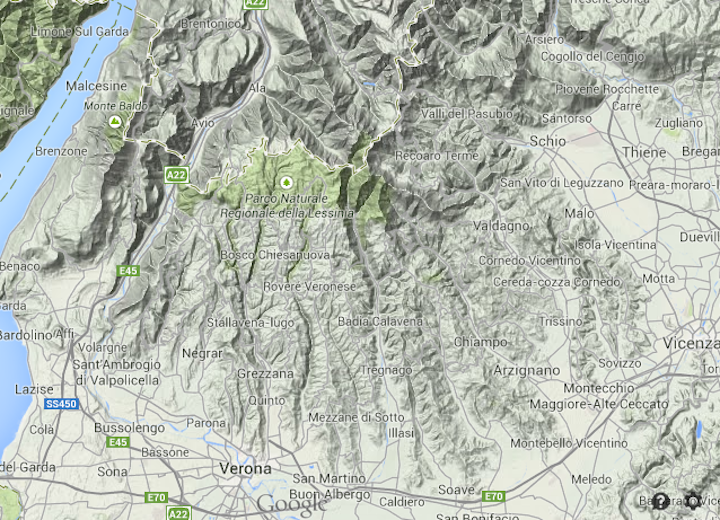
Streams cut through the hills of the Valpolicella region of northeast Italy. It’s from these geographical features this region received its historical name. Courtesy Google maps.
My wine drinking is going through similar changes, and with VinItaly only 10 days away away, I’m looking toward Italy, especially the lighter reds of Valpolicella, for refreshment.
The Valpolicella area is east of Lake Garda, in the Veneto region of northeast Italy. It’s a mix of flat agricultural lands and rolling hills, cut with permanent streams flowing north to south where they meet the Fiume Adige (Adige River).
The wine was a favorite of Ernest Hemingway, and it gained notice after he made his protagonist in the 1950 novel Across the River and Into the Trees a Valpolicella fan who describes the wine as “better when it is newer. It is not a grand vin and bottling it and putting years on it only adds sediment.”
The medium-bodied, bright-cherry fruited wine made a big splash in the1960s and 1970s with American wine drinkers, an occurrence which brought it not only attention but almost its downfall as well.
As demand for the wine grew, winemakers shifted their attention from the hard-to-farm hills to large estates on the flatter lands and as production increased, overall quality went down.
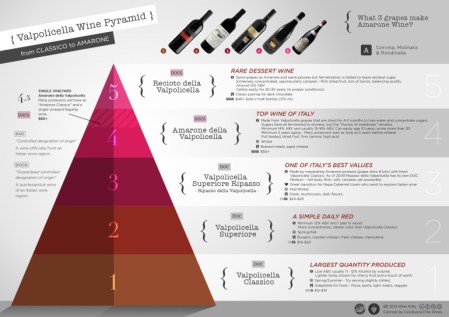
Aaron Epstein of the wine consulting business Uva Buena Fine Wines developed the comprehensive wine pyramid reproduced here to help wine drinkers better understand the world of Valpolicella wines. Click for link.
By the 1980s, the Valpolicella found in Italian restaurants across the U.S. was a weak shadow of what it once was. But the same revolution, and the changing tastes of consumers, that saved many Italian wines also played its part in saving Valpolicella.
Some of the credit goes to the late Giuseppe (Bepi) Quintarelli, a demanding winemaker who knew the wine could produce better wine and better prices.
And there was Sandro Boscaini of Masi, who was among the winemakers offering a middle-level Valpolicella style called ripasso, where regular Valpolicella is refermented on skins and seed remaining from the partly dried grapes used in the Amarone process developed by Quintarelli.
The result is a wine with higher alcohol and more heft and body, midway between the lighter Valpolicella and the mouthful that is Amarone.
Valpolicella DOC regulations allow the use of several grape varieties, mainly corvina (up to 70 percent), along with rondinella (20-40 percent), and molinara (5-25 percent). There also can be up to 15 percent of other grapes such as barbera, sangiovese and negrara.
I recently tried several Valpolicellas made in the traditional style, with bright cherry fruit, floral aromas and enough acidity to stand up to many foods. And Valpolicellas, especially the Superiore and Classico Superiore, won’t break your budget.
I found my favorite of this tasting, a 2012 Folonari Valpolicella for $7.63 at Tri R Liquors in Hotchkiss and I should have bought two. In the glass it was bright garnet with edges fading to red/purple, with a nose of cherry and dusty roses. Bright cherry with soft tannins filled the mouth.
I also had a 2011 Zenato Valpolicella Superiore ($11), a bit heavier in weight than the Folonari but still with plenty of red fruit and bright flavors, and the 2011 Sartori Valpolicella Classic Superiore ($13), biggest of the three but well-balanced with lots of dark cherry flavors and aromas of violets and roses.
As a side note, many writers fall for the story that “Valpolicella” has its roots in the Greek word for “land of many cellars,” a false cognate if there ever was one.
I prefer the explanation offered by the well-spoken Jeremy Parzen in his blog Do Bianchi, where he says the name refers to “the valley of sand deposits, from the Latin pulla, a term used in classical Latin to denote to dark soil and then later to denote alluvial deposits.”
Parzen, a linguist of note, goes on to say, “In fact, Valpolicella is not a valley but rather a series of “wrinkles” defined by the Marano, Negrar, Fumane, and Nòvare torrents (streams).”
The accompanying map shows the complexity of the Valpolicella geography.
Big Three companies dominate the wine market
If you ever feel overwhelmed while walking the aisles in your favorite wine store, here’s why:
Wine Business Monthly reports in its February edition that in 2013, the TTB approved 96,539 Certificates of Label Approval, which a winery needs prior to bottling a wine.
In 2012, that number was even higher, at 105,828.
That’s a boatload of potential new wines to crowd the shelves and daze the casual (or not so casual) wine drinker looking for something for dinner.
Some of these labels are short-timers conceived several years ago when wineries were making what WBM writer Cyril Penn termed “lifestyle brands.”
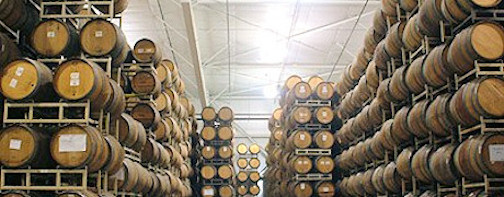
Stacks of barrels in an E&J Gallo store room hold some of the 80 million cases of wine the company produces each year.
Penn quotes Ted Baseler, president and CEO of St. Michelle Wine Estates, as saying wineries have started to pull-back from the “silly, goofy double entendre stuff.”
“It seems like there’s a return to more traditional packages and names,” Baseler said. “That’s stunning in 12 months. It’s gone from the latest catchy gimmick to more of the traditional quality, thoughtful brands.”
The same issue reveals what we already know: Large wine companies dominate the consumer market.
According to the figures in WBM, of the 7,762 wineries in the U.S., 30 companies sell nearly 90 percent of the wine produced in the U.S.
Three companies – E&J Gallo, The Wine Group and Constellation Brands – accounted for more than half (187.5 million cases) out of the 370 million cases (4.4 billion bottles, at the typical 12 bottles per case) of domestic wine produced last year.
And, the top six – add to the above three Bronco Wine Co., Trinchero Family Estates and Treasury – and you have almost 2/3 of the wine produced.
Some gleanings from the Wine Business Monthly report:
– Gallo, at No. 1 with 80 million cases, sold more than the bottom 26 wineries combined.
– I million cases ain’t so big. Precept Wine, which you might not recognize unless you’re reading the backs of bottles, made 1.1 million cases and ranked only 18th in the top 30.
– Purple Wine Co. of Graton, Cal., was the smallest of the top 30 at only 400,000 cases last year. But the company also produces another 400,000 cases of private and control label wines (wines under a certain name or label bought by a store or restaurant in large enough quantities that retailer can control the entire allotment of wine).
In comparison, in 2013 Colorado produced 140,900 cases, according to the Colorado Wine Industry Development Board.
While some industry followers have expressed concern about the iron clutch of Big Wine around the pocketbook of the American consumer, the wine industry is keyed to scale.
Which means Big Wine can make wine affordable, which leads to one more statistic – Last year, the U.S. reached 100 million wine drinkers.
Which is good for all wine, big and small.
 Wine Openers