Archive
Making the most of an ancient grape
Tezze di Piave, TV, Italy – When I first met winemaker Antonio Bonotto, of Tenuta Bonotto Delle Tezze, he looked like anything but a renowned winemaker continuing a family tradition almost 400 years old.
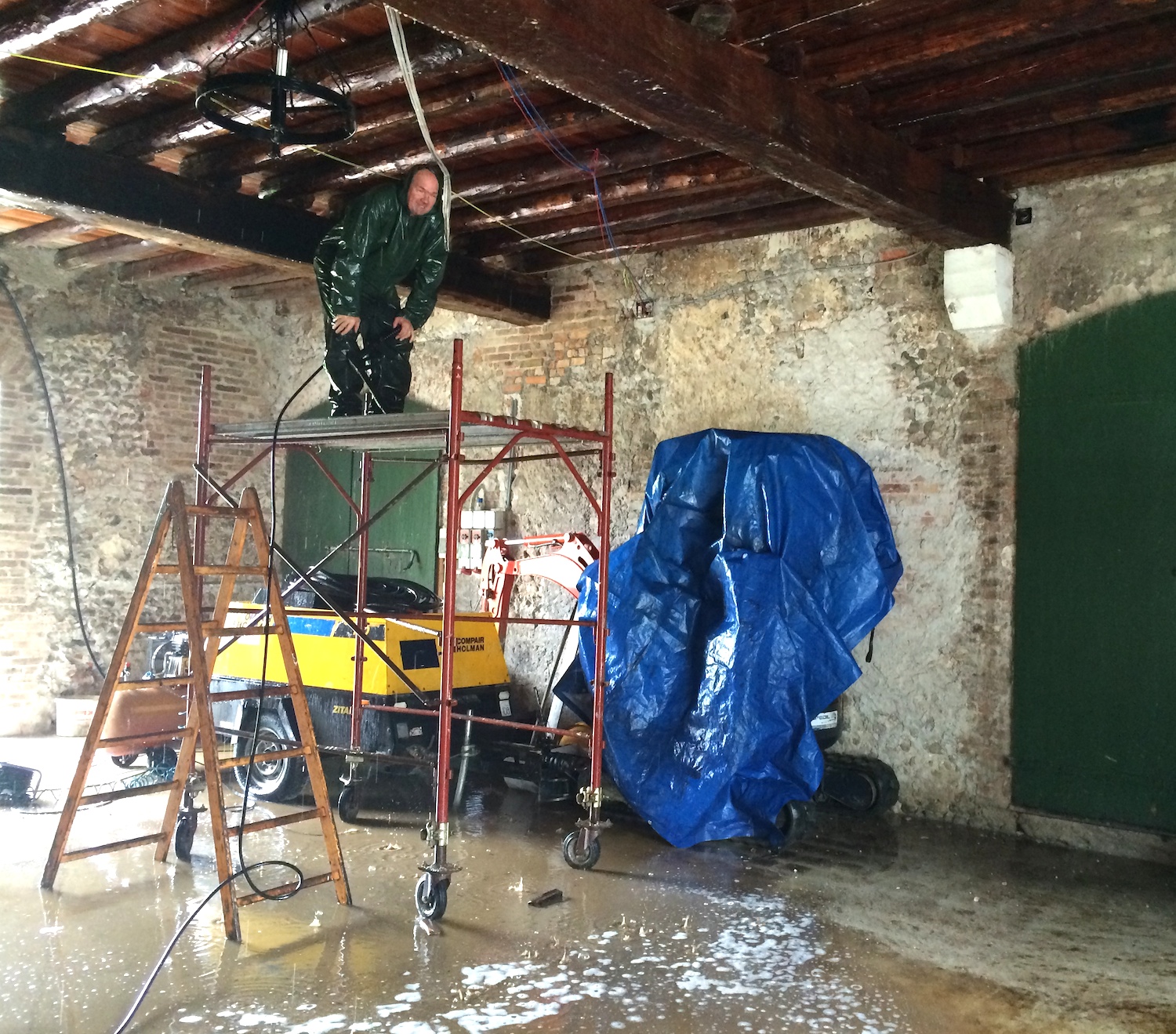
Winemaker Antonio Bonotto making something new out of something very old.
Instead, dressed head-to-toe in a forest-green rubber suit and standing on scaffolding 12 feet high, Bonotto was diligently power-washing 400 years of grime off the walls and ceiling of the ancient, heavy beamed space where grapes once were delivered by horse-drawn wagon and making the room into a new tasting room/reception area.
For the moment, Bonotto was making it rain harder inside than out.
I was with my friend Patrick Caseley of Trevignano and when Bonotto recognized Patrick, the oenologist called out, “Hey, Patrick, welcome,” and crawled down from the high rise.
“You caught me at a bad moment, I’m really working,” he said, shutting off the sprayer and walking to us.
It didn’t seem he was very dry, in spite of the rubber suit, and specks of grime dotted his smiling face
“But I’m quite happy to quit for a moment, this is hard work,” he said. “You probably don’t want any photos of me right now.”
He laughed and brought us a treasure found in the walls during the ongoing renovation.
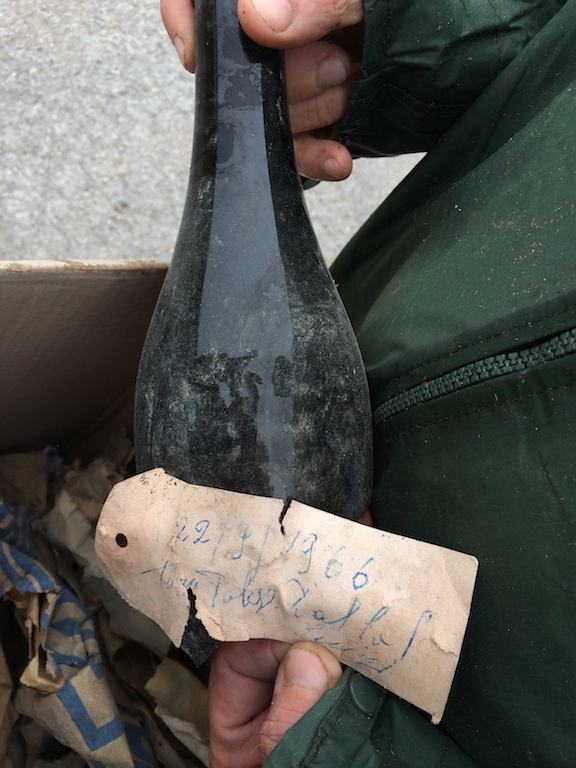
This bottle of 1966 Raboso del Piave was hidden in a wall by Antonio Bonotto’s father nearly 47 years ago. It was broken when recent construction uncovered it.
“It is, or it was, a bottle of wine my father put in the walls in 1966, when he was doing some remodeling,” Bonotto said.
He showed us a broken bottle, still bearing a hand-written label with the date 22/9/1966.
“One of my workers was inexperienced with a machine and he wasn’t able to stop in time to save the bottle,” said Bonotto, shrugging. “Too bad, it would have been nice to have it whole. My father made this wine.”
Bonotto’s family has lived in the Tezze area since at least the 1400s and for centuries the family rented farmland from the local monastery and paid their rent with wine.
The commercial winery began in the 1800s and today Tenuta Bonotto makes a line of still and sparkling wines, including a delightful Prosecco DOC (he’s just outside the Prosecco DOCG zone) in brut and extra dry and a refreshing Novalis, made of 100 percent Manzoni Bianco, with hints of oranges, apricots and a stony minerality derived from the soils and waters washing down from the nearby Dolomites.
He’s particularly proud of his Raboso del Piave-based wines.
It’s an ancient grape, Bonotto said, with ancient records indicating this indigenous grape, considered the “king of wines” by Venetian aristocracy, having been vinified since the 800s.
“The real distinctive characteristic of this grape is the acidity,” Bonotto said. “Normally, when a grape ripens the sugars go like this (moving his hand in an upward arc) and the acidity goes like this (a downward arc). But with Raboso, the acidity gives you this,” and he drew a straight line.
It’s that straight-on acidity that deters many winemakers who don’t understand how to make wines with Raboso, Bonotto said.

Vittoria Bonotto, wife of winemaker Antonio Bonotto, selects a bottle of Bonotto delle Tezze Raboso del Piave Potestá for a guest.
“It’s not something you can eliminate, so you learn to work with it,” he said. “Or not.”
When vinified as a sweet wine, the acidity balances the sugars, the result being a sweet wine with “nerve,” as Caseley said.
That bottle of his father’s wine from 1966 may still have been drinkable, given Raboso’s acidity, and the current Bonotto rued not being able to see how it might have aged over nearly 50 years.
With his wife Vittoria, we tasted Bonotto’s 2009 Potestá Raboso del Piave DOC (100 percent Raboso Piave) and found hints of violets and roses on the nose with spice, licorice and a pleasing bit of earthiness and minerality.
He also makes a Raboso Passito, its grapes dried naturally for four months before vinification, and a Raboso Rosato Frizzante, bright and indulgent in fresh red berries and cherries.
“This is the blessing of this grape, you can make so many different wines from it,” Bonotto said. “It’s a pity because we have so many other varieties here we don’t focus on Raboso. It’s really a marvelous grape.”
Wine of the Week: Ca’ Lojera Lugana DOC
Fresh from VinItaly and before that Summa 2014 in Magré and sure that no one is going to believe me having only one Wine of the Week.
It’s one week at a time, since it will take a year to talk about all the wines I tasted and the winemakers I met, but among the memorable were the Lugana white wines from Ca’ Lojera and other members of the Lugana DOC.
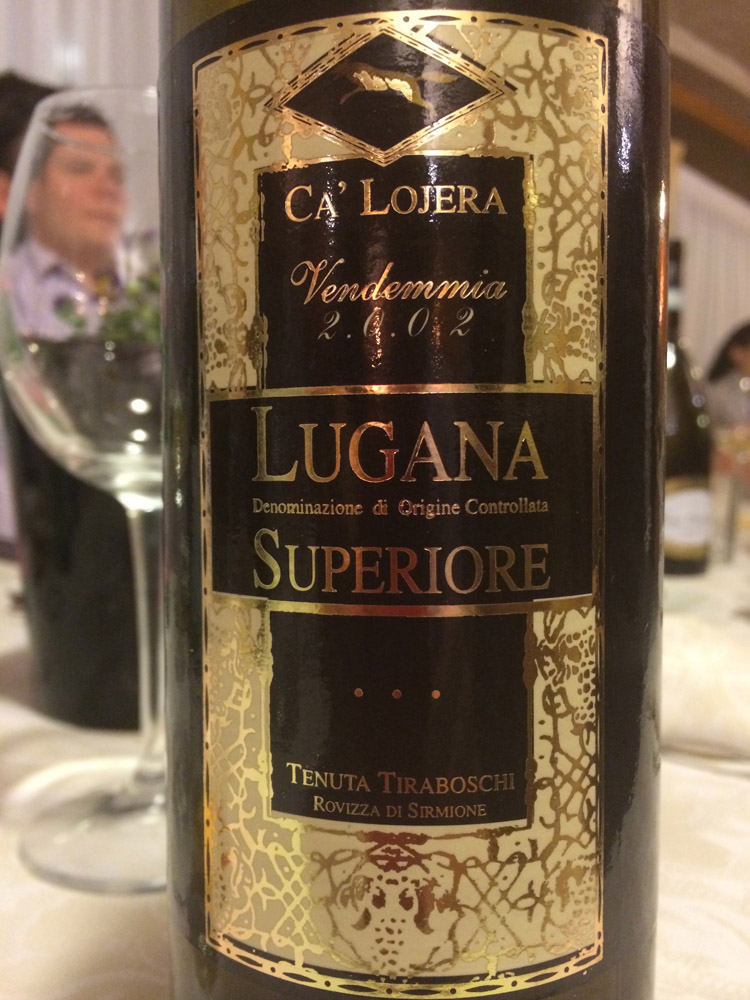
A well-kept 2002 Lugana Superiore from Ca’ Lojera
It came on my first night of a too-quick tour of the Lugana DOC , which lies at the southern end of Lake Garda and roughly midway between Brescia and Verona. The DOC was one of the first such designations (1967) in Italy and today remains one of the smallest DOCs, according to the Lugana Consorzio, which actively promotes and protects the uniqueness of this wine.
Our group, led by Francesca Goffi of the Lugana Consorzio, was welcomed at Ca’ Lojera by Ambra Tiraboschi, historian, delightful hostess and wife of winemaker Franco Tiraboschi. She poured us several iterations of Lugana, including their top-tier Riserva Lugana del Lupo, all made from the Turbiana grape. Once known at Trebbiano di Lugana, the local consorzio changed the name of the grape to the local name “Turbiana” to differentiate the Lugana wine from Trebbiano di Soave, Trebbiano d’Abruzzo and the other numerous Trebbiano wines grown in 80 of the country’s wine regions.
According to Ambra, the winery’s name (Ca’ Lojera translates to House of the Wolves) is drawn from the days centuries ago when bandits (pirates) from up north would slip down to the south end of Lago del Garda and hide their contraband in local warehouses, including one that sits a few yards from the modern Ca’ Lojera winery.
According to local lore, the hideouts were guarded by wolves (lupo in Italian). The only wolf we saw was on the label, while the wine inside was all bright fruit and good acidity, with hints of green apple, spice and the characteristic minerality for which Lugana DOC wines are famed.
This 2002 Lugana Superiore was particularly enticing, not only because it’s commonly held that Trebbiano/Turbiana wines won’t age but also because this wine had held its years beautifully, the past 12 years adding a gold color and a hint of almonds or hazelnuts to the finish.
Ca’ Lojera wines are imported by Worldwine Cellars (Fridaly, Minn.), Wine House Ltd. (San Francisco) and others.
 Wine Openers