Archive
Wineries shine like gold during Governor’s Cup competition
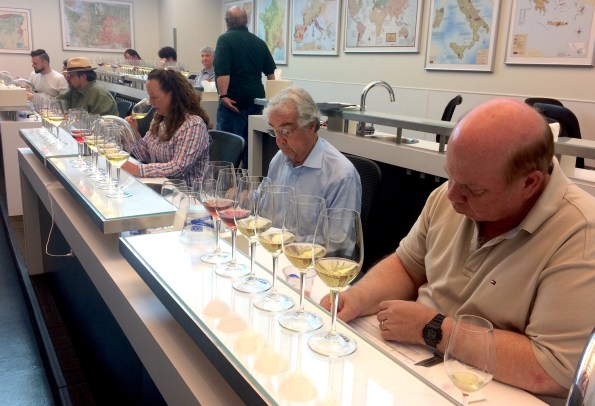
Judges at the 2017 Colorado Governor’s Cup Wine Competition swirled, sniffed and sipped through 346 wines during the two-day event. Among the judges pictured are, from left, Jenni Baldwin-Eaton (plaid shirt), Warren Winiarski and Wayne Belding, closest to camera. Story/photo by Dave Buchanan
The 2017 Colorado Governor’s Cup Wine Competition came and went over the weekend and of the 12 wines selected for the Governor’s Case were two white wines (including a sparkling Albariño), seven red wines, one fruit wine, one cider and a mead.
The Best of Show wine will be announced Aug. 3 when all the medal winners are celebrated at the official Colorado Governor’s Cup Tasting held at History Colorado Center, 1200 Broadway in Denver. Information here.
This year’s judging featured 324 wines from 46 wineries, a welcome jump of about 25 percent over last year in both categories but still well short of where the competition could be. Colorado now has close to 150 wineries, so less than a third of them take part in the contest.
Wineries offer many reasons for not entering this and other competitions, like they simply forget to send their applications in time or it costs too much or they don’t have the wine to spare. But just as Colorado Mountain Winefest brings Colorado wines to a diverse audience, in the end the Governor’s Cup contest is a boon to the state industry.
The 12 selected wines in the Governor’s Cup case are used to promoted Colorado and Colorado wines and are featured at state dinners and marketing events.
It’s notable to add that this year’s entries in the cider/mead category also eclipsed last year, indicating the continued growth of artisanal ciders and meads. Well, ciders, anyway.
Four ciders and three meads were selected for the final round of judging, which again raised the familiar argument of whether there should be a separate competition for the non-grape segment of the wine industry. You can argue all you want as to whether ciders and meads actually are wines or should be in their own category but you’ll get no take from this side.
Last year there was a separate six-pack case of ciders and meads selected to accompany the regular Governor’s Cup case but this year it will be a mixed case. There was some discussion about separating the judging (that’s been tried in the past with fruit wines) and having separate Best of Show awards and Governor’s Cup cases for grape wines and for cider and mead. The problem is that separation adds to the cost of the competition.
The Governor’s Cup case wines (and their respective medals) includes: Bookcliff Vineyards (2016 Riesling, double gold); Carlson Vineyards (2015 Tyrannosaurous Red, gold); Colorado Cellars/Rocky Mountain Vineyards (nv Raspberry, double gold); Colorado Cider Company (Grasshop-ah cider), double gold); Creekside Cellars (2014 Cabernet Franc, double gold); and Guy Drew Vineyards (2015 Syrah, double gold).
Also: Meadery of the Rockies (Strawberry/Honey, gold); The Infinite Monkey Theorem (2013 Albariño (sparkling), double gold); Two Rivers Winery (2013 Port, double gold); Decadent Saint the Winery (2013 Cabernet Sauvignon Reserve, gold); Whitewater Hill Vineyards (2016 Sweetheart Red, double gold) and Winery at Hold Cross Abbey (2015, Merlot, gold). The final medal total was eight double gold medals, 16 gold medals, 140 silver and 103 bronze, totally 267 medals out of the 346 entries.
Nothing wrong with Napa Valley Cabernet Sauvignon, except the price
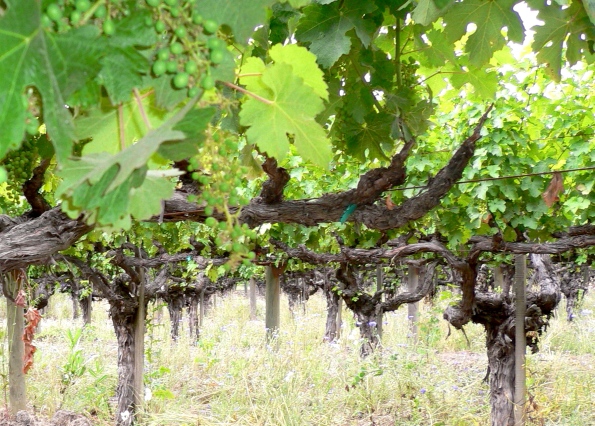
(Photo courtesy Creative Commons)
Cabernet Sauvignon vineyards in Napa Valley command upwards of $300,00 per acre, especially when it means old vines, such as these at Chateau Montelena near Calistoga, Cal. High land prices is just one reason ultra-premium wines command premium prices.
The last time I encountered Rick Rozelle he was working the wine aisles at Fisher’s Liquor Barn in Grand Junction. The meeting wasn’t completely surprising since that’s where I usually find him, dispensing knowledge and turning on clients to good buys in wines.
This time he was doing something I’d heard him do before but always enjoy hearing – talking a customer out of a pricey top-shelf wine in favor of purchasing something more affordable yet just as tasty.
Once the client left, bottle in hand and smile on face, Rick and I spent a few minutes talking and he noted how many people look first to the top shelf, where you find the Screaming Eagles and Opus Ones of the wine world, as the starting point for what’s out there.
Nothing wrong with that, except that both those ultra-premium cabs will put a big dent in your bank account. On the online wine-searcher.com, a 2013 Opus One averages about $150 a bottle, “and you can get a whole lot of great wines for much less,” laughed Rozelle.
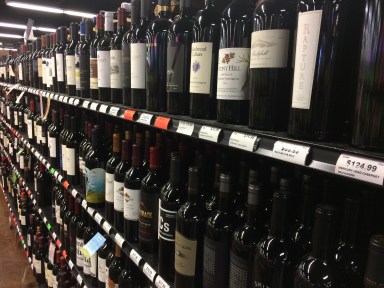
Finding the right Cabernet Sauvignon (or any wine) at just the right price often entails searching through a wall of wine. Photo by Dave Buchanan
On the whole, I consider most those upper-shelf Cabs over-priced, although that’s subjective to what you have in your pocket at the time, right?
“We’ve had people buy cases of it for weddings and stuff, so it’s not like it doesn’t sell,” Rozelle noted.
Cabernet Sauvignon remains “America’s most beloved red wine,” wrote Food & Wines eminent wine writer Ray Isle way back in 2005. “In 2009, California crushed almost 450,000 tons of Cabernet grapes, an amount roughly equal to one bottle per person for the entire U.S. population.”
One reason Cabernet Sauvignon still is so popular (it’s the second most-sold wine, period, right behind Chardonnay) is that among those millions of bottles are many selling for under $10, although you won’t find many really good California Cabs at that price.
You might find something from my colleague Jeff Siegel (www.winecurmudgeon.com) , who puts the cut-off line around $10 but has been known to inflate that number a bit when the wine is particularly good.
“Listen, it’s not easy finding cheap Cabernet Sauvignon that tastes like Cabernet Sauvignon,” said Siegel during the 2016 Colorado Governor’s Wine Competition for which he was a judge. “If there were, I’d drink more of it.”
He earlier wrote about Avalon Cabernet Sauvignon, which he described as offering the quality of Napa cabernet “at two-thirds to three-quarters of the price of comparable wines.”
The grapes aren’t Napa – they come from Lodi, Paso Robles, and Monterey County. Which is why Fisher’s Liquor Barn carries the 2014 vintage for under $10.
Siegel, who will return to Denver next month for the 2017 edition of the Governor’s Cup, wrote in a recent blog post that too many “value priced” Cabernets “are fruity and sticky, without the heft and tannins that cabernet is supposed to have— call them cabernet lite.”
“Or, if they taste like cabernet, they cost at least $20, and that’s not the point of what we do here,” Siegel wrote.
Why are Napa Cabernets so good, a fact that helps even inexpensive Cabernets from elsewhere succeed?
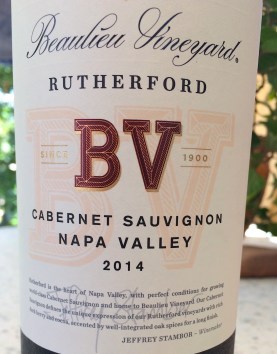
Some of the world’s best and most-desired Cabernet Sauvignon comes from Napa Valley. This Beaulieu Vineyard 2014 Napa Valley Cabernet Sauvignon is a value and can be found for as low as $25. Photo by Dave Buchanan
Simply, Napa Valley has the perfect climate and soils for growing the grape. But Napa Cabernet Sauvignon grapes are the highest-priced grapes in California, which means along with accelerating land costs ($300k-plus per acre), the price of a bottle of wine continues to grow.
Mike Fisher, on the blog Vinsights, wrote that grape costs should not exceed 25-percent of a wine’s selling price for a winery to experience a “reasonable profit.”
Because Napa grape costs are the highest in California, Fischer noted, virtually all red wine made with Napa grapes must be retail priced at $40 or more per bottle for the winery to receive a reasonable profit.
But wait. There are a lot of grapes being grown outside of Napa, and that’s where we should look for affordable Cabernet Sauvignon.
Paso Robles, Lodi, Monterrey, Central Coast, the list goes on of places where Cabernet Sauvignon thrives. And that’s just in California.
What about Washington, Chile and Italy?
Cheaper land plus cheaper grapes equal affordable and delicious California and California-quality Cabernet Sauvignon.
And if that’s not enough, Wines&Vines online recently quoted Tony Correia, a real estate appraiser and consultant from Sonoma, Cal., saying, “Any land that’s in Napa Valley, in the watershed of the Napa River, that can be planted to Cabernet and produce a good crop of Cabernet is being planted today, and they can make a call and sell the fruit for $5,000, $6,000 $7,000” per ton.
That’s about 3.5 times what those grapes cost in 1995, when the average price per ton was $2,000.
One more thing. One reason some of the ultras are so ultra is cachet. People want to feel important and have other people say nice things about them and one way to impress is to pour a wine everyone knows cost a king’s ransom.
“But that’s not what we’re here for,” to repeat Siegel’s riposte.
A weekend of events just of you
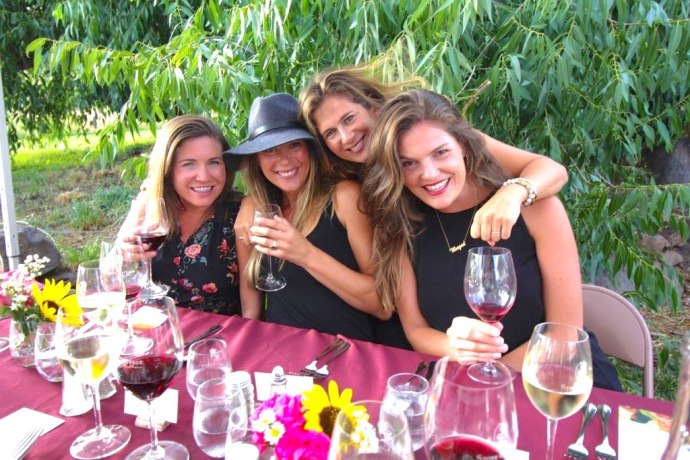
Become one of Stone Cottage Cellars’ happy fans during this weekend’s North Fork Uncorked events. Photo courtesy of Stone Cottage Cellars.
Don’t say there’s nothing to do as spring makes way for summer.
Colorado wine country (the West Elks American Viticultural Area and the Grand Valley AVA) is celebrating the last weekend of spring (it’s also Father’s Day weekend, just sayin’) with events from book releases to special dinners and barrel tastings to wagon rides and more barrel tastings.
Friday (June 16): Author Christina Holbrook and photographer Marc Hoberman officially launch their book Winelands of Colorado from 4-6 p.m. at the Wine County Inn in Palisade. More on this and related events (fees may be charged for some events): peak1studio@gmail.com.
Saturday: Winemaker Garrett Portra of Carlson’s Vineyards releases his new River’s Edge wine at the Colorado Canyons Association’s fourth annual Crazy About Canyons fundraiser at the winery. Tickets are $75 per person and includes a picnic barbecue buffet, silent auction and special presentation by Peter Jouflas in honor of his father Chris Jouflas, who ranched in what now is McInnis Canyons NCA. Information: www.coloradocanyonsassociation.org.
Saturday/Sunday (June 17-18): The West Elks AVA celebrates North Fork Uncorked and Father’s Day Weekend in fitting style with open houses and special events at nine North Fork Valley wineries. Vineyard tours, wine tastings, and other happenings. Phone numbers (all 970 area codes) follow:
Saturday: Delicious Orchards barbecue and live music, 527-1110; Black Bridge Winery barrel tasting and tractor-pulled wagon rides, 527-6838; Stone Cottage Cellars dinner with the winemaker ($80 per person) plus live music, 527-3444.
Sunday: Brunch by Pam Petersen (live music by David Sheppard), 527-3269; Azura Cellars R/C yacht racing, 390-4251; Black Bridge Winery, barrel tastings, wagon rides, 527-6838.
Participating wineries in addition to those listed above include: 5680’, 527-6476; Leroux Creek Vineyards 872-4746; Mesa Winds Farm & Winery 250-4788; and North Fork Cellars at Delicious Orchards 527-1110.
A short history of how Chardonnay became America’s No. 1 white wine

Chardonnay is the world’s fifth-most planted grape but it still needs some attention. Here, winemaker Nancy Janes of Whitewater Hill Vineyards near Grand Junction, Co., checks on some new buds following a light frost.
Chardonnay has been part of American winemaking since at least 1882, when Charles Wetmore planted the vine in his vineyard in Livermore Valley east of San Francisco.
Other plantings followed and in 1912 Ernest Wente, son of C.H. Wente, founder of the winery of the same name in Livermore Valley, convinced his father to import some Chardonnay cuttings from Montpellier University in France.
Carl Wente also brought in some cuttings from the historic Gier Vineyard in Pleasanton, Cal., and gradually Wente developed his own clones.
Today, there are nearly 100,000 acres of Chardonnay planted in California and it’s estimated 80 percent of those vines are the Wente clone.
Wente also bottled the first labeled Chardonnay in 1936, and today Wente, in its fifth generation of family winemakers, bills itself as “The First Family of Chardonnay.”
In the 1970s, thanks to America’s growing interest in wine, especially a food-friendly wine that’s also a superb cocktail wine, and one whose name offered a bit of cachet to a novice wine-drinker’s vocabulary, Chardonnay rapidly became, and still is, America’s No. 1 white wine.
Popularity means more production and as production increased, overall quality suffered.
Chardonnay is a fairly neutral grape and a winemaker can affect the final result without too much effort.

‘No Oak’ Chardonnay gained popularity after a consumer backlash over winemakers using too much oak to flavor their wines.
Some winemakers, preferring to let their vineyards and the grape show themselves without added influences, use non-reactive stainless-steel tanks for fermenting and aging to get the purest expression of the grape itself (call this the French or Burgundian style).
However, like a lot of grapes, Chardonnay also reacts well to aging in oak barrels (mainly French, American or Hungarian). However, too much oak can be deleterious.
A subtle touch of oak (with hints of vanilla, spice, caramel) can highlight Chardonnay’s natural flavors. But too much oak can overwhelm and instead of Chardonnay it tastes like crème brule.
And, of course, some winemakers tried to disguise poor winemaking by adding a lot of oak, sometimes foregoing barrels in favor of oak staves or chips.
“Winemakers must have figured that if a little oak was good, a lot must be even better,” said winemaker Nancy Janes at Whitewater Hill Vineyards and Winery on Orchard Mesa in western Colorado. “Luckily, that stopped.”
Following the inevitable backlash, including a widespread consumer revolt known as ABC (Anything But Chardonnay), winemakers have come back to a more-balanced use of oak.
Today many wineries offer both oak and no-oak choices.
“I’m seeing some consumers going back to a more-oaky style,” said Janes, who was one of the first in the Grand Valley to offer a no-oak Chardonnay. “Not the level of 15 years ago but more of a light oak touch.”
She offers both a no-oak style and a lightly oaked Reserve Chardonnay, the latter rapidly becoming one of her more-popular wines.
Wente also offers a selection of oak and no-oak Chardonnays, including Eric’s Chardonnay, a special, artisan-style Small Lot offering “preserving the delicate flavors of the fruit” and “expression of the vineyard terroir,” said fifth-generation winemaker Karl Wente.
Kissing frogs: Finding the right Chardonnay for you
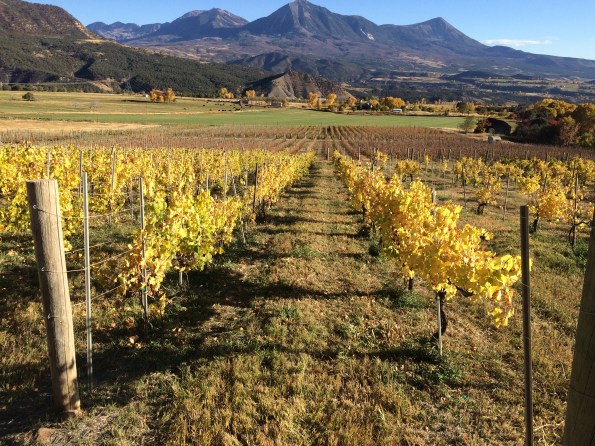
Chardonnay vines after the 2016 harvest in Colorado wine country. Chardonnay grows well in many different regions and can be adapted to many different styles.
As the Colorado summer approaches (albeit hesitantly at times), and with it the seasonal change in our dining and drinking habits, wine drinkers find themselves lured more and more to a glass of chilled white wine.
Reds are fine for winter and for those moments when the barbecue is turning out well-charred slabs of meat, but the lighter fare of warm-weather meals calls for a well-chilled (not too chilled) white wine.
Consumers have many choices in white wine and while some varieties such as Pinot Grigio, Sauvignon Blanc and Viognier will always have their time in the sun, data reveals Chardonnay remains the favorite white wine of the American wine consumer.
A recent email from New York-based Nike Communications said a 2016 survey of consumer habits revealed 42 percent of U.S. white-wine drinkers said they prefer Chardonnay.
Chardonnay sales in the U.S. in 2016 totaled almost $2 billion dollars, representing nearly 20 percent of all wine sales, amounting to more than 58 million gallons of Chardonnay, enough to fill more than 80 Olympic-sized swimming pools.
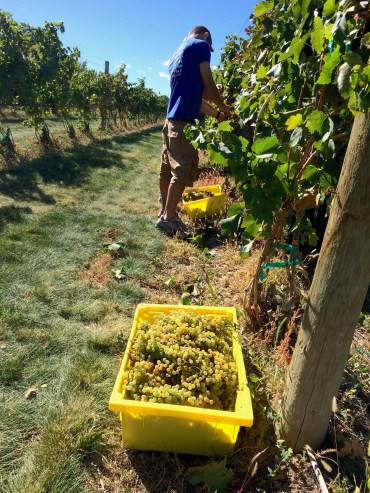
Finishing the 2016 Chardonnay harvest in Colorado’s Grand Valley AVA.
So popular is Chardonnay it even has its own holiday, which you might have missed. National Chardonnay Day (May 25) may or may not entitle you to a long weekend but it certainly opens the door for a glass of wine.
Chardonnay’s popularity isn’t surprising, since Chardonnay comes in many styles, is widely available and generally affordable, and is easy to pronounce.
The latter isn’t just a punch line. Most people won’t order something you can’t pronounce, a fact noted by the late Robert Mondavi who in 1968 introduced his drier (less-sweet) version of Sauvignon Blanc by, at least in some versions of this story, changing the name to Fumé Blanc. This not only was in deference to the popular dry Loire Valley wines made from Sauvignon Blanc but also in hopes people could pronounce Fumé Blanc.
The U.S. remains a #Chardonnation, as the people at Nike Communications like to put it, and according to some Nielsen data, is America’s most-asked for wine variety, followed by Cabernet Sauvignon, Pinot Grigio, Merlot, and Pinot Noir.
Why? Because people like the way Chardonnay tastes.
“I love this grape, it’s such a nice food wine,” said winemaker Nancy Janes at Whitewater Hill Vineyard on Orchard Mesa. “It’s sometimes hard for me to pin down the complexity of Chardonnay but it’s so food friendly.”
Riesling may be known as the world’s most-transparent grape because it shows its place of origin so clearly, but Chardonnay may well be the most-neutral and the grape winemakers love most to work with.
It grows almost everywhere and can be adapted to nearly any style, from lean and crisp to buttery and round, heavily fermented in oak barrel or completely non-oaked in stainless steel.
Chardonnay, by its nature, benefits from the judicious use of oak but by that very mutability led to a downturn in Chardonnay’s popularity when a consumer backlash against the increasing use of oak and oak flavorings (some fad, some to cover sins in winemaking) brought on a consumer backlash in the ABC (Anything But Chardonnay) movement.
Recently, however, the general movement in winemaking is back toward using oak as a highlight, not the feature, although there still are many people who want a mouth-filling, buttery Chardonnay.
It’s been said you have to kiss a lot of frogs to find a prince or princess, and the same might be said of Chardonnay. It takes some research (tough, but someone has to do it) to find the right Chardonnay for you, but given its abundance and popularity, the field work will be rewarding by itself.
On the heels of an early spring, winter makes a comeback

The cloudy precursors of this week’s cold snap loom over young Glera grapes in the Prosecco DOC. – Dave Buchanan
As I was boarding a plane Wednesday morning at the Verona airport, I turned to look to the north.
A fierce, cold wind whipped the open tarmac and a line of clouds boiled over the Alps, harbingers of the storm to come.
“It looks bad,” said a fellow passenger, with whom I had been talking earlier in the airport. He eyed the massive front moving south over the land. “It might be a bad night for winemakers.”
And indeed it was. As Jeremy Parzens reported Friday in his blog, newspapers across northern Italy are reporting temperatures Thursday night reaching well below zero (C) and fears of widespread damage to grapes, tomatoes, asparagus and other agricultural products.
The cold arrived after days of springlike weather and is feared to have devastating affects on the economy, although it’s still a bit early to tell how great.
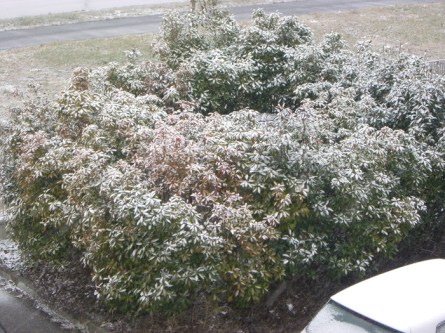
More than 3 million tomato seedlings and 450 hectares of vineyards were damaged by Thursday’s frost in Emilia-Romagna. Photo by ANSA
In Valdobiaddene, famed for its Prosecco DOCG, growers woke Thursday to frost on the Glera vines after temperatures dropped to 1 below zero. And another frost is expected for tonight (Friday, April 22). This after what had been an early start to the growing season and lots of tender new shoots on the vines.
Other fruit growers (the area produces apricots and kiwi, among other crops) also expect to see damage to their young fruit.
“The weather this year is scary,”‘ said Stefania Kofler, chairman of the fruit growing sector of Confagricoltura Treviso.
Il Gazettino in Pordenone reported that additional damage could put the local “viticulture and fruit cultivation on its knees.” The reporter, David Lisette, noted that this isn’t the region’s first experience with late spring frosts, but other stories said the occurrent of events is increasing.
Lisette cites a statement from Coldiretti, the agricultural federation of Emilia-Romagna, where temperatures fell to 3 degrees below zero (27 F), which said the sudden swings in temperatures, and recent “heavy impacts on agriculture” including “the rapid transition from drought to flood, short and violent rainfall accompanied by hail and (f)rost” is part of the changing climate occurring across Italy.
And ANSA, the Italian version of our Associated Press, said such climate impacts have resulted in a loss of 1.billion (euros) in agricultural products over the past 10 years. The story was accompanied by the photo shown here, of a well-frosted tomato plant.
A natural desire for better wine offers choices for the consumer
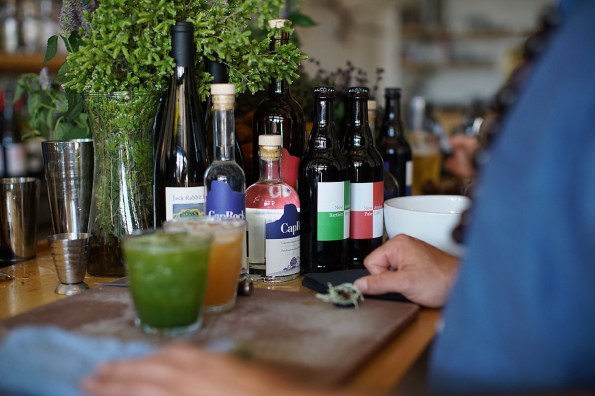
A sampling of the selection of organic, natural wines, spirits and ciders available from Lance and Anna Hanson of Jack Rabbit Hill Farm on Redlands Mesa. The Hanson’s products will be featured during Colorado Natural Wine Week, April 17-22. Photo courtesy of Lance Hanson
Cerea, Italy – I knew I was in for a winetasting like no other when I turned to my host for a translation and he winked knowingly.
“Think Topo Gigio,” he said with a Cheshire’s grin.
Topo Gigio? That big-eared Italian TV-star mouse from the 1960s and ‘70s?
“You mean, she said ‘mousey’?” I offered, and he nodded.
“You never know what you’ll get with a natural wine,” he said with a delighted grin.
We were in the renovated furniture factory-turned expo space in the village of Cerea, Italy,

The initial approach to a natural wine is one of investigation and personal definition. What makes a natural wine different and what am I looking for in a wine? Photo courtesy of ViniVeri
about 30 minutes south of Verona, attending Day 2 of ViniVeri 2016. This wine fair is devoted solely to natural wines, those made through organic or biodynamic farming and without the interventionist methods of conventional wines.
There were about 300 other natural wine lovers wandering the space, talking to 100 or so producers, representatives and distributors, and sharing thoughts on what may happen when a winemaker lets nature run its course in the winery.
The answer, of course, is as subjective as all wine preferences tend to be. There are no international standards as to what an organic or natural wine can be, although at the least they are organically grown, hand-harvested and made with minimal human intervention.
I sought out Lance Hanson, co-owner, along with wife Anna, of Jack Rabbit Hill Farm on Redlands Mesa near Hotchkiss, Colorado. Hanson makes true-to-the-essence wines, spirits and ciders, all using local, organically grown fruit and fermented and distilled in a natural manner.
“We had this idea of making place-driven or terroir driven wines inspired by the organic growers in this area,” said Hanson, whose organic farm was certified biodynamic in 2008 by Demeter USA. “It was that (certification) experience that introduced us to the idea of really making and producing wine in the same way we farm: Low-input, very light handling, non-interventionist.”
One standard for a natural wine is that either biodynamic or organic farming techniques must be used.
Most important, however, is the lack of additives, something most people notice the first time they taste a natural wine.
Those missing the additives are what “hide or mask the character of the wine,” Hanson said. “It’s our opportunity to take advantage of the unique character of the fruit grown here and create a unique product.”

The wines of Paolo Bea of Montefalco in Italy’s Umbria region were among those featured at ViniVeri 2016. Bea is one of that country’s quintessential artisanal wine producers. Photo: Dave Buchanan
One winemaker I spoke with at ViniVeri said he was at first put off by the strange flavors in his mouth but then realized he was, for the first time, actually tasting the wine itself.
“Now, I can’t drink a commercial wine,” he said.
No commercial yeasts, no chemicals, no enzymes or flavorings, no Mega Purple to make it darker or reverse osmosis or cryoextraction to make it sweeter or more-concentrated, all of which are common in conventional wines. This is low intervention, hands-off winemaking.
Jeff Gordinier last year said in an article in the New York Times that “when you leave additives out, that means anything goes, with flavors that can be all over the map.”
That unrestrained latitude is one of the attractions of natural wines and one of the reasons natural wines lovers, well, love natural wines. You must have a sense of adventure and willingly check your prior attitudes regarding fermented grape juice at the door before entering.
Was our “mousey” wine bad, in the sense of being “off”? Not necessarily. It wasn’t undrinkable, just unexpected.
But none of the 100 or so natural and organic wines we tasted over two days were like anything I’ve ever had. Most were intriguing, beguiling, mysterious, deserving of more than a quick swirl, sip and dump before moving on to the next.
“That exactly it,” Hanson said when quizzed. “How do I let the fruit express itself in a bottle of wine without getting in its way? That’s what natural winemaking is all about.”
Which is where Colorado Natural Wine Week, set for the Denver/Boulder area on April 17-22, comes in.
You can spend the week days attending seminars by and about winemaker and numerous in-store tastings and extend your nights with wine-bar takeovers and special dinners with selected winemakers. Restaurants in both cities will offer Natural Wine Week specials.
The main event is the public Grand Showcase from 4:30-8:30 p.m. on April 19 at the Space Gallery, 400 So. Santa Fe in Denver. Tickets are $39/$75 and are available online at coloradonaturalwineweek.org.
And if you’re in Italy in early April, ViniVeri 2017 takes place April 7-9, again in Cerea.
The demand for natural wines is growing, albeit with growing pains including a pushback from conventional and commercial wineries. Maybe it’s a sign of the maturation of the American wine palate that drinkers are willing to explore beyond their comfort zone, to allow themselves some freedom of expression in their glass.
One can hope.
Wine, starting at the ground up
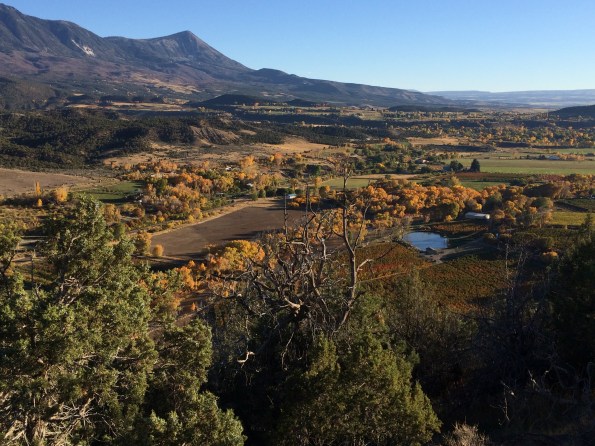
The view across the North Fork Valley is one of diverse terrors, all producing a sense of place in the agriculture and people of the region.
One of the most-revealing ways to visit a winery is to walk its vineyards. This long has been popular as a way to get close to the very land that grows the grapes. You may smell, touch and even taste what it is winemakers are talking about when promoting the importance of terroir, “minerality”, and the like.
The concept of “terroir” can encompass many variants but it has been best served by several writers as the “somewhereness” of a wine, meaning the sum of those factors contributing to a sense of place from which a wine comes.
I’ve spent hours in vineyards with grape growers explaining the differences in soil texture, color and mineral/chemical content and then retiring to tasting rooms where all the strands converge and are revealed in the glass.
If, as it often is, the grape grower and the winemakers are the same person (or work closely together), the message you received in the vineyards is the same message speaking to you from the glass.
However, with the recent discovery of the vine-devastating phylloxera louse in Colorado’s vineyards, the opportunity is gone to walk vineyards (the louse can spread from one vineyard to another by the soil on your shoes) but you still you can look from a distance and, of course, talk to the winemakers about the most-basic of the tools they work with.
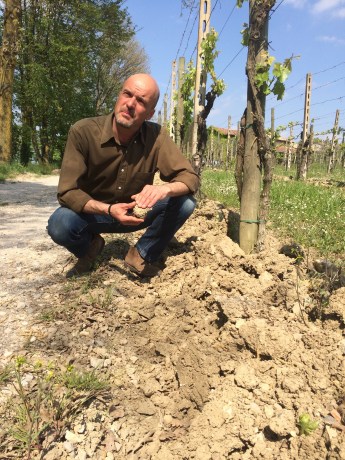
Luca Formentini of Podere Selva Capuzza in Brescia, Italy, explains to visitors the importance of the soil to his wines.
While the type and condition of the soil is a common topic of discussion in other winemaking regions, I’ve rarely heard the topic presented in Colorado tasting rooms. Maybe the hosts and hostesses just don’t get asked, or maybe there’s a feeling that the audiences may quickly go glassy-eyed at the very mention of soil chemistry.
And, indeed, some wine critics are skeptical of the concept of terroir or that a vine’s roots can absorb and transfer flavor-enhancing compounds from the soil to the roots.
There’s an interesting article (at least to the stone-suckers among us) about the role of soil to terroir and wine flavors on the wineanorak.com site. The New York Times’ wine critic Eric Asimov recently wrote about the “many variables” that go into “making a wine from a particular place can often be overwhelmed by grape-growing and winemaking decisions.”
This, he argues, loses the “intricacies of terroir” that one finds in wines from, say, Burgundy where that expression “has been raised to a high art.”
He does emphasize, terroir not withstanding, that “the human element” remains uppermost in winemaking. A talented winemaker (the human element) can make good wines no matter where the grapes come from, that’s a given. And that same winemaker learns to use the flavors of the terroir to the wine’s best advantage.
Now let’s return to Colorado wines. I’m often asked (it’s the nature of the job) for my favorite Colorado wine and over the years I’ve discovered there isn’t one, only favorite winemakers.
I’m a firm believer in the role of terroir (I wrote about it here) and this valley and the North Fork Valley have immense ranges of terroir. The Grand Valley has sandy terraces on the west and heavy clay soils on the east, with a few ancient riverbeds, floodplains and long-dry lakebeds thrown in.
The most-obvious example might be in the North Fork, where the Gunnison River divides the landscape into distinct geological regions, volcanic on one side, lots of Mancos Shale across the river, and the wines reflect those differences.
The wines might not taste exactly alike, depending on their origin (part of the terroir). Even grapes from within the same vineyard can taste differently, which is what French winemakers learned centuries ago.
You can test this: Find a winery that makes estate-grown wines and also makes wines from purchased grapes and see if you can distinguish place-of-origin (estate grown) vs. winemaker’s touch theory.
It’s certainly not a bad thing that the human element has a determining role in a wine’s finished product, and you may find it’s not the place or the grape but the winemaker that lifts your spirits.
– Story and photos by Dave Buchanan
Awaiting the return of winter
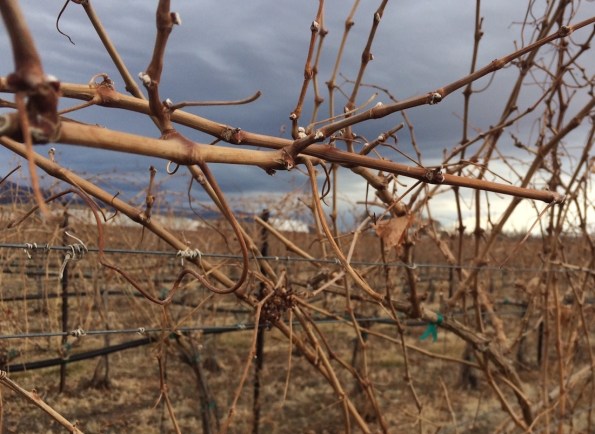
Grape vines on East Orchard Mesa haven’t yet responded to recent warm temperatures and growers are hoping for a return of cold weather to delay bud break.
On an overcast February afternoon, winemaker Bennett Price walked away from a barrel of wine he was readying to bottle and headed outside, to a fence near his DeBeque Canyon Winery where clusters of very dry grapes were shifting nervously in the breeze.
“These are Pinot Noir,” he said, reaching under the bird-proof netting drawn over the vines. “They were pretty good grapes, too, but they came on real early last spring, too early really to do anything with.”
On the third consecutive day of 60-degree plus highs, in what’s suddenly behaving as if it were the northern extension of the Colorado Banana Belt, one can be forgiven if the weather has you thinking more of mid-spring rather than mid-winter. While the sides of nearby mountains still wear thick blankets of snow, there hasn’t been any snow, or any moisture of any kind, in the lower valleys for several weeks.
Instead, here at 4,200 feet, plenty high enough for winter to return for another month or two, birds are building nests, golfers are swinging away and winter-dormant lawns are starting to green.
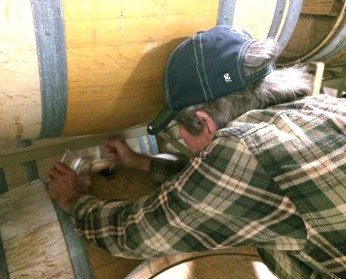
Bennet Price of DeBeque Canyon Winery in Palisade reaches for a sample of wine.
“I think we’re going to have an early bud break,” Price said. The unseasonal temperatures “warm up the soil too much and that stimulates the roots to start pushing.”
The temperatures, while warmer than normal – unless this is the new normal – still haven’t been consistently high enough to break the vines’ winter dormancy. It takes 50 degrees to see the return of spring, said state viticulturist Horst Caspari.
“And that’s on a 24-hour cycle, not just a quick jump up and then back to below freezing,” he said. “We’re still getting enough diurnal variation that nothing’s broken yet.”
Yet Bennet Price isn’t convinced after hearing a weather forecast calling for cooler temperatures followed by more warm days.
“We were up to 60-something yesterday and our low was 46 or something like that and today it’s back up there again,” he said. If the vines do respond to the warmth, “hopefully we won’t go back down to the low 20s or teens because you can start damaging the canes and trunks because the sap’s coming up.”
Tree-fruit growers are extremely wary of such mid-February warm spells because their trees are close enough to bud break that prolonged mild weather can bring early and unwanted development. Climate change hasn’t yet brought Western Colorado to where a heavy spring frost is out of the question.
Grapes, however, come on several weeks later than cherries, peaches and apples, which gives a bit of leeway and enough time for the weather to back to cold.
“But he’s right, the ground is being warmed up,” agreed grape grower Neil Guard at Avant Winery on East Orchard Mesa. “And look, it’s dry, there’s no snow at all. Which means if it stays warm, the vines are going to need water and we can’t get any irrigation water until April 1.”
Should the vines suffer freeze injuries, they then are susceptible to a bacterial infection called crown gall, which can eventually kill the vine.
Crown gall, caused by a bacterium that lives in the soil, also can result from mechanical injuries caused by normal vineyard maintenance such as pruning, grafting and training vines.
“I’m working in some vineyards and I have to go through and mark the vines with crown gall so they don’t prune that vine,” Price said. “You don’t want to prune that vine because if you prune it and then go to the next vine, you’re going to pass that bacterium to the next vine.”
He said the only way to treat crown gall is to pull and burn the vine and replant.
“It’s just another thing to think about if you’re planning on owning a vineyard,” Guard said, with a laugh.
– Photos, story by Dave Buchanan
Nature’s role in winemaking takes on added significance

Firefighters watch as flames scorch Chile’s vineyards. Photo – Juan Gonzale/Reuters
2016 may go down as the year Nature caught up with the wine business.
Fires, freezes and bouts of hail were among the changes brought to the world’s wine industry and the people who work there.
Foremost, of course, was Chile, which suffered what Chilean President Michelle Bachelet called “the greatest forest disaster in our history.”
More than 135 wildfires burned an estimated 1 million acres (404,685 hectares) of land, nearly four times the size of New York City, including more than 100 vineyards in the wine-producing region of Maule in Chile’s Central Valley, that country’s top wine-producing region.
Chile is the world’s fifth-largest wine-producing country and in 2015 exported to the U.S. alone more than $1.9 million worth of wine, according to the USDA’s Foreign Agricultural Service.
While forest fires are accepted part of Chile’s hot, dry summers, this year has been especially difficult, said NPR’s Phillip Reeves.
“These (fires) have taken on disastrous proportions, thanks to prolonged drought, strong winds and unusually hot weather,” Reeves said.
The wildfires destroyed towns, forests, plantations and vineyards and killed at least 11 people in Central and Southern Chile, several news reported.
Firefighters in Maule reported temperatures reaching over 100-degrees C (212 F), leaving homes without power after their cables melted. Three firefighters lost their lives while battling the flames.
Sergio Amigo Quevedo, winemaker at Cancha Alegre in the Maule region, lost six hectares of old vines to the fires.
“It’s hard to believe that vines you’ve taken care of with such love and sacrifice are lost along with part of the viticultural patrimony of Chile, because of a voracious fire caused by careless men,” he told Decanter.com.
Diego Morales of Bisogno Wines lost 25 hectares of 150-year-old País vines, having tried to fight the fire with his family.
Carlos Gálvez of Bisogno Wines said in an interview with The Washington Post, that unless his vines recover next season, he will lose half its wine production.The winery’s blog posted a video showing a hellish landscape of fire-destroyed vines.
“The fires destroyed our vines but not our dreams,” Gálvez said. “This is a low-income region, and many live off the vineyards. There are some who have lost everything.”
The fires are thought to have been started by arson.
There also were fires in South Africa, where up to 40 percent of the 300-year old Vergelen wine estate was destroyed; in California’s Lake County where an arson-caused fire razed 1,600 heroes (about 4,000 acres) including the Tuscan Village winery and community complex; and in France’s Languedoc-Rousillon more than 1,200 hectares were burned.
It was reported wild boars caught on fire and then ran, spreading the flames through the vineyards and forests.
The fires came only a few months after the Languedoc area received a deluge of hailstoms that damaged up to 60 percent of the 2016 grape crop, said Decanter Magazine.
Similarly, Chablis suffered two bouts of hail and an unseasonal frost reduced the forecast size of the harvest in Burgundy, Loire and Champagne.
 Wine Openers