Archive
2012 grape harvest begins with Colorado Mountain Winefest on tap
PALISADE – Say it quickly enough and “wine harvest” and “Winefest” sound similar, but looking around the valley as the 2012 grape harvest gains steam, one notices more work, less fest when it comes to turning grapes into wine.
Hand-picking grapes in the early light leads to long, hot days where endless lugs of plump berries are dumped into that seemingly bottomless destemmer and raucous pumps force crushed grapes through pulsing, boa-sized hoses to the immense tanks where the must (the grapes, skins and seed) will sit while the juice picks up color, structure and flavors.
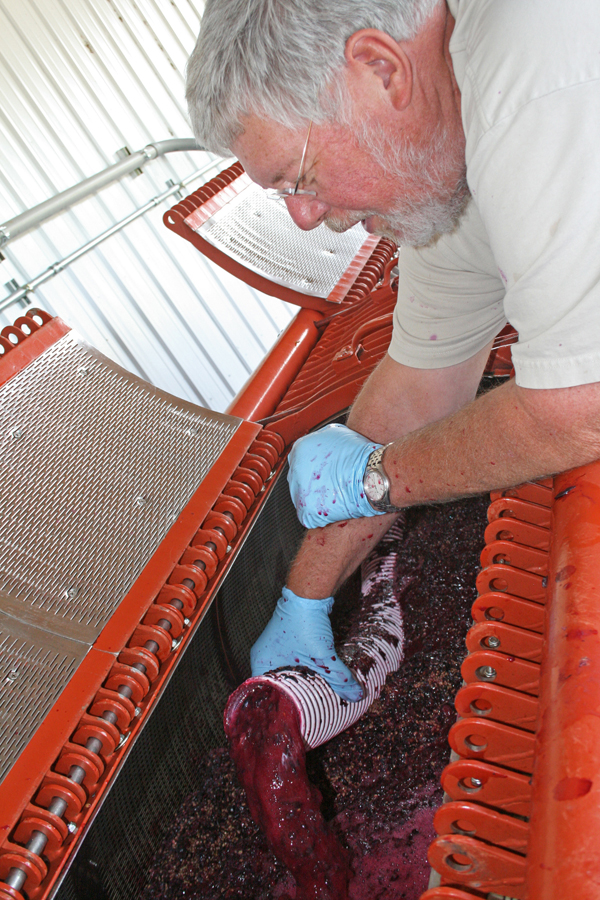
Winemaker Parker Carlson of Carlson Vineyards monitors the crushed merlot and orange muscat grapes entering his pneumatic wine press during the early stages of the 2012 harvest. The juice from the grapes will be vinified into Carlson’s popular “Sweet Baby Red.”
Occasionally a hose connection explodes, spewing a blast of juice and crushed grapes over everything and everyone in the way.
All you can do is sigh, wipe your face and grab a squeegee and broom. The show goes on.
The smell in the wineries isn’t unpleasant, an industrial-strength fruit odor that carries substantial weight, and soon there will be fruit flies everywhere.
I mean everywhere, including the one gnawing inside my ear. Excuse me, while I, umm, ah-h-h, much better.
Does anyone ever bother to point out these times to those newly retired folks dreaming of the “romantic life” of a winemaker?
As you’ve read here and elsewhere, grapes this year are ripening early and winemakers from Palisade to Redlands, Paonia to Olathe and around Montezuma Creek are juggling manpower, time and equipment as picking crews make the rapid transition from peaches/apples/veggies to grapes.
Adding to the controlled chaos is Thursday’s kick-off to the 21st annual Colorado Mountain Winefest, which runs through Sunday.
Monday, Parker Carlson of Carlson Vineyards in Palisade was busy pumping the moist-damp must for his popular sweet red wine Sweet Baby Red (this year it’s merlot and orange muscat) from the poly maceration tanks into the large pneumatic press.
“Earlier we just de-stemmed and crushed the grapes and now we’ll press them and let the juice sit in the tanks for a couple of weeks,” said Carlson, keeping an eye on the garnet-colored stream of grapes pouring into the press. “Usually we let the wine ferment longer but we want to keep the sugar levels up for our Sweet Baby Red.”
Across the valley, winemaker Jenne Baldwin-Eaton at Plum Creek Cellars was pressing a light load of sauvignon blanc grown in the winery’s Redstone Vineyard in Delta County.
“There wasn’t much this year because the vines are still young and haven’t reaching full production,” Baldwin-Eaton said. “So far the harvest is looking really good and we should start picking merlot Thursday.”
(Errata — An earlier story about the Winefest Best of Fest wine competition failed to say the Plum Creek Cellars Palisade Festival, a non-vintage blend of Riesling with smaller amounts of chardonnay and sauvignon blanc, won double gold in the white wine category. That prior report said the award went to the Plum Creek Palisade Red.)
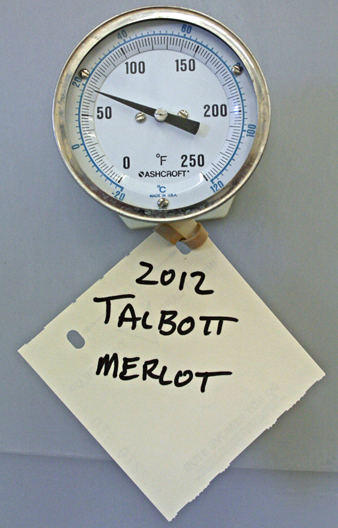 Having harvest hit full stride this week means Carlson, Plum Creek and the rest of the wineries will be smacking it down with harvest just as the Winefest revelry begins.
The presses and crushers and assorted equipment will slow a bit Saturday, freeing teams from every winery to take care of business at the Festival in the Park, and you can bet more than a few winemakers and Winefest attendees will be feeling the effects of the various dinners being held around town Friday evening.
Tickets still are available ($43 general admission, $185 VIP) for the Festival in the Park, which starts at 10:30 a.m. Saturday. The day features chef demos, live music, seminars and the unique opportunity to chat one-on-one with winemakers from around Colorado.
For information, go to here.
Harvest is on, rain stay away
The rain began in earnest as I was leaving Denver last night and by the time the lights of the Eisenhower Tunnels on Interstate 70 were overhead some drivers were pulling over to wait out what had become a torrential curtain.
Everywhere you hear tales of heat and drought and the mountains of Colorado are no different. The ground is so dry that even during the height of the storm no puddles were forming, every bit of life-restoring moisture being sucked into the earth.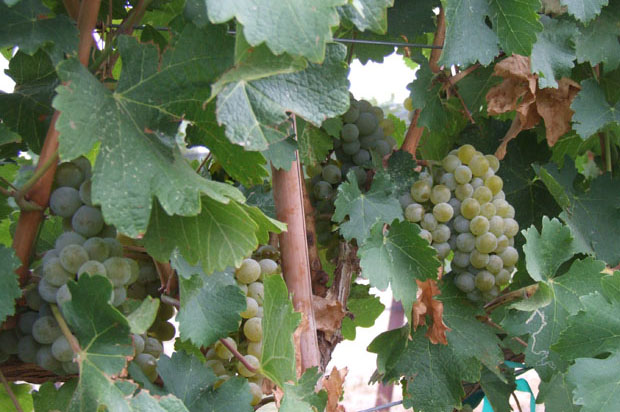
Winemakers aren’t eager to have rain now, with some early ripening white grapes (sauvignon blanc, chardonnay) already ripe for harvest and teams of pickers moving through the vineyards. Sugar levels are inching up and too much water – whether from heaven or hoses – could delay harvest just long enough for the birds to find the berries.
So we’ll talk instead about wine already in the bottle.
Folie á Deux Alexander Valley Sonoma County 2009 Cabernet Sauvignon – Not sure how long this wine has been in my basement – I mean, wine cellar – but I wish there was another down there. No oak to speak of (are you sure this is a California cabernet?) but lots of fruit, balance and depth. Dark, rich fruit – bush-ripe currants and forest berries (a hint of being wild, uncultivated but not sweet); with some bramble and fresh-turned earth scents. My notes read “tobacco, mocha, cedar,” which indicate something else there in the finish. I’m going back to the basement, maybe there still is another down there. I saw it on wine.com for $20.
Doña Paula Los Cardos Mendoza 2011 Malbec – Say “malbec’ and most people will respond “Argentina,” symbolic of how well that country has adopted and adapted a French grape to the American palate. Lots of fruit, great price, just what the doctor ordered for your ailing palate. And you have responded: According to the trade association Wines of Argentina, shipments of Argentine malbec to the United States have quintupled since 2005 to almost 5.6 million cases. This wine offers the soft blueberries without being jammy, with easy tannins and a sense of depth and complexity to add polish. Imported by the Trinchero Family Estates. $10 SRP.
Doña Paula Los Cardos 2011 Chardonnay – Why do I want to duck whenever someone says “Chardonnay”? For starters, how about wine manipulated to show too much oak, yeast-derived flavors, and a wine that tastes like fruit salad, not chardonnay. So I was surprised and pleased (OK, so I’m easy) to find the Los Cardos Chardonnay showing nice acidity and a light touch of oak to match flavors of pears, bananas and tropical fruits. At $9 SRP, this is a wine you’ll be happy to serve.
Freixenet brings taste of Spain to Grand Junction
The Little City that voted, or How Freixenet cava discovered Grand Junction:
On a recent mid-week evening, Donna Bitting was standing smack in the middle of BIN 707 Foodbar in downtown Grand Junction, enjoying a night she had waited 30 years to arrive.
Freixenet, the world’s leading producer of traditional method Spanish cava, including the top-selling Cordon Negro Brut in its distinctive black bottle, selected Grand Junction and BIN 707 as the site of its exclusive “My City” national promotion. Bitting likely was the reason the event happened here.
“We had Freixenet for our wedding 30 years ago and we’ve always considered it something special,” said Bitting, inclining her head toward her nearby husband, Rollin Bitting. “So when I saw on their Facebook page they were having this promotion, I started calling all my friends and everyone I could think of to vote.”
The Freixenet (it’s said “fresh-eh-net” because it’s Spanish (more accurately it’s Catalan) and not French) “My City” online promotion pitted cava fans from 250 cities around the nation, all voting to host the event in their city, said Lauren Burkhart of Freixenet.
“We thought we might be going to Austin, or Seattle or maybe Chicago, so you can imagine how surprised we were when Grand Junction won,” said Burkhart, laughing at the memory. “We had to scramble for some maps.”
Jesse Hamrick of the New York PR firm Sawtooth Group said he drove 280 miles after landing at Denver International Airport after wisely deciding the ticket from New York ($700) was pricey enough without adding the $300 or so airline tag on to reach the Western Slope of Colorado.
“But the drive and the scenery was great. It’s the first time I’ve ever driven in the mountains so it was pretty interesting at times,” said Hamrick, whose friendly smile over a table full of cava was the first thing to greet party goers.
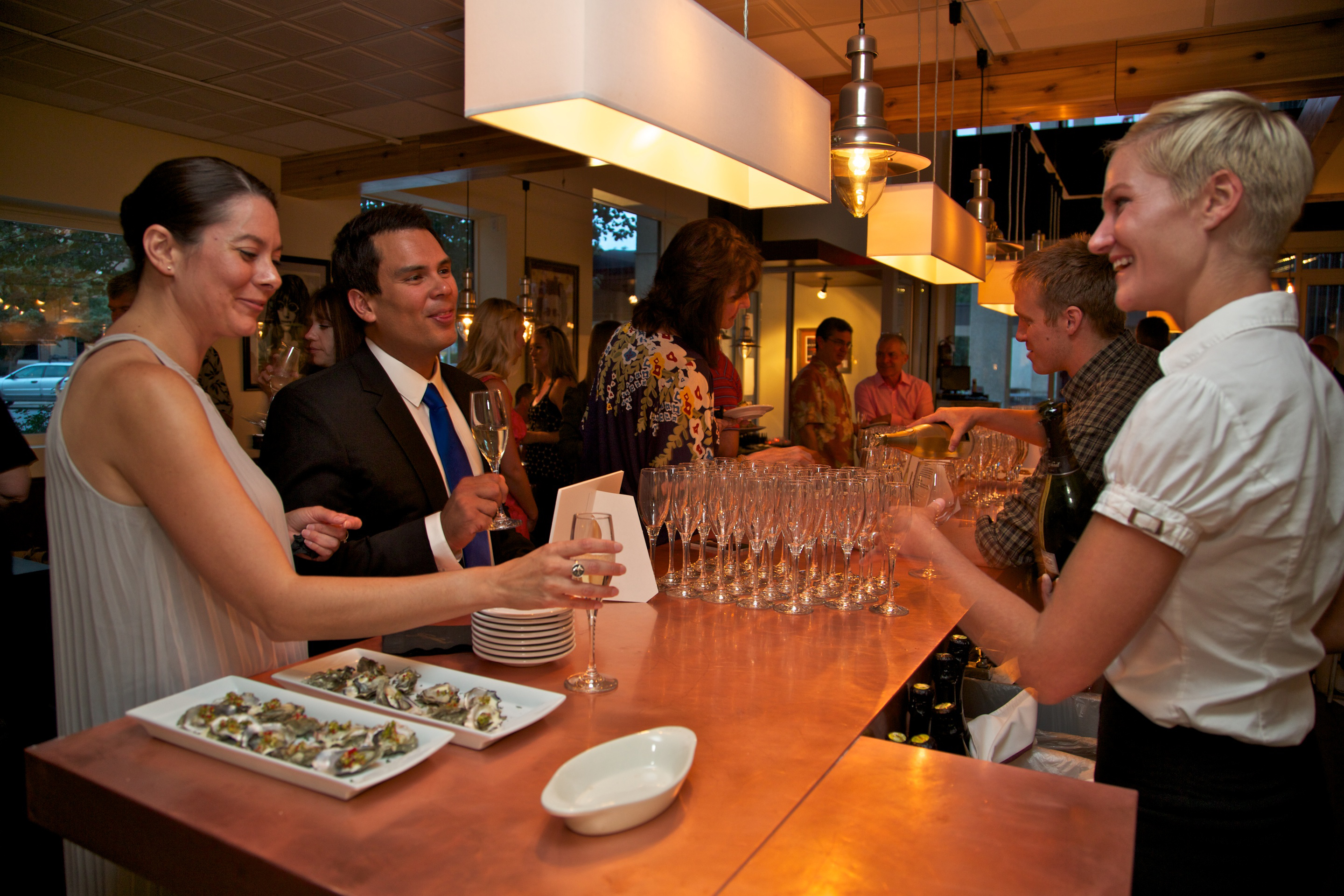
Jodi Coleman, co-owner of BIN 707 Foodbar in Grand Junction, pours Freixenet’s Elyssia Gran Cuvee for Zanaan Frame and his date Brittney during the recent Freixenet “My City” promotion in Grand Junction.
Photos by Wil Fernandez
Grand Junction has about 115,00 residents, probably quite a few less than some Chicago suburbs but apparently GJ has more people interested in Freixenet.
Burkhart said she couldn’t remember exactly how many votes Grand Junction received but she kindly estimated it was in “the thousands.” One key to the vote-getting is the rule you could vote only once per day but as many days as you wanted during the three-month promotion. Rollin Biting admitted voting “at least 17 times.”
“When I saw that rule, I kept calling my friends everyday, telling them to vote again,” said Donna. “I never guessed we could have something like this here in Grand Junction.”
Freixenet is the world’s largest producer of traditional method sparkling wine, which means it adheres to the same fermented-in-the-bottle production methods as Champagne. Along with its second-label Segura Viudas, the company produces some 200 million bottles of cava each year. The production is based in the tiny (pop. 12,345) Catalan town of Sant Sadurni D’Anoia, in the heart of Spanish cava production a few kilometers outside Barcelona.
Having Freixenet’s invitation-only event in Grand Junction was a coup highlighting the interest of the local Freixenet lovers (the party was limited to 50 invitees) and the skills of the talented staff at BIN 707 Foodbar, one of the new establishments enlivening downtown.
“Seriously, you guys out-voted some really big cities for this,” Burkhart said. “I don’t think you won by a whole lot of votes but still you won and here we are. This has been a lot of fun and the people here are so nice.”
Winning by one or 1,000 votes made little difference to Bitting, who said she made sure all the voters wrote the 81501 zip code “so we wouldn’t split our votes. This is so amazing.”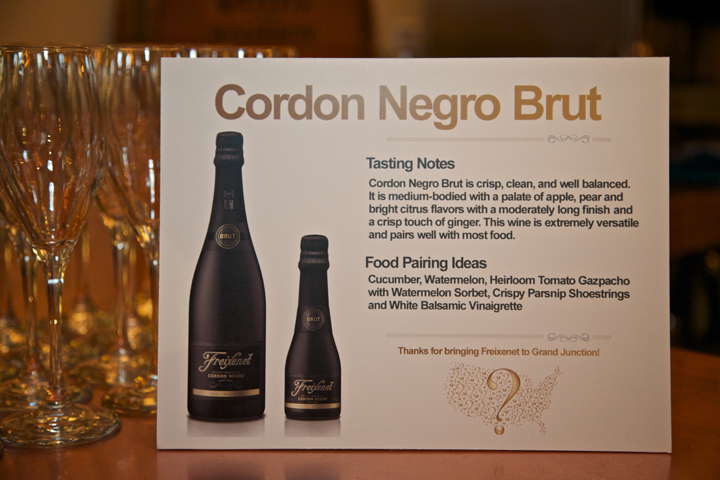
BIN 707 Foodbar chef and co-owner Josh Niernberg (his wife Jodi Coleman is the other co-owner) blew up the evening with his impressive and fanciful tapas-like pairings to fit the Freixenet line, from the best-selling Cordon Negro Brut to the pinot-noir-based Elyssia Gran Cuvée.
The pairings included:
- Cordon Negro Brut: Cucumber, Watermelon, Heirloom Tomato Gazpacho with Watermelon Sorbet, Crispy Parsnip Shoestrings and White Balsamic Vinaigrette.
- Cordon Negro Extra Dry: Olathe Sweet Corn Blini with Creme Fraiche, Black Truffle “Caviar” and Heirloom Carrot Green.
- Cordon Rosado: Crispy Prosciutto Canape with Applewood Smoked Goat Cheese Whipped Cream and Radish, Grilled Peach and Watermelon Pico de Gallo.
- Carta Nevada Semi Dry: Crispy Fried Heirloom Tomato “Sandwich” with Fresh Jumbo Lump Crab, Sweet Pickled Jicama, Micro Greens and Arugula Oil.
- Elyssia Gran Cuvee: Fanny Bay Grilled Oysters, Fruition Farm’s Shepherd’s Halo Cheese and Asparagus Mignonette.
- Carta Nevada Brut: Truffles of Dark Chocolate Chili and High Country Orchard Cherries.
Geographer’s book binds ‘intricate, complex landscapes’
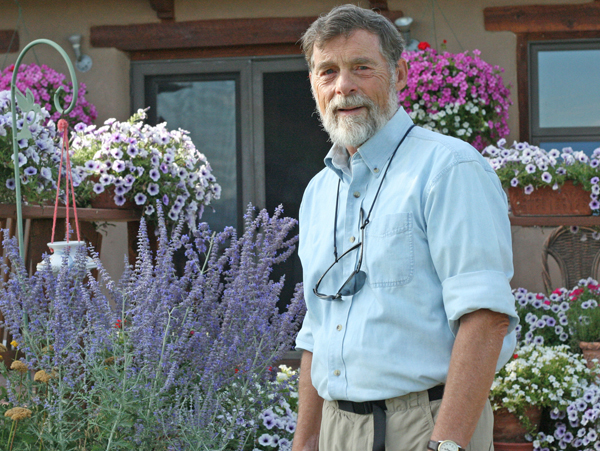
Author and geographer Thomas Huber amid the blossoms on the deck of the Leroux Creek Inn and Vineyards near Hotchkiss, Colo.
HOTCHKISS – From the spacious lens of glass on the second floor of the Leroux Creek Inn near Hotchkiss, a viewer sees well-manicured vineyards stretching into the distance and the gentle fall of land dipping north to the North Fork River and then climbing again to the distant mesas and patchwork tablelands of Fruitland Mesa.
All of us, asserted writer/geographer Wallace Stegner, are “conditioned by climate and geography, ” those “forms and lights and colors” of the natural world that have shaped us.
For Thomas Huber, also a geographer and author, the landscape stretching out before his gaze brought to mind another “climate and geography” – one more similar than different: that of the Provence region of southeast France.
 “Seventy-five percent of the two valleys are the same,” said Huber Saturday afternoon, standing on the inn’s flower-laden deck just prior to a dinner marking the West Elks Wine Trail celebration. “The main difference is the vineyards here are 15 years old while the vineyards in Provence are 2,000 or more years old.”
Shaky history aside – vineyards have been planted in the North Fork Valley for much more than 15 years – it was fitting that Huber was in Delta County this weekend for the fourth annual West Elks Wine Trail, a celebration focusing on local-produced wines and foods, with several of the West Elk AVA wineries hosting special dinners.
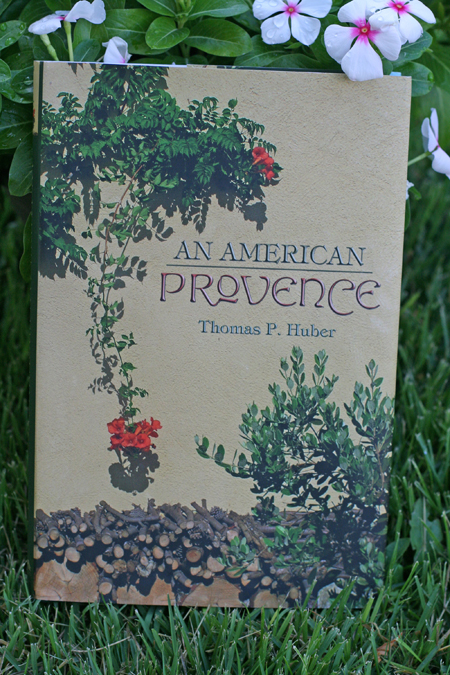
Americans are wont to source, correctly or not, the current trend of locavore-istic noshing to ‘les agriculteurs et viticulteurs’ of the French countryside (and to a degree that of Italy and Spain) and Huber’s most-recent novel “An American Provence” is a scholarly and highly entertaining treatise on the connective roots shared by people thousands of miles apart who love and work the land.
Inspiration for the book came during an early morning amble in 2002 when Huber and his wife Carole first visited Leroux Creek Inn and Vineyards, owned and operated by Yvon Gros and his wife, Joanna Reckert.
“For an instant my sleep-addled brain found itself in Provence,” writes Huber of that first morning wandering through the inn. “An instant later the mental fog lifted and I was back in western Colorado but wondering why the Provencal image had not flashed into my mind sooner.”
He already was familiar with Provence, thanks to visits there with French-born Carole to visit her mother, who had raised her daughter to “love and honor France and Provence.”
Huber, a geography professor at the University of Colorado – Colorado Springs, found a particular connection between the North Fork Valley and that of the Coulon River valley in northern Provence.
That connection, Huber said, “set in motion my desire to chronicle, these two complex, intricate, and intimate landscapes.”
He notes the differences in the geology (Provence has thick beds of limestone while the North Fork Valley is predominately sedimentary shales) and the different plants and trees.
“But really, there is the same valley terrain, the same aspect, the same sort of ‘garrigue’ and the same type of people focused on the landscape and working that landscape,” he said while speaking to some of the 60-plus guests attending Saturday’s Provence-style dinner prepared by chef and winemaker Yvon Gros.
Curiously, “garrigue” refers to a Mediterranean, limestone-rooted shrub ecosystem but it’s also a term occasionally heard in wine tasting referring to the warm, earthy scents of autumn often found in rustic-style wines.
With chapters with such titles as “Places”, “The Land”, “Villages”, “Wine” and “Food”, Huber takes readers on an intimate journey into the unexpected intertwining of two cultures separated more by distance than outlook.
As Gros, himself a native of Provence, said, only half in jest, “Perhaps Tom’s book will convince people who don’t want to travel to France to come and get a brief taste of the Provence in the North Fork Valley.”
“An American Provence” was published by University Press of Colorado and is available through Amazon.
Concert to help fund fruit, wine research
Another lesson in be careful what you ask for came Saturday. An innocuous phone call to fruit grower Neil Guard on East Orchard Mesa turned into a wide-ranging and thoughtful lesson in peach and grape management, politics, research funding and several other topics, including using a safety pin as a low-tech but effective cleaning tool for drip-irrigation nozzles.
“Hey, Neil, whatcha doin’?”

Fruit grower Neil Guard of East Orchard Mesa checks on some of the ready-to-pick Red Haven peaches in his orchard. In addition to 6 acres of peaches, Guard also grows nine acres of wine grapes, including both red and white wine varietals.
“Fixing sprinkler heads in the vineyards, come on out and enjoy the fun,” came Guard’s answer against the background scream of his recorded hawk calls, designed to keep marauding starlings from eating his peach and grape crops. In addition to his nine acres of grapes, Guard raises peaches on six acres of trees, all of which are heavily burdened as picking time nears.
“It’s crazy,” said Guard, pictured at right, as we walked down one row where ready-to-pick Red Haven peaches bent the branches like a thousand Japanese lanterns. “I’ve got a fantastic crop and just down the road they were hit hard by the April freeze.”
Such are the challenges of raising fruit in the Grand Valley, where spring frosts (damaging frosts this year hit in late April and early May) only compound the injuries from severe winters and blistering summers. It’s part of the terroir, that combination of environment and sense of place, that makes Colorado fruit stand out from that grown elsewhere.
While weather extremes save Colorado from the host of bugs and disease plaguing other fruit and wine-making areas, sub-zero cold and plus-100 temperatures bring their own challenges. Because fruit growing is a year-round contest, it requires year-round answers. Growers across Colorado often turn for answers to the knowledgeable but understaffed and underfunded crew at the Colorado State University Orchard Mesa Research Center.
Some larger programs in other fruit-growing areas, such as the University of California – Davis, offer answers but these typically are for California-centric problems, which may or may not apply to Colorado.
The local research station, which isn’t local at all but answers to wine-makers and fruit growers from Cortez to Sterling, is funded largely by CSU, and you know how tight school budgets are today.
To augment the state funding, some of the money that ensures there will be peaches, apples and wine grapes to enjoy comes from the fruit-growers themselves through the Western Colorado Horticultural Society.
Finally, here’s where you come in. The Hort Society and Grande River Vineyards are hosting a benefit concert Saturday at Grande River Vineyards by the Beatles tribute band “Imagine.” It’s part of the winery’s “Heard It Through the Grapevine” series of concerts and the second year of benefit concerts (last year, Marcia Ball played the only night it rained all August) to raise money for the Hort Society and the Orchard Mesa Research Center.
“Things are changing all the time and we need research all the time,” said Guard, showing where various bugs, birds and blight have damaged fruit, making it commercially useless. He said one growing concern (though not yet confirmed in Colorado) is the brown mormorated stinkbug, a hardy and voracious Chinese invader you probably haven’t heard of before but for which there currently is no control.
First confirmed sighting in the the U.S. was in Pennsylvania in 2000. Researchers say the stinkbug attacks fruit trees and vegetable crops, including just about everything you have in your garden. A researcher from Rutgers University’s Pest Management program says the brown mormorated (marbled) stinkbug threatens to “throw growers out of business.”
Your dollar can fund research to keep Colorado in fruit and you in wine. Concert tickets, available at Grande River Vineyards and Fisher’s Liquor Barn, are $20 advance, $25 at the gate. Gates open at 6:30 p.m., music starts at 7:30.
Also, a locavore barbeque featuring locally grown ingredients will be available separately for $12 (dessert – Palisade peach cobbler and lavender ice cream – $3 extra). Buy a ticket, eat a peach, save a fruit grower.
Back to work – And what great work to have
Bozzetti:
Late July finds me wayward in my regular weekly wine reviews. After a couple of weeks away from the computer, it’s time to catch up.
Estancia Pinnacles Ranch Monterrey County 2010 Chardonnay – (sample) Grown in the cool climate and sandy soils of Monterrey County gives this luscious, mouth-filling Chardonnay a ripe, creamy intensity with bright notes of tropical fruit, lemon and vanilla and a lingering finish. The oak is noticeable but additive, not overwhelming. $15.
Round Pond Estate 2011 Sauvignon Blanc – (sample). I’m about to capitulate and admit the Rutherford AVA of the mid-Napa Valley (just north of Oakville) is my favorite winemaking region in northern California. Much of that favoritism can be blamed on the shipment of Round Pond Estate wines I recently received.
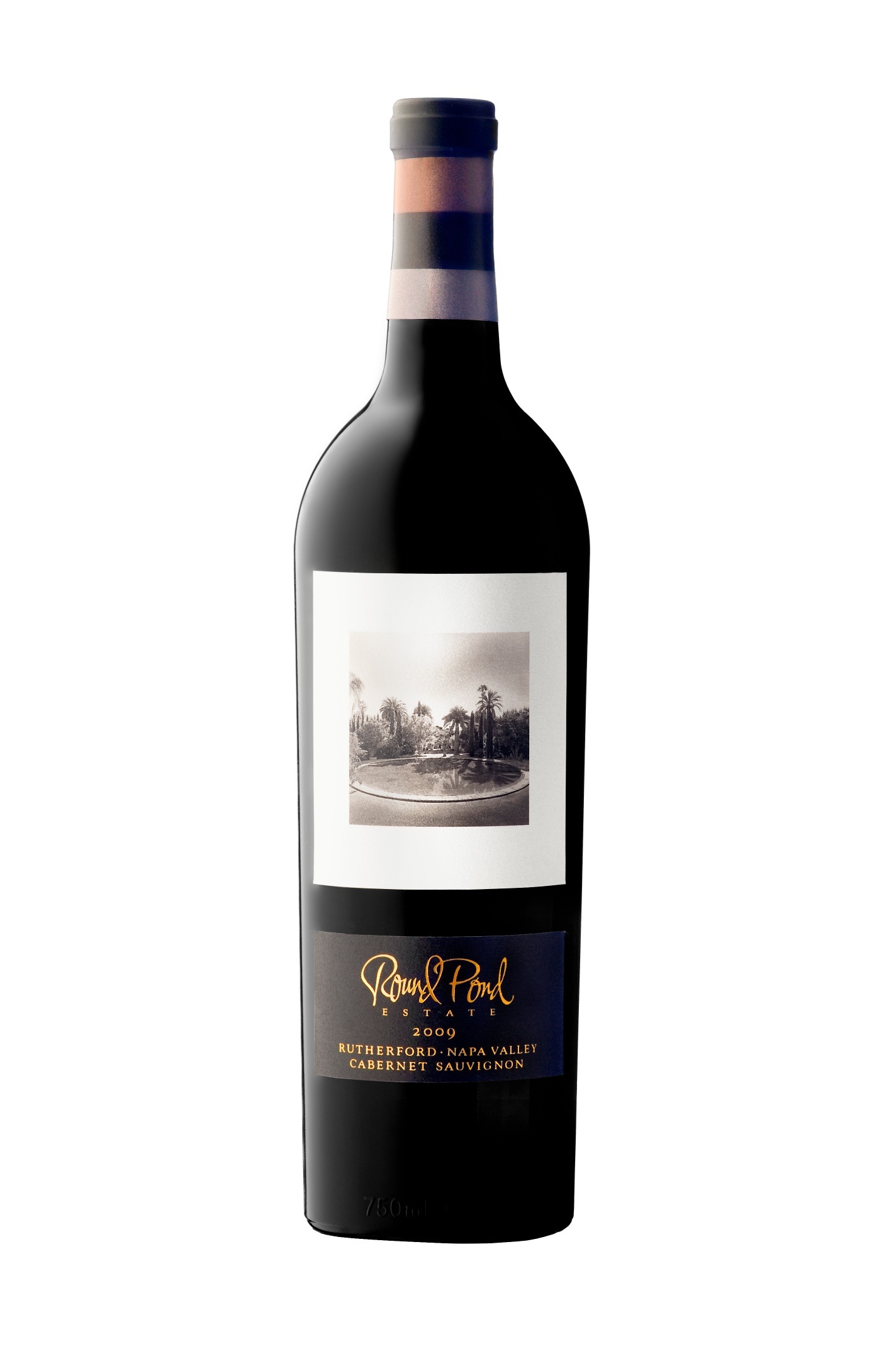
Round Pond Estate 2009 Rutherford Cabernet Sauvignon
The Round Pond Estate 2011 Sauvignon Blanc is a classic of this wonderful summer varietal: non-oaked, crisp acidity, flavors of citrus, floral and (I live in Colorado’s peach country) white peaches with a hint of apricots. 100 percent stainless steel, with a stone-minerality finish. Don’t serve it too cold; the wine develops multiple layers of flavors as it warms a bit. Winemaker Brian Brown said: “My goal with this wine is to transfer the fruit from the vineyard directly into the wine glass. Essence of white peaches in a glass.” $20-$24.
Round Hill Estate 2009 Rutherford Cabernet Sauvignon – It’s not that I have a bias against most California cabs, it’s just, well, maybe I do. Often too oaky, too jammy, too much in-your-face (for that I’ll watch Fox News). But the well-composed Round Pond 2010 Cabernet Sauvignon had me thinking of Spain, not northern California. Hints of Spanish lavendar, leather and dark chocolate open to stone graphite and dark fruits, and memories of rainy days in Rioja. $50
Round Hill Estates 2010 Napa Valley Cabernet Sauvignon – Call this the little brother to the pricier and more-complex Estate cab reviewed above. The Napa Valley version, based on Round Hill estate fruit and augmented by grapes sourced from trusted growers around the valley, is aged in second-year oak to allow the dark fruit flavors to shine through. Well-balanced, very drinkable now (I did, and it is), this is one little brother you’ll want to adopt. $30.
Nobilo Icon 2010 Marlborough Pinot Noir – This award-winning winery on the north end of New Zealand’s South Island was founded in 1934 by Croatian immigrant Nikola Nobilo, the scion of a family with 300 years of winemaking experience.
Grapes are sourced from vineyards across the Marlborough region, which is renowned for its cool-climate varietals, notably pinot noir and sauvignon blanc. The Nobilo Icon 2010 Marlborough Pinot Noir offers a classic profile of pinot noir, with textures of dark berries, chocolate and mocha adrift in silky tannins and lifted by a hint of smoky peat. It was perfect served slightly chilled with a barbecue of planked salmon and fresh sweet corn. It was equally delightful by itself. $22.
Nobilo Icon 2011 Marlborough Sauvignon Blanc – (sample). These two Nobilo Icon wines were my first encounter with this 78-year old winery and they made me wonder which turnip truck I’ve been riding in. To say I was delighted and amazed isn’t enough; the wines were the standouts of the week and had my guests wondering aloud why I suspiciously was scrimping (I mean, serving) one bottle of each.
The Nobilo Icon 2011 Marlborough Sauvignon Blanc offered notes of crisp tropical fruit (pineapple, guava) and grapefuit. Complex and rich with hints of stony minerality and a bit of the sea. Again, avoid serving this sauvignon blanc too cold, as it develops richness and character with slight chilling. $22.
Summer entertaining calls for the lift of a good rosé
Αfter last month’s initial blast of 100-degree days, the summer has settled into a routine of hot days and sultry warm evenings, perfect for entertaining outside.
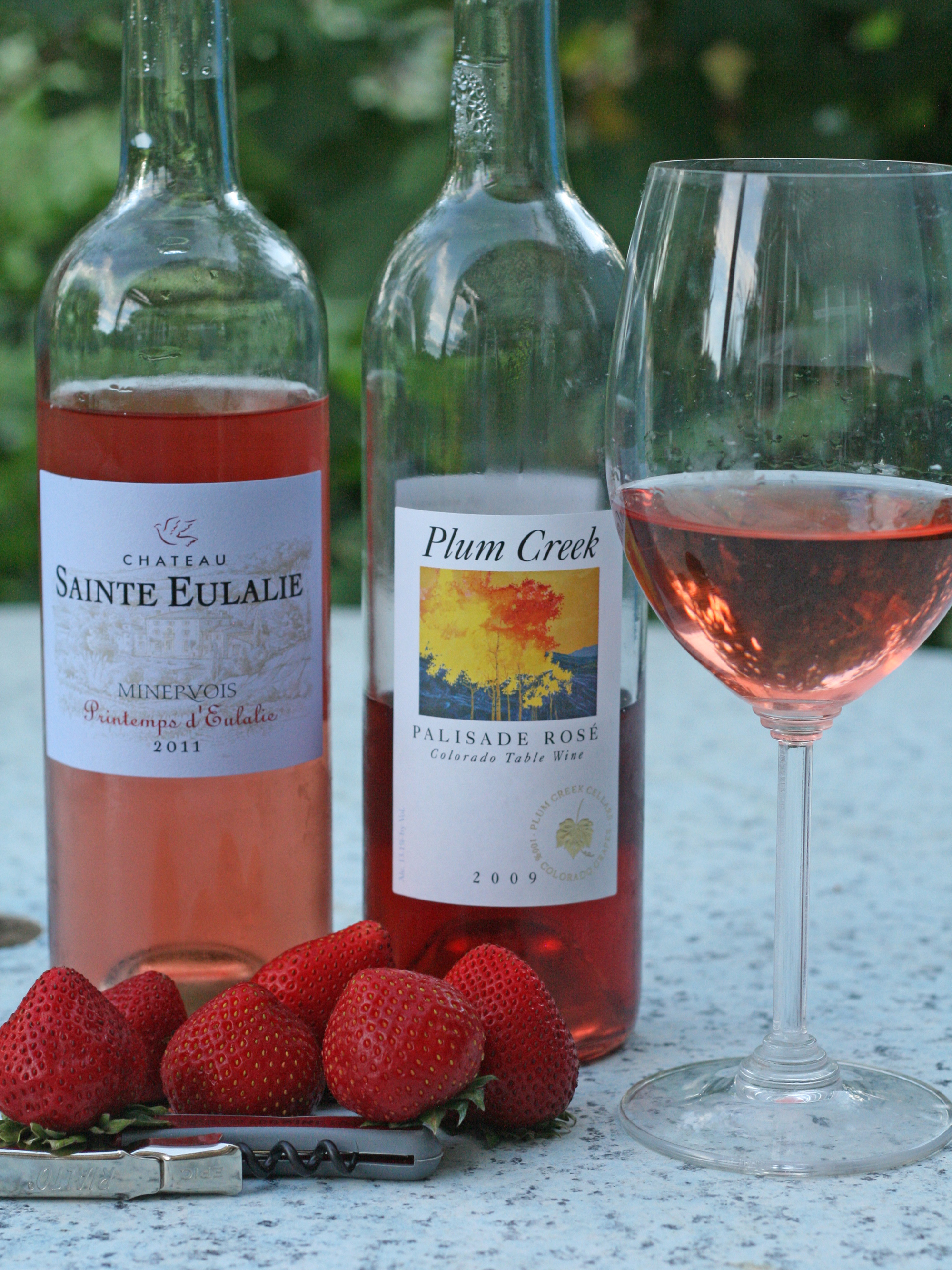
Summer calls for entertaining with rosés, which come in a wide range of hues with flavors dominated by strawberries, cranberries, raspberries and watermelon.
However, summer entertaining can pose a challenge for wine drinkers finding themselves choosing between heavy-bodied reds and over-simplified white wines.
Oddly, many wine drinkers have a pre-conceived bias against rosés, even when it’s someone who hasn’t tasted one since the Beatles were together.
“I think the last one I had was in a funny-shaped bottle way back in college,” said a guest recently, her hands outlining the unforgettable shape of Lancer’s Rosé, which did double duty as a wine-bottle slash candleholder for many a college student when Nixon still was president.
Sadly, it’s easy to dismiss pink wine. Say “rosé” and most Americans think of something cheap, the sweet “blush” wines such as Lancer’s or Sutter Home’s white Zinfandel.
But there are many reasons to enjoy rosés, as fellow wine writer Jeff Siegel, aka The Wine Curmudgeon, noted recently in his annual rosé review.
“I especially pondered that question (of why American’s don’t do much rosé) preparing for this post, the blog’s fifth annual rose extravaganza,” Siegel wrote. “And I can’t come up with a good reason. Rose is cheap. It’s better made than ever before. It’s food friendly. You can put an ice cube in it. What more do you need from a wine?”
A bit of pink-wine history is supplied by David White, founder and editor of the daily wine blog Terroirist.com.
In a recent column, White explained that way back in 1975, Sutter Home winemaker Bob Trinchero had some of his white Zinfandel get “stuck” during fermentation, meaning the yeast died before all the sugar had converted into alcohol. Rather than add more yeast, Trinchero let the wine sit for two weeks, White said.
When Trinchero revisited the wine, he knew this wine would be a hit and that’s how what we now know as Sutter Home’s white Zinfandel was born. As White and others have seen, the white Zin bandwagon would fill quickly.
But popularity does not mean great wine. White Zinfandels and similar “blush” wines usually are too sweet, more like strawberry Kool-Aid with an alcohol kick. True rosés, particularly those from France and Spain, are bone dry, multi-layered and refreshing. And those layers of complexity make the wines as food friendly as any wines.
There are several ways to make a rosé wine, but the two most common are leaving grape skins in the fermenting juice just long enough to add some color (remember all grapes give white juice) and the process called bleeding (“saigneé”), where the light-colored wine is siphoned off the freshly crushed grapes.
The main flavors are strawberry, cranberry, watermelon and raspberry although you might find a kiss of red flowers, some spice and even a hint of minerality.
And don’t take “pink wine” literally because not al of them are pink. Rose´s can vary from a light salmon to a medium red or dark rose (as in flower). And most alcohol levels can/should be 13 percent or less, which means a glass or two is refreshing rather than stupefying and puts you asleep by the pool.
Americans slowly are coming around to rosés, in part, I think, because Americans are traveling to countries where good rosés are common.
Some recents tastings:
Chateau Pesquie “Les Terrasses” 2010 — $13, well-balanced, dry, medium-bodied with raspberry and red cherry flavors.
Plum Creek Palisade Rosé 2009 — $9, semi-sweet, notes of ripe strawberries, watermelon and red cherry.
Canyon Wind 47-Ten Rosé 2011 — $14, dry, medium-bodied, notes of strawberry, cranberry and pineapple, at 14.6 percent alcohol the hottest of the tasting.
Chateau Sainte Eulalie Minervois 2011 — $15, dry, made in the saigneé method, hints of strawberries, raspberries and spice, 13.5 percent alcohol.
The future is now for Canyon Wind Cellars
Throughout the year, I’ll occasionally focus on a single winemaker and it only makes sense to feature promising winemakers few people have yet to meet. This week I visited Jay and Jennifer Christianson of Canyon Wind Cellars in Palisade.
PALISADE, Colo. – On a warm late-spring morning, surrounded by acres of emerald-green vines, Jay and Jennifer Christianson, owners of Canyon Wind Cellars, looked around and saw the future around them.
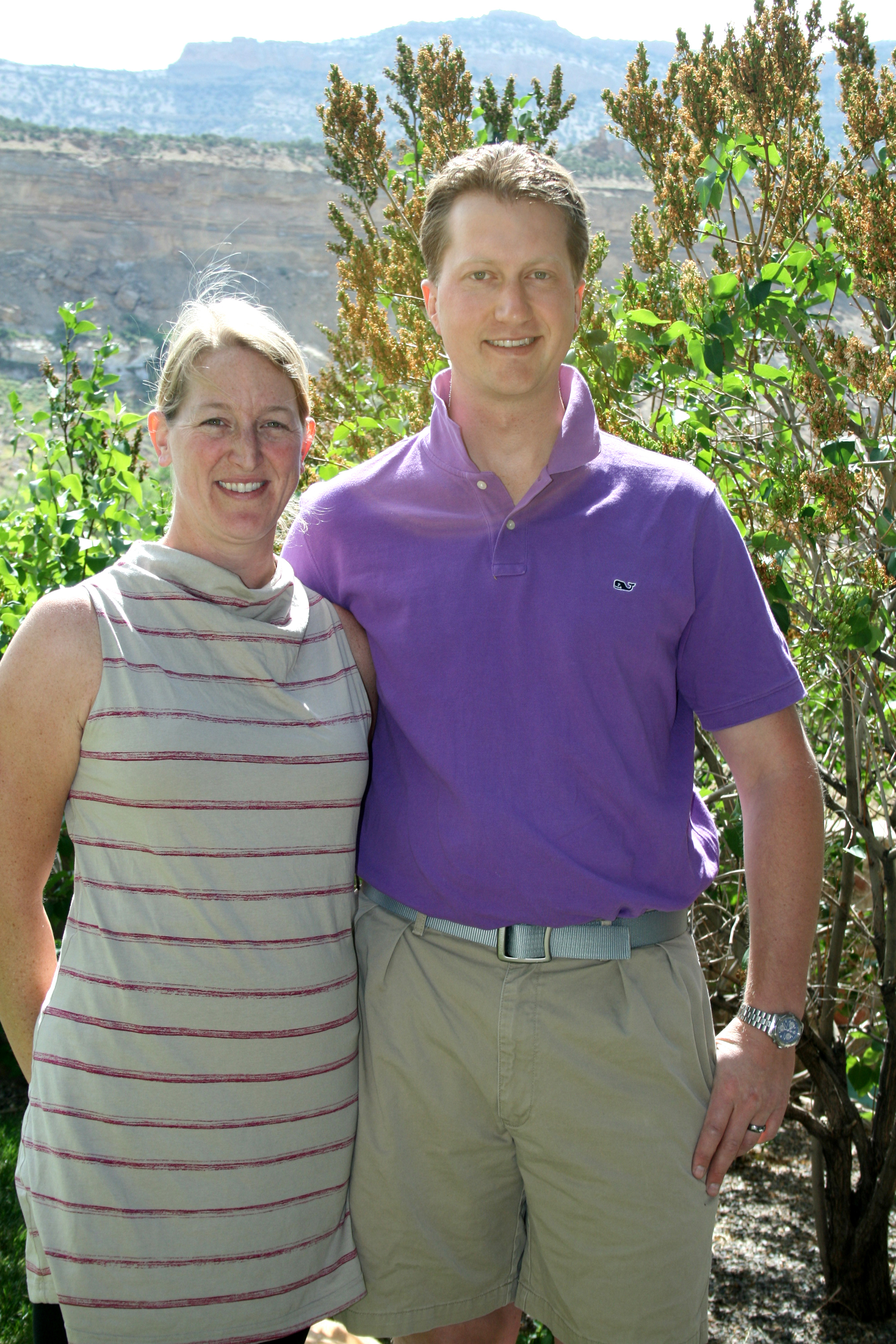
Jennifer and Jay Christianson of Canyon Wind Cellars in Palisade, Colo.
Perhaps that should read “new” owners, since the current generation of Christiansons two years ago assumed day-to-day operation of the winery started by Jay’s father, Norm Christianson, in 1996. The changes initiated by Jay and Jennifer are subtle but reflective of lessons well-learned during semi-regular wine-tasting trips to California and other wine regions.
“We saw some terrible tasting rooms and some great ones,” said Jay, “and we saw what we could do better.”
Jay is typical of many second-generation winemakers who grew up in the winemaking business, learning at his father’s side about the finer points of wine. He received his initial taste of the labor side of the business working his first harvest at the age of 9.
“My first real harvest was the 1996 chardonnay and merlot,” Jay recalled with a smile. “I think I was very sore afterwards but it gave me insight into what it really takes to have your own vineyard.”
Jennifer’s wine education, however, has been on the fast-track since the two were married in 2009.
“When we first met, I knew exactly nothing about wine,” said the Chicago native with a laugh. “It’s been a lot of learning since then.”
The two met in Vail, where Jay was balancing jobs as a youth ski coach and as the Front Range marketer/salesman for Canyon Wind and Jennifer was the fundraiser and development director for local and U.S. team skiers. He asked her to pet-sit his two dogs while he made one of his road trips to Denver and it wasn’t long before that temporary job turned into a long-term relationship.
“I thought (ski team fund-raising) was pretty much the coolest job until I got into winemaking,” Jennifer said.
Jay, 30, and Jennifer, 36, are among the first of Colorado’s nex-Gen era of winemakers, along with Julie Balistreri of Balestreri Vineyards in Denver who also continues the winemaking tradition of her father and grandfather. Being that bridge between generations requires not only continuing the tradition and reputation honed by the winery founders but also reaching out to the savvy younger crowd of wine lovers whose preferred wine-list reading runs to blogs, Twitter, Facebook and other social media.
What isn’t lost on the two young Christiansons is that the best way to sell wine is to make good wine. With Jay’s knowledge of the retail side gained from years marketing and selling Colorado wine before Colorado wine became popular (“You learn to have a pretty thick skin,” he said of those days) and Jennifer’s MBA background in human resources and her well-tuned palate, which Jay readily admits is better than his, the two are aiming at an audience looking for something perhaps a bit different than other Colorado wineries.
An hour or so into our visit, deep in the underground cellar unlike any other in the state, where barrels of wine lie sleeping until their release, Jay said, “Our goal is to make the best wine for the property.”
Which means “we grow everything,” said Jay said, , who attended classes at UC Davis to hone his wine knowledge. He emphasized it is a point of pride to deliver a true low-intervention “vin de terroir” such as the dark-fruit rich Boreas, the top of their new Anemoi line of wines. “We’re also taking a more thoughtful approach to making wine from the vineyard.”
Much of that philosophy is adapted from renowned winemaker Robert Sinskey, who has among his 10 points of winemaking, “Fine wines have a sense of place” and “Know your vineyards.”
As a winery, Canyon Wind Cellars, which still sees the seasonal guidance of winemaker and winery consultant Robert Pepi, produces 14 wines under three labels: the affordable 4710 brand (named after the vineyard’s elevation); eight varietals under the familiar Canyon Wind label; and the Anemoi line, a name Jennifer found while perusing an assortment of lists and books while accompanying Jay on his frequent four-hour drives to Denver.
Anemoi (it’s “ann-eh-moy”) refers both to the Greek wind gods as well as the canyon breeze that cools the vineyard in summer and protects it from frost in winter. Jay’s father Norm called that canyon wind a million-dollar breeze for its unmistakable value in savin countless harvest from early and late frosts.
It’s the Anemoi wines, currently two hearty red-blends named Boreas (north wind) and Zephyrus (east wind) and Iapyx (the north-west wind), a late-harvest pinot grigio, that most excite Jay and Jennifer and where they see their future. The two red wines are produced in limited amounts and as such are premium priced ($35 each).
“We made these to see what the vineyard could do and we’ve been very pleasantly surprised at their reception,” Jay said. Developing Anemoi, Jennifer said, “was the perfect opportunity for me to dive into creating a style of wines that I love.”
The 2009 Boreas ($35) is a true vin de terroir, blending cabernet sauvignon (43 percent), merlot (21 percent), cabernet franc (21) and petite verdot (15) into a dark wine of full fruit flavors, round tannis and a lasting finish. The 2010 Zephyrus ($35) is 50/50 cabernet franc/petite verdot, taking full advantage of two varietals that are doing well in the Grand Valley AVA’s high-desert climate.
The Christiansons also hand-number each bottle of Boreas, a time-consuming act thoughtfully done, giving Jay and Jennifer one more connection with an unseen consumer in whose opinion lies the future of their efforts.
Summer arrives with a blast
After last month’s initial blast of 100-degree days, the summer has settled into a routine of hot days and sultry warm evenings, perfect for entertaining outside.
However, summer entertaining can pose a challenge for wine drinkers finding themselves choosing between heavy-bodied reds and over-simplified white wines.
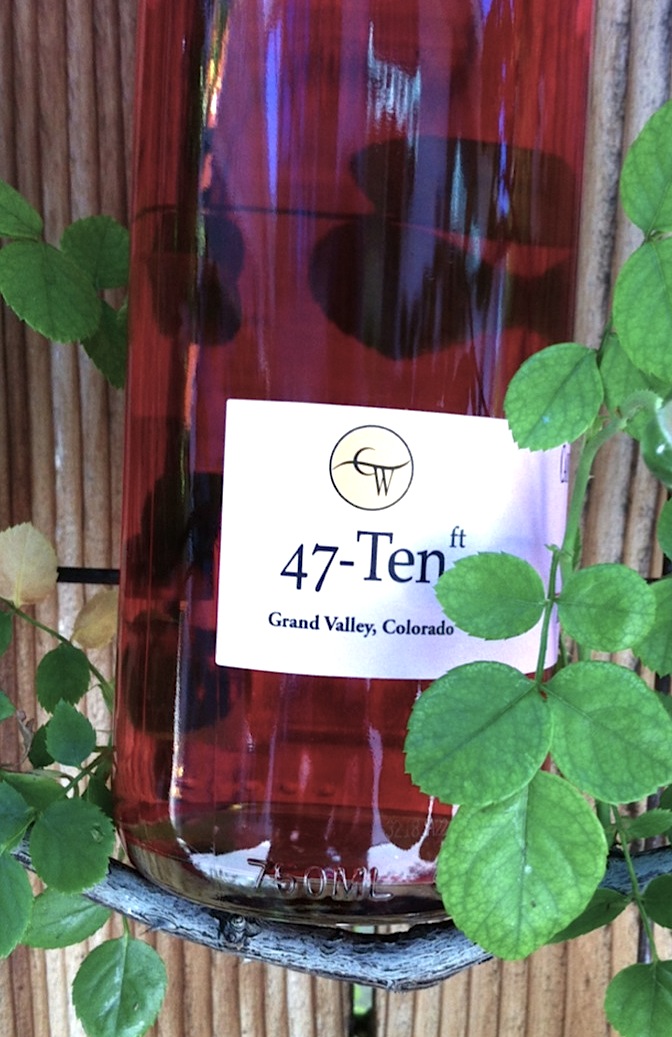
The Canyon Wind Cellars 47-Ten Grand Valley Rosé, a 100-percent Merlot dry rosé named for the elevation (4,710 feet above sea level) of the vineyards in which the grapes grow.
Oddly, many wine drinkers have a pre-conceived bias against rosés, even when it’s someone who hasn’t tasted one since the Beatles were together.
“I think the last one I had was in a funny-shaped bottle way back in college,” said a guest recently, her hands outlining the unforgettable shape of Lancer’s Rosé, which did double duty as a wine-bottle slash candleholder for many a college student when Nixon still was president.
Sadly, it’s easy to dismiss pink wine. Say “rosé” and most Americans think of something cheap, the sweet “blush” wines such as Lancer’s or Sutter Home’s white Zinfandel.
But there are many reasons to enjoy rosés, as fellow wine writer Jeff Siegel, aka The Wine Curmudgeon, noted recently in his annual rosé review.
“I especially pondered that question (of why American’s don’t do much rosé) preparing for this post, the blog’s fifth annual rose extravaganza,” Siegel wrote. “And I can’t come up with a good reason. Rose is cheap. It’s better made than ever before. It’s food friendly. You can put an ice cube in it. What more do you need from a wine?”
A bit of pink-wine history is supplied by David White, founder and editor of the Terroirist.com.
In a recent column, White explained that way back in 1975, Sutter Home winemaker Bob Trinchero had some of his white Zinfandel get “stuck” during fermentation, meaning the yeast died before all the sugar had converted into alcohol.
Rather than add more yeast, Trinchero let the wine sit for two weeks, White said.
When Trinchero revisited the wine, he knew it would be a hit, and Sutter Home’s modern-day white Zinfandel was born. As White and others have seen, countless imitators soon would follow.
But popularity does not mean great wine. White Zinfandels and similar “blush” wines usually are too sweet, more like strawberry Kool-Aid with an alcohol kick.
True rosés, particularly those from France and Spain, are bone dry, multi-layered and refreshing. And those layers of complexity make the wines as food friendly as any wines.
There are several ways to make a rosé wine, but the two most common are leaving grape skins in the fermenting juice just long enough to add some color (remember all grapes give white juice) and the process called bleeding (“saigneé”), where the light-colored wine is siphoned off the freshly crushed grapes.
The main flavors are strawberry, cranberry, watermelon and raspberry although you might find a kiss of red flowers, some spice and even a hint of minerality.
They aren’t all pink. Rose´s range from a light salmon to a medium red. And most alcohol levels can be 13 percent or less, which means a glass or two won’t have you falling asleep by the pool.
Americans slowly are coming around to rosés, in part, I think, because Americans are traveling to countries where good rosés are common.
– Chateau Pesquie “Les Terrasses” — $13, well-balanced, dry, medium-bodied with raspberry and red cherry flavors.
– Plum Creek Cellars Palisade Rosé — $9, semi-sweet, notes of ripe strawberries, watermelon and red cherry.
– Canyon Wind Cellars 47-Ten Rosé — $14, dry, medium-bodied, notes of strawberry, cranberry and pineapple, 14.6 percent alcohol.
– Chateau Sainte Eulalie Minervois — $15, dry, made in the saigneé method, hints of strawberries, raspberries and spice, 13.5 percent alcohol.
Memories remain of 30th annual Food & Wine Classic in Aspen
ASPEN – The 30th annual Food & Wine Classic in Aspen is history, although perhaps not without a hangover or two to prolong the sweet memory until next year.
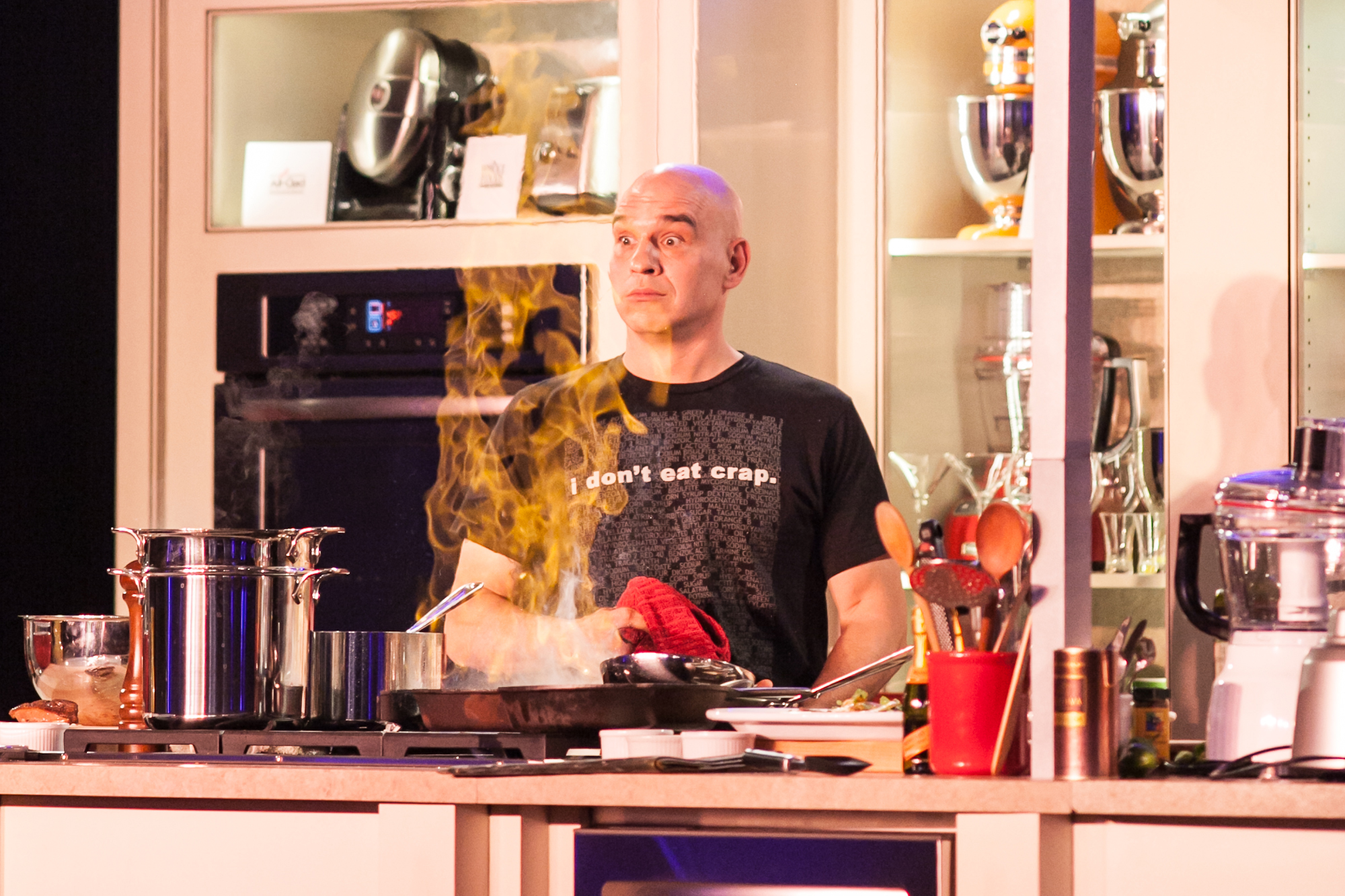
Chef Michael Symon shows his surprise Sunday after a pan caught fire and the flare-up melted part of the overhead mirror during the Classic Cook-off at the 30th annual Food & Wine Classic in Aspen. Photo: Huge Galdones/Food & Wine
I’m not sure how many people have been at all 30 of the Classics but perennial favorite Jacques Pepin said he’s been to 27 or 28 which surely puts him among the leaders. Pepin, who said he teamed with the unforgettable Julia Child 10 or 12 times until Julia found Aspen’s 7,800-foot elevation a bit much, paired this year with long-time friend and fellow chef Jean-Claude Szurdak to win Sunday’s Classic Cook-off.
The Pepin-Szurdak team outwitted the team of chefs Bobbie Flay and Michael Symon to win the popular votes from the exuberant standing-room crowd at Aspen’s St. Regis Hotel. One of the event’s many highlights included Symon doing one of those “why don’t these guys make mistakes?” mistakes when a pan flared and the overhead mirror melted. He took the mishap in impeccable stride, as did Pepin after opening the oven early on his three omelettes, a move expressly warned against in most cookbooks. The audience gasped at this culinary faux-pas but Pepin only shrugged and the omelettes, of course, came out perfect.
Pepin called on his experience with Child when one of the audience asked him about when to use butter. For a moment Pepin channeled his old friend and then responded, “I called in to Julia. You use butter all the time.”
And of course we’ll remember Mark Oldman, not only for his enthusiastic and sometimes irreverent sharing of wine knowledge but also for his attire, this year with an eye on 1982, reflecting the Food & Wine Classic’s first year in Aspen. The irrepressible Oldman (right) spent the weekend garbed in red leather pants (acquired via a used clothing outlet online), black T-shirt and red headband ala Mike Reno, lead singer of the ’80s band Loverboy, which had the hit “Working for the Weekend” the year the Classic began.

Mark Oldman, at the Food & Wine Classic in Aspen, preparing to saber a bottle of sparkling wine.
Oldman also likes to bring surprise wines to Aspen and this year, in honor of the 30th, he shared two wines from 1982, a Jordan Cabernet and Chateau La Croix Bordeaux, both from his personal cellar.
Missing among the 300 or so purveyors under the Grand Tasting tent was a strong showing from Italy, a country that normally has a section to itself. This year, though, you had to wander a bit to find the Italian presence scattered among the other countries.
“You know, with the politics and the economy, things are little tight and I think many of them stayed home,” said Lilly Lo Cascio of Tasca d’Almerita. “Some of them are here, you have to look for them.”
Parts of the American economy seem on the road to recovery. This was the first year since 2008 the Classic sold out (it’s been capped at 5,000 attendees since 1997) in advance and the popular single-day tickets of previous years were not available.
In an interview with the Aspen Business Journal, Food & Wine magazine publisher Christina Grdovic said consumers are still watching their money but are starting too spend a little more.
“Everybody was more frugal and everyone had a strict budget the last few years,” Grdovic said. “Now, people are still careful and maybe more efficient, but things are feeling grander. One of the things that seems to be happening is parties: people are having more and bigger parties again.”
She went on to say that in a recession, people make decisions on what to cut and keep. “So they’ll cut luxury items, but they want to keep some vacation time, time with family and friends,” Grdovic said. “And that’s what Food & Wine is all about, and that works to our benefit.”
And the benefit goes both ways. The S’Wine in the Mine party sponsored by the Infinite Money Theorem winery raised $1,500 for the Aspen Volunteer Fire Department, which is helping fight the High Park wildfire near Fort Colllins.
 Wine Openers