Archive
Colorado Wine Week Day 3 and a tiger (or cougar) by the tail
It’s Tuesday, almost halfway through Colorado Wine Week 2013 and there still are so-o-o many more wines to try during the initial Colorado Wine Week Challenge.

Parker Carlson’s 2011 Cougar Run Grand Valley Dry Gewurtztraminer. Carlson began putting animal figures on his wines 30 years ago, well before so-called “critter” wine became popular. The quality of the drawing is in direct correlation to the improvement in computers and digital art.
I’m leaning in, honest, and I know it seems like work but press on and pull those corks.
You know the drill: Open and share a Colorado wine (or two) every day or night this week. I was hoping it would rain today and cool things off (so hot, so hot) and had a lush cabernet franc (the Grand Valley grows great cabernet franc) all ready to pop but no-o-o.
No rain, temps in the low 90s and drier than a divorce attorney’s laugh.
So tonight, I chose a Carlson Vineyards 2011 Cougar Run Grand Valley Dry Gewurtztraminer ($13.50).
Lots behind this medium-bodied wine, which has crisp acidity and tropical fruit and roses (notice the cute photo)…
Carlson started making a dry gewurtz in 2009, said assistant winemaker Ian MacDonald, when the local chardonnay was in short supply.
“We didn’t have enough chardonnay to make our normal blend and we had this gewurtztraminer ready so I suggested to Parker we dry it out and sell it,” said MacDonald, who starts tomorrow (June 5) bottling the 2012 dry gewurtztraminer.
To Parker’s surprise, the dry version sold, well, I can’t honestly say it ran out the door like Carlson’s luscious cherry wine, but MacDonald said the dry gewurtztraminer pays it’s own way.
And really, that’s all any winemaker can ask.
Carlson made 800 gallons of the 2011 gewurtztraminer, which with my math comes out to about 335 cases.
Even at that, it sells out every year.
The Gewurtz grape itself has a convoluted genealogy but apparently wa-a-a-y back when, it might have originated in a grape from around Tramin in northern Italy’s South Tyrol, where the residents speak German more than Italian.
Back to Colorado Wine Week. The Governor’s Cup Award presentation is Friday night at The Hospitality Learning Center at Metro State College University (sorry, an old habit, y’know), but Parker Carlson won’t be there. Seems every June he and his wife Mary take off for 6 weeks to go fishing in Michigan.
Last year, Mary caught the bigger fish.
Colorado Wine Week Challenge Day 2
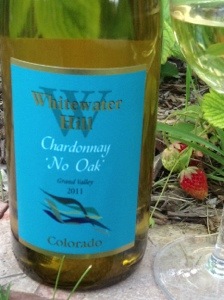
the 2011 “No Oak” Chardonnay from Whitewater Hill Vineyards on Orchard Mesa.
It’s Day 2 of Colorado Wine Week and my personal Colorado Wine Week Challenge, where your task – such as it is – is to open and share a Colorado wine every day during this special week.
My selection today is the 2011 Chardonnay ‘No Oak’ ($14) from winemaker/owner Nancy Janes at Whitewater Hill Vineyards on Orchard Mesa.
Like many of us who enjoy chardonnay, Nancy quit drinking chardonnay for a couple of years after she was put off by the over-oaked wines that swept to popularity a few years ago.
“I like a little oak but that was too much for me,” she said, and the ABC (Anything But Chardonnay) crowd agreed.
She finally gave in, but instead of drinking one of the all-oak, no fruit wines, she decided to make a “no oak” because she wanted something to drink that reflected the heritage of the chardonnay grape.
This wine is a pure reflection of the Chardonnay grape, with a bright, minerally nose and no malolactic fermentation to disguise the grape.
The wine recently received an 87 from the Beverage Tasting Institute.
She also makes a lightly oaked chardonnay for those who just have to have a little oak.
Nancy will be among the winemakers in Denver this weekend for the Governor’s Cup Awards presentation Friday at Metro State University and the Colorado Urban Winefest presented by Westminster Total Beverage at Infinity Park in Glendale.
Colorado Wine Week Challenge, Day 1
This is the first day of Colorado Wine Week 2013, a weeklong (or did you know that?) celebration of this state’s vibrant wine industry and the best opportunity you may have to sample Colorado wines.
And great food.
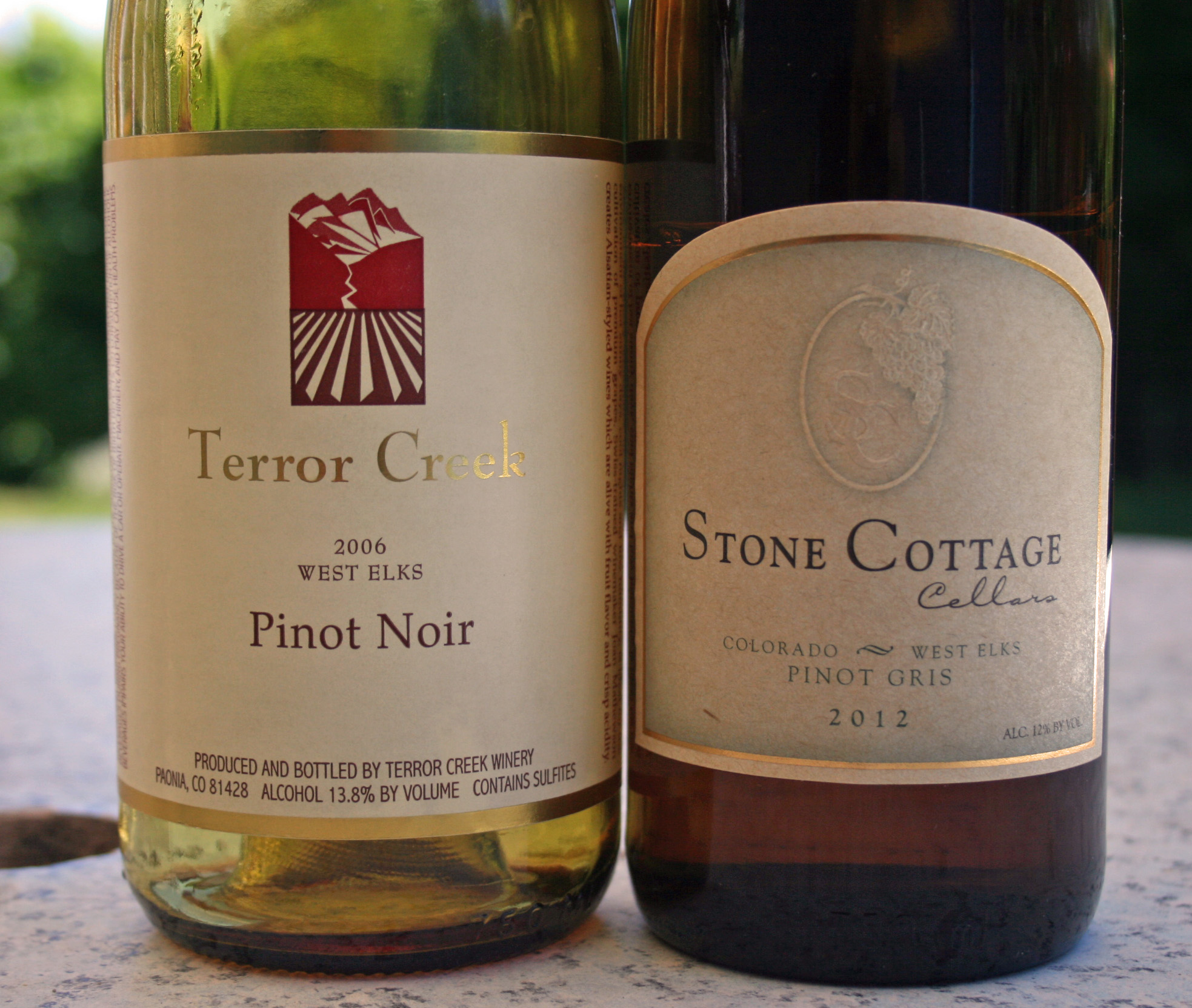
Two first-day selections for Colorado Wine Week Challenge 2013.
And Colorado wines and great food, together.
While the week is sort of, kind of, a statewide thing, its really designed as a Front Range get-together, which for those of you who don’t live in Colorado (that’s fine, don’t move here) means everything east of the Continental Divide.
Which really means the event is aimed the 8 jillion or so people in the urban strip from Fort Collins (north) to Colorado Springs (mid-state).
My blogging and Colorado wine colleague Jacob Harkins of Godot Communications and Local Winos Media has been doing the heavy lifting, which means trying to herd cats with press releases, emails, etc and etc.
You can get all the information you need here, but in short, the week culminates in the third annual Colorado Urban Winefest (presented by Westminster Total Beverage, I have to add), which this year roosts at Infinity Park in Glendale, an innr-suburb of Denver, which obviously is THE place to be Saturday. Around 46 wineries, including many you need to know, pouring their hearts out to please your palate.
That is, if you like Colorado wine, are curious about Colorado wine or know someone who is either or both.
As for me, here’s my contribution – A Colorado Wine Week Challenge: Open and share a Colorado wine every day this week.
Yeah, I know it’s already Sunday but give it a try.
Tell you what. I’ve already opened two local wines, so you can use one for your starter (there’s a glass or two left in the bottle). The rest of the week is up to you.
My first-day choices are the 2012 Pinot Gris from Stone Cottage Cellars ($22) and the 2006 Pinot Noir ($26, if available) from Terror Creek Winery. Both are West Elks AVA wineries and situated near each other (like 500 feet apart) just west of Paonia, high above the valley of the North Fork of the Gunnison River.
And when I say high, I mean that Joan Mathewson of Terror Creek is making her elegant and thoughtful wines at 6,417 feet, making hers the highest winery in the north hemisphere.
And Stone Cottage Cellars Pinot Gris has a body and heft, hints of melon, fig and almonds, that recalls how well-made pinot gris tasted before the demands of the market onslaught ruined it, just as the same overweening push for profits ruined merlot. Thank you, Brent and Karen Helleckson of Stone Cottage Cellars.
That’s the end of the Sunday sermon.
Take the week to explore some of the restaurants and bars offering food and Colorado wine pairings, menus available here.
Keep me posted on what you’re drinking, and tomorrow I’ll share the Day 2 selections for the Colorado Wine Week Challenge.
Let’s see, where is that corkscrew??????
A rosé is a rosé except when it’s not
Curious about how marketing targets a single demographic and looking for something  totally different, I received a sample of Mommy’s Time Out, a line of wines imported from Italy by Selective Wine Estates of East Hanover, N.J.
The Mommy’s Time Out line includes a Moscato (from Sicilian grapes), a Pinot Grigio/Garganega blend, a Rosso Primitivo and Delicious Pink, a blend of merlot and raboso all priced around $10.
I had the Delicious Pink, and while it’s not something I’ll drink everyday, it showed nice berry notes on the nose with raspberrry and strawberry flavors and a bit of spice.
An easy drinking wine, a bit sweet for some palates (mine, for sure, which makes me think I’m not the demographic this wine is meant for) but something a lot of people will like for an afternoon relaxing or a picnic on the lawn.
Here’s a quote I found credited to Mike Cincotta, president of Selective Wine Estates, Inc. importers and brand owners of Mommy’s Time Out.
“Mommy’s Time Out is purchased primarily by women, who are also avid fans of rosé wines,” he said. “It seemed logical to extend the brand offerings with a rosé wine that our existing fans would enjoy.”
By color alone this qualifies as a rosé, just as white zinfandel and Blue Nun qualify as rosés.
I passed a bottle to one of my “volunteer testers” – aka the nice ladies who work at the front desk and who are always willing to take a gamble on a wine they don’t recognize – and one of them took the bottle home and then had to play keep away from her husband, who supposedly wasn’t a wine drinker. He at first downplayed the pink label but came back for his second glass.
Which may indicate the demographic is wider than Mike Cincotta stated.
Information here.
Delayed bud break has grape growers waiting
Those shaggy-maned grape vines you see around the valley haven’t been ignored, they’re actual serving a purpose.
It’s bud break in the Grand Valley, a time when most of the valley’s grape growers finish pruning their winter-long vines on the bet those still-tender roseate buds will survive anything Mother Nature might throw their way.
However, with this spring a series of warm/cold, then warm-and-cold again fluctuations, nobody’s quite sure how to prune, which means growers are leaving some vines undocked until it’s known with certainty which plants survived the winter cold.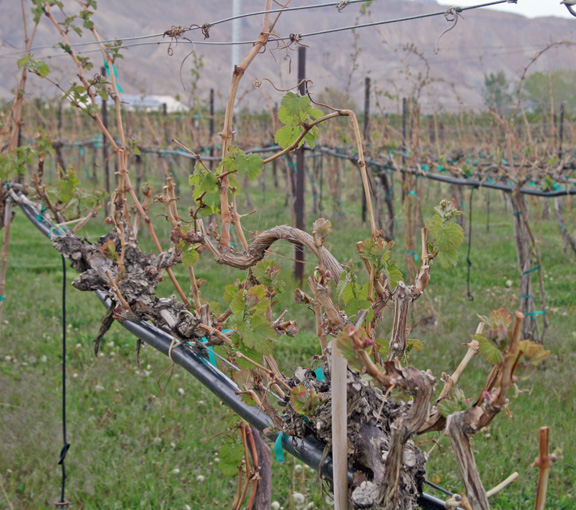
(Right: The uneven arrival of bud break in spring 2013 has grape growers waiting, hoping the green returns to signal life in the vines after the deep cold of January.)
Bud break normally occurs irregularly around the region, spread out among the many micro-environments and grape varietals dotting the area, but this year, what’s normal?
“It’s just all over the place this year,” said state viticulturist Horst Caspari. “It’s abnormal even by Colorado standards.”
He said an extended bud break isn’t unexpected “but now we’re seeing plants 100 percent out and unfolding their leaves and next to them are plants that are barely into bud break.”
When bud break starts, though, it seems to happen overnight. The first rush of growth comes quickly; vines that were winter-dormant Monday will have swollen buds Tuesday and tiny green leaves Thursday.
“It really happens fast, once it gets started,” said Nancy Janes of Whitewater Hill Vineyards, walking last week through the vineyards near her winery on 32 Road.
Some of the canes (branches) in her vineyard are whiplike and long, flocked with bits of green from emerging leaves and mini-clusters, all a bit of insurance to protect the buds closer to the main stem, she said.
“Normally we cut this off, leaving these two buds on a short cane,” she said, showing where a pruner would remove much of the longer canes. “The less vine, the more the energy goes in the grapes and not into growing the canes.”
The vines are apically dominant, which means the end bud releases a chemical (auxin) that retards the development of lateral buds closer to the stem.
If the apical bud is removed, the other buds start to grow. Controlling the growth of those lateral buds through careful pruning is how grape growers control their vines and also how bonsai trees and espalier (growing a plant two-dimensionally against a wall) are created.
Topiary is the three-dimensional version. Think of those Mickey Mouse trees at Disneyland and you get the idea.
Tomatoes are not apically dominant, which is why they spread out instead of up. This widening eliminates competition by creating a cleared area around the plant.
Cutting the apical buds spurs growth in buds closer to the trunk or stem but once buds break dormancy they are more-susceptible to frost.
Historically the average last day for frosts in the Grand Valley is May 13, a comment that brings a laugh from my friend Neil Guard.
“Yes, but Mother Nature doesn’t read the calendar,” said Guard, who grows grapes and peaches on his farm and vineyard on East Orchard Mesa.
“It’s really a gamble at this point,” Guard said Sunday afternoon as he walked part of his vineyard. “We had the crew prune the riesling because we know that usually does fine but look at the tempranillo, there’s hardly anything there at all.”
The name “tempranillo” comes from the Spanish world for “early” but you’d never know it by looking at Guard’s vines. While nearby rows of cabernet franc ware flush with new buds and leaves, the rows of tempranillo are showing slight signs of life and he’s purposely left those vines long and wild until he sees what grows.
“Look here,” he said, grabbing at a nearby vine. “I’ve got vines with lots of buds and leaves right next to vines that look like their dead, which they might be after last winter.”
He sighed and stood up to survey the rows of vines.
“We’re going to wait,” he said cautiously. “We still have almost two weeks and why spend the money on pruning something when you might end up cutting it off at the ground?”
The uneven arrival of bud break in spring
The uneven arrival of bud break in spring 2013 has western Colorado grape growers waiting, hoping the green returns to signal life remains in the vines after the deep cold of January.
Those shaggy-maned grape vines you see around the Grand Valley’s vineyards this spring haven’t been ignored, they’re actual serving a purpose.
It’s bud break in Colorado first AVA, a time when most of the valley’s grape growers finish pruning their winter-long vines on the bet those still-tender roseate buds will survive anything Mother Nature might throw their way.
However, with this spring a series of warm/cold, then warm-and-cold again fluctuations, nobody’s quite sure how to prune, which means growers are leaving some vines undocked until it’s known with certainty which plants survived the winter cold.
Bud break normally occurs irregularly around the Grand Valley, spread out among the many micro-environments and grape varietals dotting the area, but this year, what’s normal?
“It’s just all over the place this year,” said state viticulturist Horst Caspari. “It’s abnormal even by Colorado standards.”
He said an extended bud break isn’t unexpected “but now we’re seeing plants 100 percent out and unfolding their leaves and next to them are plants that are barely into bud break.”
When bud break starts, though, it seems to happen overnight. The first rush of growth comes quickly; vines that were winter-dormant Monday will have swollen buds Tuesday and tiny green leaves Thursday.
“It really happens fast, once it gets started,” said Nancy Janes of Whitewater Hill Vineyards, walking last week through the vineyards near her winery on 32 Road.
Some of the canes (branches) in her vineyard are whiplike and long, flocked with bits of green from emerging leaves and mini-clusters, all a bit of insurance to protect the buds closer to the main stem, she said.
“Normally we cut this off, leaving these two buds on a short cane,” she said, showing where a pruner would remove much of the longer canes. “The less vine, the more the energy goes in the grapes and not into growing the canes.”
The vines are apically dominant, which means the end bud releases a chemical (auxin) that retards the development of lateral buds closer to the stem.
If the apical bud is removed, the other buds start to grow. Controlling the growth of those lateral buds through careful pruning is how grape growers shape their vines and also how bonsai trees and espalier (growing a plant two-dimensionally against a wall) are created.
Topiary is the three-dimensional version. Think of those Mickey Mouse trees at Disneyland and you get the idea.
Tomatoes are not apically dominant, which is why they spread out instead of up. This widening eliminates competition by creating a cleared area around the plant.
Cutting the apical buds spurs growth in buds closer to the trunk or stem but once buds break dormancy they are more-susceptible to frost.
Historically the average last day for frosts in the Grand Valley is May 13, a comment that makes Neil Guard laugh.
“Yes, but Mother Nature doesn’t read the calendar,” said Guard, who grows grapes and peaches on his farm on East Orchard Mesa.
“It’s really a gamble at this point,” Guard said Sunday afternoon as he walked his vineyard. “We had the crew prune the riesling because we know that usually does fine but look at the tempranillo, there’s hardly anything there at all.”
The name “tempranillo” comes from the Spanish world for “early” but you’d never know it by looking at Guard’s vines. While his nearby rows of cabernet franc are pulsing with buds and leaves, the rows of tempranillo are showing slight signs of life, and he’s purposely left those vines long and wild until he sees what grows.
“Look here,” he said, grabbing at a nearby vine. “I’ve got vines with lots of buds and leaves right next to vines that look like their dead, which they might be after last winter.”
He sighed and stood up to survey the rows of vines.
“We’re going to wait,” he said cautiously. “We still have almost two weeks and why spend the money on pruning something when you might end up cutting it off at the ground?”
The King of Blues adds line of signature wines
At 87, most people might be ready to slow down.
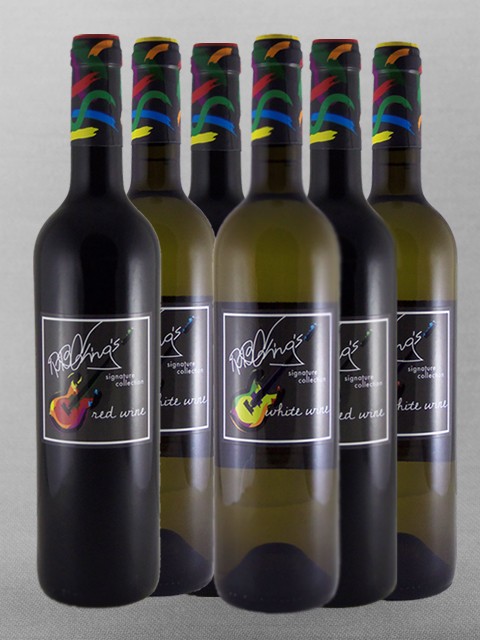
The B.B. King line of signature wines from Votto Vines importing.
Guess we already know blues guitar legend B.B. King isn’t what you might consider “most people”.
In a life filled with accolades, including 15 Grammys, membership in both the the Blues Hall of Fame (1980, first year inductee) and the Rock and Roll Hall of Fame (1987), the Presidential Medal of Freedom (2006), millions of fan and countless hours of performing, King likely has accomplished what few musicians have accomplished.
Now, maybe to show us he’s not strictly one-dimensional and knows a bit about a whole lot in addition to music, the “King of Blues” is launching his own line of wines.
King is collaborating with Connecticut-based Votto Vines Importing to release a new line of B.B. King signature wines.
So far the list contains only a red and white, but even the King had to start playing by the scales.
The wines rolled out this week in Memphis (where else?) and Nashville and soon will be found in B.B. King’s Blues Clubs and in retail stores, wine bars and music clubs throughout the country, according to a release from Votto Vines.
Although Votto Vines is best known for its in-depth knowledge and handling of wines from boutique wineries worldwide and for its role in importing and promoting Italian wines (the company is the sole U.S. importer for Order Sons of Italy), the B.B. King wines are sourced from the Bodega Santa Cruz Winery in Almansa, Spain.
Almansa is a D.O. region in the southeast part of Castilla-La Mancha (think Don Quixote) in southeast Spain. The region is known for its Garnacha Tintorera –based wines, which are different from the Garnacha-Grenache wines. Almansa has nearly 1.7 million acres of vines, some of the most extensive vineyards in Europe.
The B.B. King Signature Collection Red 2010 is a Crianza blend made from Garnacha, Syrah, and Cabernet Sauvignon while the B.B. King Signature Collection White 2011 is comprised of 100% Verdejo grapes.
Both are listed at $13.99.
The red blend is aged 12 months in French and American oak and has earthy notes with red and dark fruits, soft tannins and some unexpected elegance in a wine with enough backbone to stand up to some Memphis barbecue.
The Verdejo, a perfect spring-time wine, is pale straw-yellow with notes of citrus and tropical fruits and a touch of Verdejo’s characteristic minerality on the finish.
B.B.King’s wines may be a cure for the blues.
Pushing the edge: Growing a high-country hybrid

Jeff Stultz grows hybrid Norton grapes in these vineyards southwest of Cañon City, Colorado
High along Oak Creek Grade, eight miles south of Cañon City, Colo., where the pavement ends and the road melts into the Pike-San Isabel National Forest, travelers come upon an unexpected sight – neat rows of dark-green vines bearing deep-purple grapes.
Vineyard owner Jeff Stultz says many people stop to take photos, unaware that back in Cañon City, in the tasting room at the Winery at Holy Cross Abbey, they will find a wine made from those high-country grapes.
It’s a wine different from other Colorado wines, which is fitting for the singular winery rooted at a former Benedictine Monastery.
The wine is a Norton, made from the American hybrid grape of the name familiar in the South and Midwest but a commercial rarity in Colorado, where the industry is dominated by European grape varieites, which aren’t always the right match for Colorado’s cold winters and unseasonal frosts.
The vines belong to Stultz and his wife Sue Allen-Stultz and Jeff’s parents, Fred and Gloria Stultz. Jeff is the assistant winemaker at the Abbey winery and in a former life was head greenskeeper at the Steele Canyon Golf & Country Club near San Diego, where Sue was the head golf professional.
Jeff’s family homesteaded near Cañon City in 1873 and when Jeff and Sue decided in 2001 to make Colorado their home, they found his parents already had some vines at the family ranch, which sits at 6,800 feet.
Those vines also were the expected European wine grapes, including cabernet sauvignon, merlot and chardonnay, all ill-suited to what may be the highest vineyard in the nation.
On the advice of Abbey winemaker Matt Cookson and state viticulturist Horst Caspari, an outspoken advocate of hybrid varieties, Jeff planted riesling and Norton vines.
“We planted 150 Norton vines and 500 riesling vines,” said Stultz, 44. “After a winter or two, the riesling were dying and we just couldn’t kill the Norton. So we kept planting Norton and now we’re up to about 500 Norton vines and there are probably between 30 to 35 riesling vines still hanging in there.”
Norton was developed in the early 1800s by Daniel Norton in Richmond, Va. Considered the cornerstone of a burgeoning U.S. wine industry until Prohibition ended most domestic winemaking, the grape today is grown along the East Coast, South and Midwest, where it’s sometimes referred to as the “Cabernet of the Ozarks.” It’s so popular that famed Austrian glass manufacturer Riedel made a special Norton glass in 2009..
Norton is popular because it is disease- and cold-resistant and lacks the pungent “foxiness” found in other hybrids. During the 2012 Drink Local Wine gathering in Denver, several Nortons were tasted and at least one of them, from Missouri but I can’t find my notes to tell you the name, was quite enjoyable. The others were unremarkable.
Back to Stultz: As his Norton vines matured, Stultz had enough grapes for Cookson to blend some into a popular merlot-based sweet red wine called Sangre de Cristo Nouveaux.
Stultz discovered that sending the Norton juice through malolactic fermentation, which converts harsh malic acid into softer lactic acid, drops the wine’s initial acidity (and its pungency) while enhancing the grape’s dark-berry fruit characteristics.
He said the vineyard’s elevation produces smaller grapes with deeper phenolics, which affect the color, flavor and mouthfeel of the wine.
“The color is so intense, you’re totally stained after crush,” he said. “The wine is a fruit bomb with really bright flavors.”
It’s not like they’re over-run with grapes. In 2010, about three tons of Norton were harvested, enough for 65 cases.
That wine, likely the only 100 percent Norton bottled in Colorado, was released this spring and is expected to sell out quickly, said winery spokesperson Sally Davidson.
The Winery each year produces between 13,000 and 14,000 cases of wine, but don’t expect much expansion in the hybrid line.
Cookson wants to focus on his present line of wines and Stultz, who judges homemade wines at the Fremont County Fair, is blunt in his assessment of most hybrid wines.
“They don’t do anything for me,” he said. “But the Norton has been a great wine. Those trying it really like it and now we have 200 gallons of it.”
The wine is available only at the winery in Cañon City.
The world at their door – Artisan Colorado distiller gains national attention
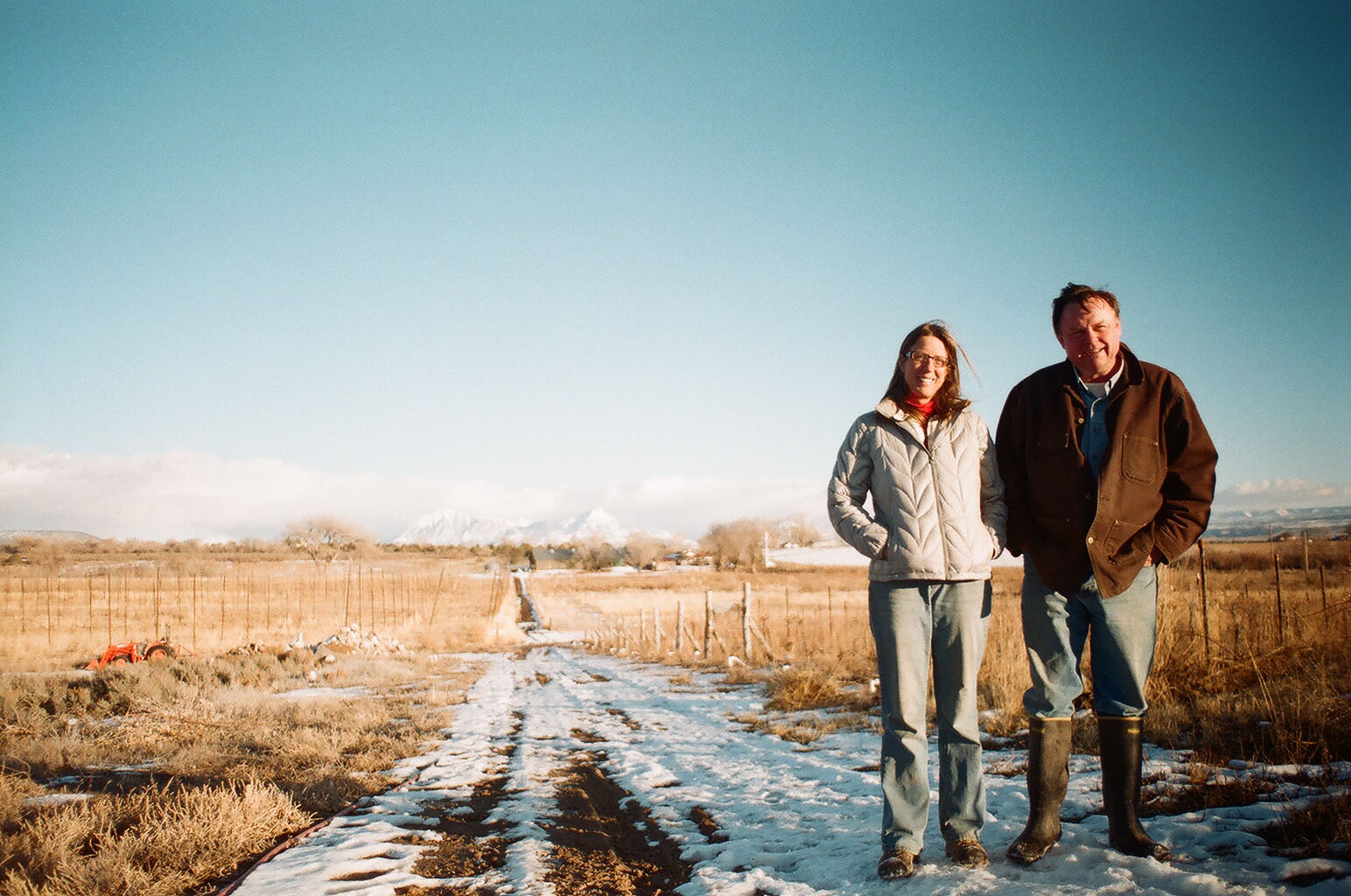
Anna and Lance Hanson of Redlands Mesa in western Colorado have been attracting national attention with their artisan wines and spirits. Their Peak Spirits CapRock Organic gin was a semifinalist in the 2012 Jame Bears Foundation awards.
REDLANDS MESA – The mid-March sun streams into the south-facing windows, spreading warmth and light into the spacious interior of Anna and Lance Hanson’s hardwood-floored home.
A fireplace is sunk into a wall of hand-dug rock and just outside the wall of glass, among the rows of grape vines awaiting the return of spring, wanders a small flock of sheep, carefully monitored by Stella and Luna, the Hanson’s twin Great Pyrenees guard dogs.
This multi-story house, perched like a sentinel overlooking the Hanson’s 72-acre farm on a south-sloping shoulder of Grand Mesa, not only is their home but also, as Lance points, “the world headquarters” for their Jack Rabbit Hill Winery and Peak Spirits distillery.
Although the Hanson’s Demeter-approve biodynamic farm and vineyards on Redlands Mesa initially may seem a bit isolated, the discriminating world of food and drink has found its way to their doorstep.
Last year, their CapRock Organic Gin was a semifinalist for the prestigious James Beard Award in the Outstanding Wine & Spirits – Professional category.
Also, both CapRock gin and vodka were the 2012 Good Food Awards winners in their respective categories. The awards recognize outstanding artisan food products and producers in different categories, including cheese, cured meats, beer and spirits.
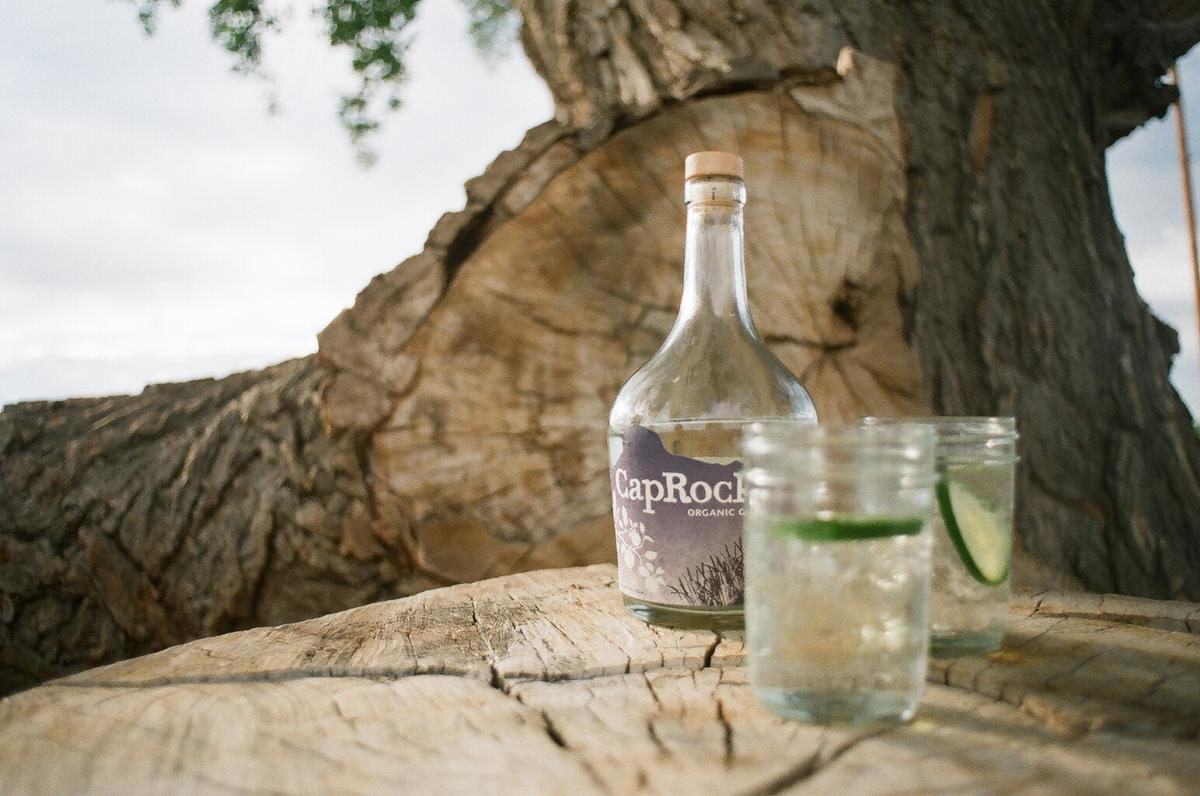
The Peak Spirits CapRock Organic gin was a 2012 Jame Bears Foundation semifinalist as well as the winner of a 2012 Good Food award.
“That was a complete surprise to us,” said Lance in a rare quiet moment not devoted to managing a biodynamic winery, distillery, and hops farm.
“Awards like that are great, and we’re immensely proud and appreciative,” he said. “But what awards like that really tell us is we’re on the right path.”
The right path includes using local, organically grown Jonathon and Braeburn apples for their gin and their estate-grown biodynamic Chambourcin grapes for their vodka.
There’s also the water used to reduce the 170-proof base spirit to around 40 percent (80-proof) in the final product. Peak Spirits uses unfiltered spring water issuing from beneath the volcanic cap of Grand Mesa.
“We can’t take you there,” said Lance when asked about the source. “I mean, we really can’t because the road is snowed in.”
“Besides, it isn’t very glamorous,” offers Anna.
Glamorous or not, that naturally filtered spring water is key to the gin’s pure flavor, Lance said.
“We would argue water has lot to do with it,” said Lance, watching sunbeams dance in a small glass of his gin. “You have to sell what you have and the bottom line is we think this water definitely is contributing to the quality of our product.”
Using that pure mountain water allows the pure expression of fruit, herbs and other botanicals used in their gin, vodkas and brandies.
“Things get more complicated when you put it in the bottle,” Lance said, suggesting the hardest thing to get right (as if there were only one) is retaining the desirable mouth feel, a dimensional roundness giving a pleasing depth to the drink.
“I think the water has something to do with it plus we’re using distilled fruit rather than grain,” Lance said.
Also worth trying are the Peak Spirits brandies – an organic pear eau de vie and biodynamic grappa, both made in limited quantities.
“Our European visitors love eau de vie, they say it’s like capturing summer in a bottle,” Lance said.
Maybe it’s because Americans are traveling more and being exposed to European ways, but in recent years there has been a small uptick in domestic appreciation of these European-style brandies.
“There’s a definite upward trend,” said Anna, ruefully recalling how soon they’ll sell out of the current limited bottling of eau de vie (French for “water of life”) and grappa. “We should have made more.”
The Hanson’s Jack Rabbit Hill Winery offers organic and biodynamic estate-grown and single vineyard wines. We’ll get to those on our next visit.
Season changes begin down on the (organic) farm
Let’s see. You’ve visited most of the wineries in the valley, bent your elbow at a nearby distillery and quaffed a brew or two (I love that) at one of the local brewpubs.
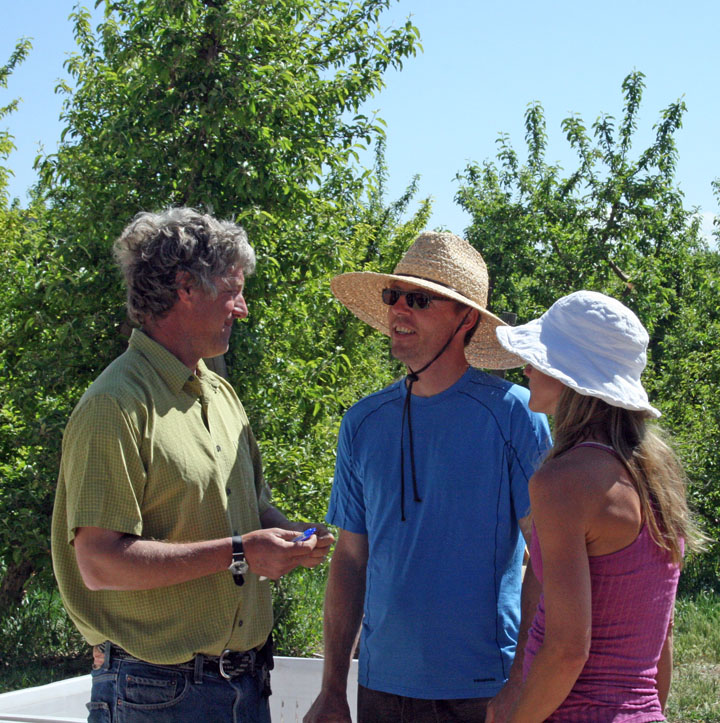
Steve Ela of Ela Family Farms on Rogers Mesa discusses the secrets of organic farming with Mark Glenn and Melanie Evans-Glenn of Conscious Coffee, a craft micro-roaster in Boulder, during the 2012 Ela farm tour.
What to do, what to do?
There is the entire North Fork Valley to visit, with wineries and brewpubs and yes, even a distillery or two, although most of the wineries are in winter mode, which means call first, while the distilleries and brewpub(s) always are happy to see a new face.
Here’s a hint for something more seasonal: Know farmers, know food.
It’s almost calendrically spring, if there is such a word, and that means fruit blossoms, rambunctious baby animals and the universal green emergence that nearly overwhelms the winter-dulled senses.
Because the green-fuse energy is so concentrated in a small valley, few places in Colorado can rival the explosion of spring that overwhelms the North Fork Valley.
Toss in a happy farmer or two, especially one willing to share the secrets to the bounty from his land – and with a sense of humor to boot – and you find yourself face-to-face with Steve Ela of the Ela Family Farms on Rogers Mesa.
Just so you won’t think his is strictly a one-man farm, Steve and Becky Ela and their family and co-workers will be hosting their annual Farm Tour this year on April 14, a whole day before your taxes are due and time enough to forget that next-day date with the foot-tapping accountant.
The tour starts at 10 a.m. and takes the better part of two hours, maybe more, if you ask a lot of questions and can talk Steve into grafting a new fruit tree or two, starting up the wind machine (hold on to your hat) and explaining why he grows peaches, cherries and apples and not, say, apricots.
For someone whose “farm” consists of a 10×15 garden in the backyard, what happens on a real farm, particularly an assiduously organic farm, can be something of a mystery.
When do you prune and how much, do you use pesticide/insecticide, where do all these apples go, and how many types of apples do you have, anyway, are good questions to pose, since Steve and Becky know the answers.
The tour is popular among the members of the Ela CSA (Community Sponsored Agriculture) and you’ll meet people from all around Colorado. Last year’s tour drew around 80 people while the farm dinner attracted about 100.
This year’s Saturday night dinner, due to the spring-fresh mid-April date, will be at Dava Parr’s delightful Fresh & Wyld Farmhouse Inn in Paonia. Dinner costs are $45 adults, $16 children under 4 feet, $8 children under 2 feet.
Many of the visiting Front Rangers spend Saturday night camping in the Elas’ orchard (or one of the Elas’ orchards, anyway), where this year the sliver of moon won’t hide the countless stars peppered across the sky.
The tour and education is free, the accompanying box lunch (from The Living Farm in Paonia) are $16 adults, $9 children.
Tour information and meal registration is available from Jeni at jeni@elafamilyfarms.com or 720-941-4889. Farm information at http://www.elafamilyfarms.com
The friendship and peach blossoms also are free.
 Wine Openers