Archive
Plenty of grapes but a shortage of accuracy
Here is another example of how bad reporting makes for confused readers.
In a recent online issue of The Business Insider was a story headlined “America Won’t Have Enough Grapes To Make All Of The Wine It Wants To Drink.”
Neither the all-caps headline nor the breathless claim stand up to scrutiny.
The story quotes an report from Gino Rossi and Craig Woolford. Craig is marketing analyst for Citi, the global banking conglomerate, specializing in supermarket retailing.
Their premise is that because an oversupply of California wine grapes 20 years ago caused some growers to pull their vines for more-profitable crops such as almonds, the increased interest seen recently in wine drinking means grape growers can’t keep up with demands and that in a few years a grape shortage is likely.
Well, maybe not and here’s why…
Rossi and Woolford write, apparently without their fingers crossed, that “[S]trong consumption growth in the US has meant that demand has eventually caught up to supply and the small harvest in 2011 caused many industry participants to panic,” they add. “This sent grape prices higher, indicative of how nervous the industry is about a growing grape shortage.”
It’s not new news that more Americans are drinking wine and that seems to have spurred a cottage industry in stories about a possible grape shortage.
Of course, it seems such stories invariably originate from sources who stand to make money from the higher grape prices resulting from a perceived shortage.
Funny that anyone with half a sense would forecast a grape shortage, since we’ve been reading stories such as this which says California winemakers are concerned about not having enough tanks for this year’s harvest following last year’s record harvest.
And this announcing Marlborough’s record harvest and and this from Bloomberg saying the French harvest, despite hail in parts of Bordeaux and Burgundy, may be up by 11 percent overall this year.
Fortunately, there are insightful and cautious industry watchers such as Lew Perdue at Wine Industry Insight who saw through the awful story and posted this rebuttal and then there was this from the inestimable Jeff Siegel of The Wine Curmudgeon, who also scoriates the above mentioned marketing types for their hyperbolic “pump and dump” style of writing.
Impacts of winter cold being felt in vineyards

State viticulturist Horst Caspari shows the gap between where a healthy grape vine should be and where this year’s vines have reached after the deep freeze of last January affected this year’s growth.
With an exasperated sigh, Colorado state viticulturist Horst Caspari grabbed at yet another untrimmed grape vine hanging from a trellis and wove the emerald fuse between two wires.
“I know there won’t be many grapes this year in most of these places, but that’s no excuse not to be out here taking care of the vines,” said Caspari, midway through a morning tour of several Grand Valley vineyards on East Orchard Mesa. “You have to spend time in the vineyards this year so you get a good crop next year.”
Valley grape growers are finding this summer a re-run of 2010, when many vineyards were regrown after being killed to the ground by a Dec. 2009 freeze.
Growers again this year are letting most of their vines go wild, building vigor, storing nutrients and growing new branches (canes) to replace those lost to winter cold.
While it lessens the time (and money) owners spend this summer in the vineyard, Caspari said effort now means better production in the future.
“In 2011 we did OK but didn’t have (the grape crop) we should have,” he said. “That’s because (grape growers) didn’t do a good job of retraining the vines in 2010.”
He looked at the dense foliage splayed before him. “This is all this year’s growth and next winter you just re-establish the complete framework,” he said, holding up a handful of new shoots. “But you don’t just lay it down and let it go.”
Last January, shortly after a valley-wide freeze sent temperatures as low as minus 21 degrees, Caspari guessed grape growers this year would see a 75-percent grape loss.
Recent surveys indicate the loss may not be that severe but we saw a lot of leafy but empty vines.
Caspari said the January cold and an April frost that reached 20 degrees was too much for many of the favorite grape varieties.
Merlot seems to have been particularly hit hard across the valley, along with syrah and gewurtztraminer.
“If you can grow Merlot this year, you’ll sell every bit of it,” Caspari said. “Good location is the key.”
“You try to scientifically get your head around it but it’s impossible,” said grape and peach grower Neil Guard at Avant Vineyards on East Orchard Mesa. “You’ll have three plants that have grapes and four that don’t, all within 50 feet.
“I think my Cabernet Franc, Riesling and my Petit Verdot look fine, absolutely just a normal year,” said Guard. “There’s no rhyme or reason to the damage we see.”
As Guard noted, Cabernet Franc, a red grape known for its cold-hardiness, came out of the winter in good shape in most places while Riesling leads the white varieties.
Another challenge facing growers this year is uneven ripening after the late freeze and a cool spring in some places delayed bud break.
“Look, these won’t ripen,” said Caspari, holding a vine bearing several clusters of grapes, each berry tiny and hard, no bigger than a pencil eraser. “They are at least two or three weeks behind now, and all they do is steal nutrients and vigor from the other grapes.
“What’s bad is they will change color so the pickers can’t tell them apart from the ripe grapes,” he said. “But they’re green and they’ll add off-flavors to your wine. They have to go.”
And he started tearing away the green berries, moving vine to vine and throwing the pre-mature clusters on the ground.
Caspari stopped midway down a row of grapes, looking ahead at the hours of work awaiting some vineyard worker.
“There’s an old saying that the thing you want to see the most in the vineyard is your shadow,” he said. “I don’t think people understand how critical it is to train your vines this year in preparation for next.”
Robert Mondavi Private Selection Central Coast wines
Forty years ago you could drive the California coast south to north, staying on the back roads as much as possible and marveling at the many faces of this immense state.
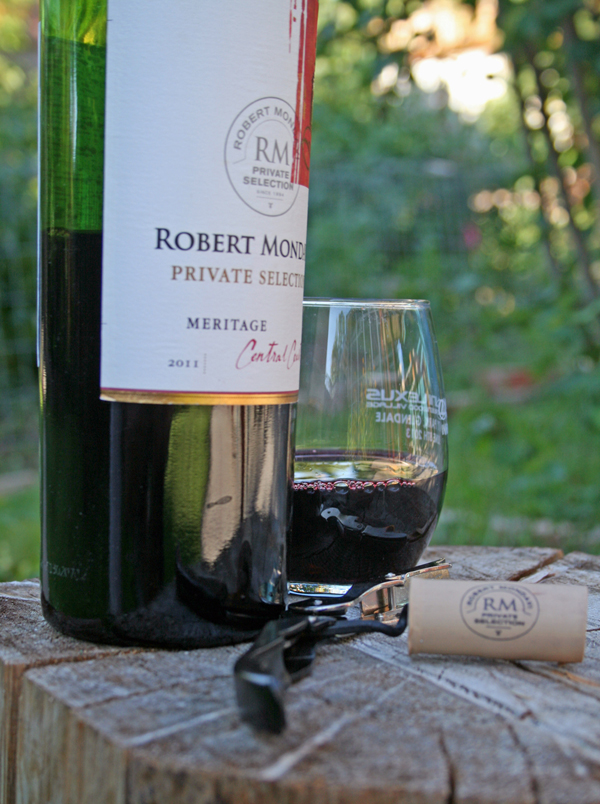
The Robert Mondavi Private Selection 2011 Central Coast Cabernet Sauvignon is one of the Central Coast wines providing quality wine at and affordable price.
In that era when gas cost 40 cents a gallon, you could wander from place to place but one site you wouldn’t see is the amount of winemaking we now see along what’s today is the Central Coast AVA. At least not much compared to the estimated 100,000 acres of grapevines found there today.
Marked by fog, damp and patchy sunshine, the Central Coast AVA stretches more than 250 miles long, a vast area of agriculture tied together by the influences of the Pacific Ocean. The AVA produces 15 percent of California’s wine grapes, including those of Robert Mondavi’s Private Selection wines.
The Mondavi Private Selection wines, founded by Mondavi in 1994 to take advantage of the region’s wide-ranging growing conditions and more recently the RM line of wines aimed at Young Transitionals (upscale 21-35 y.o. with no kids), are examples of how well, and how affordably, dedicated winemaking can produce delicious wines.
This year (June 18) marked the 100th anniversary of Mondavi’s birth and as part of the ongoing celebration of what Robert Mondavi meant (and still means) to winemaking in California and the nation as a whole, I recently had the opportunity to sample a range of his Private Selection Central Coast wines.
This line includes 11 wines – seven reds, four whites, not all of which I tasted – includes Cabernet Sauvignon, Malbec, Meritage, Merlot, Pinot Grigio, Pinot Noir, Riesling, Chardonnay, Sauvignon Blanc, and Zinfandel.
Whew. All are line-priced at the wallet-friendly $11.99 and offer a level of quality rarely seen at that price. It’s easy to forget for a moment these are mass-produced wines, that’s how good they are.
As winemaker Rick Boyer says on the Mondavi Central Coast web site, “To me, winemaking is a lot about combining gut feel, experience, and art. We hope there is soul there.”
The “soul” part I can’t speak of, but the ability of Boyer (and Robert Mondavi) to produce sound, consistent wines at an affordable cost has helped the company become the “third most powerful wine brand” in the world, according to a report from strategy consultants Intangible Business.
2011 Central Coast Meritage – A Cabernet Sauvignon-based blend with Merlot, Malbec and Petit Verdot, offering dark berry flavors with black-cherry and plum notes. Mouth-filling but not over-whelming.
2011 Central Coast Cabernet Sauvignon – A return to the early days of California Cabernet, before the domination of oak hid the natural flavors that initially propelled California to world attention. Lots of red and black raspberry and red cherry with a touch of earthy notes, all highlighted with subtle American and French oak.
2011 Central Coast Chardonnay – If only all California Chardonnay was this subdued, this tasty and this affordable. Lemon rind, green apples and a hint of peach highlight this product of one of the coolest growing season in Central Coast record.
2011 Central Coast Sauvignon Blanc – right out of the bottle, this wine recalls a New Zealand Sauvignon Blanc, with hints of grass and lemon/lime citrus. Behind that,of course, are the citrus, melon and spice that mark California’s version of this uber-popular wine. Crisp acids and bright flavors, a good late-summer sipper.
Mondavi still the Father of American Wine
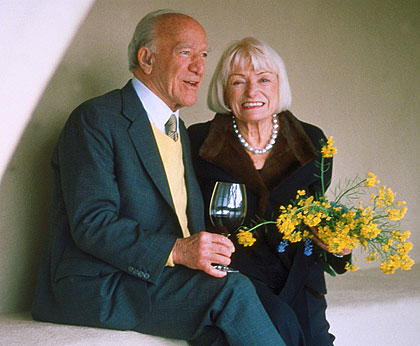
Robert and Margrit Mondavi.
As I write this, standing on the desk near the computer are two bottles of Robert Mondavi Private Selection wines. Like the rest of the Mondavi Private Selection wines (there are 11 in all) the 2011 Meritage and the 2012 Chardonnay are solid, well-made, affordable ($11 SRP) wines from selected vineyards in California’s Central Coast, and they all display the bright fruit, insightful construction and immediate accessibility Mondavi wanted in his line of everyday wines.
It’s been a couple of days since the wrap-up of the 2013 Food & Wine Classic in Aspen and there still is so much to write about, but today it’s all about Robert Mondavi.
June 18 was the 100th anniversary of Bob Mondavi’s birthday (that’s how he introduced himself in his outgoing, direct manner that reportedly was the bane of PR people) and it’s only proper to acknowledge his role in the American wine scene.
You can read elsewhere the lengthy bios about Robert Mondavi but here’s a quick review.
He was born in Virginia, Minn., to first-generation Italian immigrants Rosa and Cesare Mondavi, who in 1921 moved to Lodi, Cal., to raise their family.
In 1943 the family, at Robert’s urging, purchased the Charles Krug Winery where Robert and his brother Peter both worked after graduating college (Robert from Sanford, Peter from Univ. of Cal. – Davis).
Contention ran in the family. The two brothers disagreed – Peter opting for value-priced wines and Robert for wines as good as Europe’s best.
These competing visions eventually led to a family break-up and soon after Robert Mondavi founded the winery bearing his name.
Curiously, his two sons, Michael and Tim, eventually would split up for reasons similar to those dividing Robert and his brother Peter.
Robert Mondavi introduced many of what now are standard winemaking practices, including stainless steel tanks, cold fermentation and using French oak barrels to age wine. But Mondavi’s real strength was in his marketing skills, said Mondavi winemaker Rich Arnold, with whom I spoke in Aspen.
“When I got there, the winery was in transition, with Michael doing the winemaking but Robert was involved with all the blending decisions,” said Arnold, who started with the Mondavi family in 1974. “But his greatest skill was marketing.”
Among Mondavi’s notable decisions was renaming sauvignon blanc “Fumé Blanc,” reportedly because he felt “sauvignon” was too hard for Americans to pronounce and so they wouldn’t order the wine.
“He put the Fumé Blanc in clear bottles when the original frosted bottles weren’t available, and soon everyone was copying the idea of white wine in clear bottles,” Arnold said.
In 1979, Mondavi joined with Baron Phillippe de Rothschild to create the Opus One Winery and it was the Opus One wine that showcased the initial Napa Valley Wine Auction, which Mondavi also founded.
Mondavi passed away in 2008 at the age of 94, but his legacy continues, with his wife Margrit still involved with the winery.
“Margrit is the heart and soul of the winery,” said Rich Arnold. “We get her blessing with each vintage and each bottle.”
I think of that as I look at the two Private Selections wines next to me. It’s interesting to picture a link from those bottles to the legacy of Robert Mondavi, the man known as the Father of American Wine and most-responsible for showing California’s wine industry that affordable, world-class wines were within reach and that America would buy them.
I found this quote from Margrit in a story by Katie Key Bell on the Forbes website:
“He gave everybody advice. Bob’s ecumenical spirit: ‘the more good wine that comes out of Napa Valley the better it is for me.’ So he shared, he was generous, he was philanthropic and I believe that was his biggest contribution to Napa Valley. ” –Margrit Mondavi
Day Two at the Classic and a lesson from Spain with Marnie Old
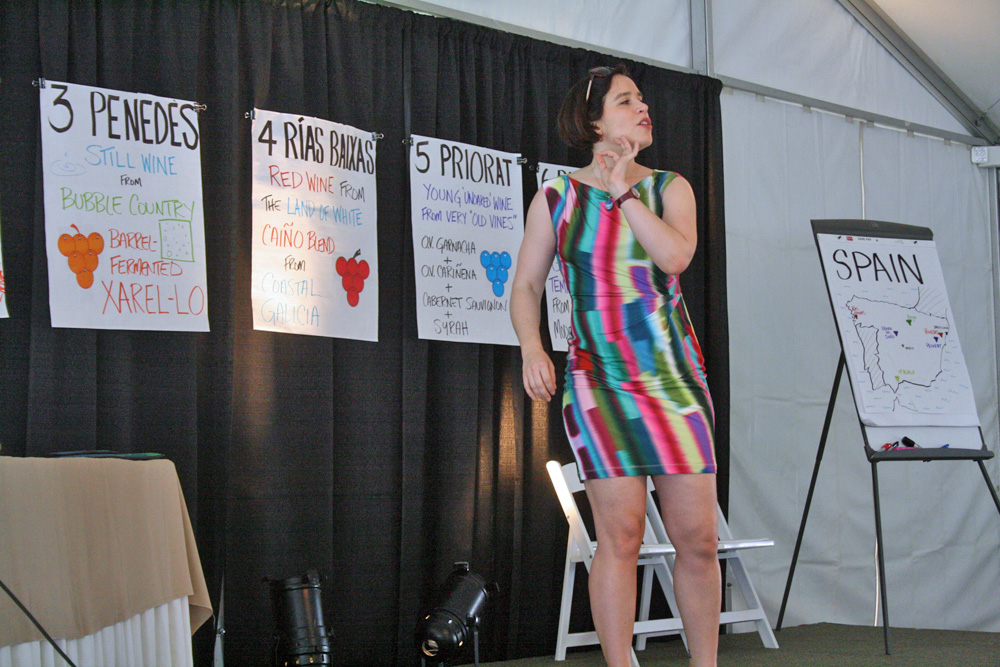
The always entertaining and educative Marnie Old takes her audience on a lively trip through Spain’s best-known wine regions during her presentation Saturday at the 2013 Food & Wine Classic in Aspen.
ASPEN – The second day of the Food & Wine Magazine Classic is a day to catch up with some of the seminars missed on Day One.
Although there never is enough time to see everyone, the weekend schedule is flexible and offers repeat performances of most seminars, allowing me the chance to slip into Marnie Old’s presentation on “Unknown Wines from Spain’s Iconic Regions.”
Marnie Old is very popular, in part because she has a sparkling and engaging personality and also because she’s the best-prepared of the presenters I usually see at the Classic. While some of the presenters may offer difficult-to-see maps and some offer hand-outs listing the wines in their talk and others leave you guessing, Marnie has great maps and visual aids, as we called them in school, and she says it’s because talking to people is how she makes her living.
“A lot of (the speakers) are in the wine business, or own restaurants or aren’t around people a lot,” she said. “I’m the only one who makes her living as an author and speaker, so I know what it takes to capture an audience.”
And communicate she does. Lively, entertaining, not shy about dancing around the stage to make a point, Marnie engages the audience in her topic, which this time was about “breaking the mold” when it come to exploring Spanish wines.
In her quest, she had us tasting Tempranillo Blanco from Rioja; a dry Moscatel from Málaga; barrel-fermented Xarel-lo (one of the three grapes more commonly found in cava): a Caiño dominated red blend from Rías Baixas; “Niti,” a garnache/carineña blend from Priorat; and finally a Gran Reserva tempranillo from Bodegas Protos in Ribera del Duero.
The Tempranillo Blanco, from the five-generation Bodegas Valdemar, was especially interesting because the scarcity of these white-mutation Tempranillo grapes makes this a rarely seen varietal wine.
“Only a few bodegas have enough vines to make an unblended wine,” Marnie said. “But the family behind Valdemar has helped to discover and propagate the grape. We had only two of these wine shipped to us” for the Classic.
Marnie has published two books and is working on her third and also offers an iPad/iPhone app called “Wine Simplified.” She described it as an “interactive crash course for the wine curious.”
It’s available on her web site.
Now, it’s off to the day’s first Grand Tasting, where a world of wine is waiting.
Back in the saddle at the Food & Wine Classic in Aspen
ASPEN – It’s late on Day One of the Food & Wine Classic in Aspen and it was a lovely day, thank you.
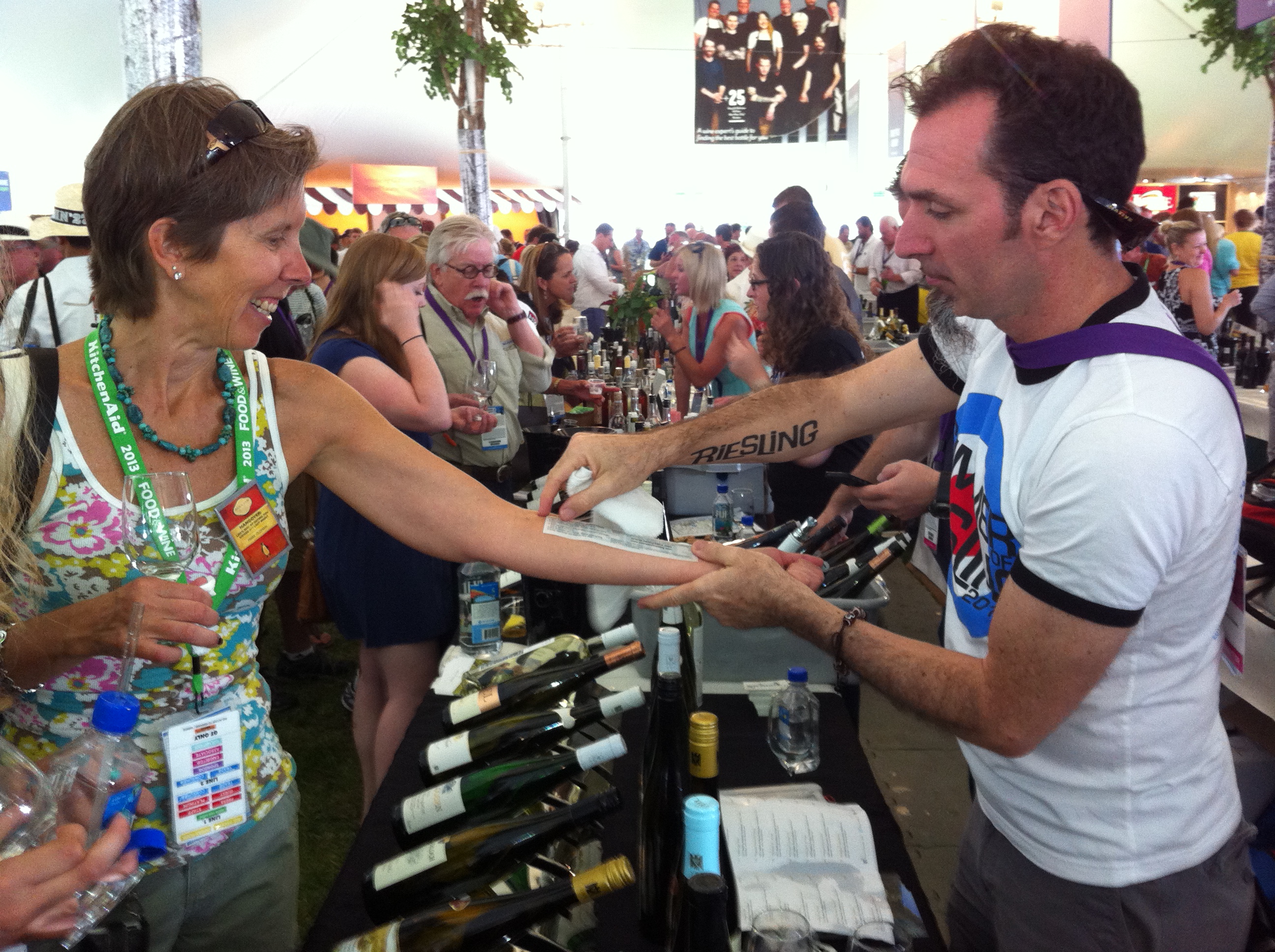
Paul Grieco, restaurateur and Riesling authority (although he modestly denies it) and instigator of the popular Summer of Reisling, administers the rite of a Riesling tattoo to a Brigitte Bielinski during Day One of the 31st annual Food & Wine Classic in Aspen.
This is the 31st annual F&W Classic here in Glitter Gulch and this town puts on a terrific hoedown.
The $1,300 general admission tickets sold out early this year, a sign the economy has recovered a bit, although some cynics might point out that most of the better-heeled fans of the Classic weren’t much bothered by the R(recession)-word.
While many events are very-exclusive, with some of the top chefs doing private meals and wine- and food-related companies tossing invite-only parties, there are plenty of opps for everyone to enjoy great food and sample some of the world’s best wines, which can make for the “Gee, now where do I go?” dilemma so dear to all of our hearts.
As usual, my weekend began with listening to Chief Terroirist Paul Grieco of Hearth Restaurant in NYC disseminate on riesling, one of his (and mine) favorite topics.
It’s Grieco, you remember, who three years ago founded the Summer of Riesling, a movement to sway bars and restaurants to pour more riesling.
This year the focus is on German riesling and Grieco spoke at length (he pleaded, to no avail, to be allowed to go beyond the 45 minutes allotted him) about the transparency of riesling, of the grape’s ability to reflect it’s place of origin.
“The beauty of riesling is it’s transparency,” Grieco said, “while the greatest drawback to riesling is it’s transparency.”
Then it was off to the first of three Grand Tastings held Friday under the immense white tents now symbolic of the Classic.
A quick stroll up and down the line of wineries got me a sip of Henriot Champagne, a splash of Torre Muga 2006 Rioja and then a stop to chat with Ben Parsons, the talented winemaker and owner of The Infinite Monkey Theorem Winery in Denver.
And soon also to be in Texas, he said.
“I’m going to open another (urban) winery in Austin,” said Parsons. “It will be the same sort of urban winery and I’ll be getting some grapes from the Texas Hill Country.”
His immensely popular line of wines includes some lightly carbonated reds (syrah) and whites (rosé, moscato) in 6-ounce cans (serious wines in a not-so-serious presentation) as well as a series in glass.
Parsons’ 100th Monkey, a blend of cabernet franc, syrah, petite syrah and malbec, was especially smooth, luscious and well-balanced.
And then it was time for author and out-sized (in a good way) wine personality Mark Oldman, who each year adopts an alternate personality (at least he claims it’s an alternate personality) for the weekend of the Classic and this year he’s wearing bolero hat, white shirt and black scarf with a new (really new, like fresh from the gag store), caterpillar-sized handlebar mustache.
Yes, he’s channeling “Gaucho Marks” and talking about Argentina malbec.
His take-home message, he said, is “Malbec isn’t for curmudgeons. But if you are the type who into sensual pleasures, a good malbec is almost everything you need.”
And that’s only part of the day. Whew.
Saturday it all starts over. What a weekend, what a Classic.
One last wrap on the Colorado Urban Winefest
DENVER – Gee, I survived almost too-much-fun Friday night at Row 14, waded through the 1,500 or so wine enthusiasts that kindly showed up for the third annual Colorado Urban Winefest on Saturday (where I paired a grilled PBJ with smoked bacon on whole wheat with a Boulder Creek 2010 Cabernet Franc) and then took a serious stumble Monday when I screwed up misstated the facts in my column for my real job at the The Daily Sentinel.
Arrgghh, as pirates would say.
I got confused, or distracted, or just simply wasn’t being mindful. Fortunately, you don’t have to see the crash, although there are a few readers in Grand Junction and elsewhere who this morning are mightily surprised to find out several winemakers have moved to new digs, courtesy of my writing.
So, ugh, let’s move on, shall we?
Overall, Colorado Urban Winefest continues to improve with age, not unlike the Colorado wine industry itself. Final attendance numbers for Saturday’s third annual Colorado Urban Winefest presented by Westminster Total Beverage came out Monday and indicated around 1,500 wine enthusiasts showed up Saturday at Infinity Park in Glendale.
When I spied Kyle Schlachter of the Colorado Wine Industry Development Board schlepping a bit of lunch through Saturday’s crowd, he mentioned strong last-minute tickets sales and healthy walk-up traffic as contributing to the pleasant turn-out.
“I’m really happy with the turnout ,” said Cassidee Schull, director of the Colorado Association for Viticulture and Enology and it seems everyone else was, also. It’s also likely the temperate weather (unlike 2012 when the thermometer was topping out at around 102) – Saturday’s mix of sun and clouds with a cool breeze along with the extensive acres of grass fields – kept fest-goers and winery representatives comfortable all afternoon.
“Yeah, this is a great place,” agreed Mike Thompson of Boulder Creek Winery, one of the 36 wineries present. “I really like the layout here.”
Among the selections Thompson was pouring was the Boulder Creek 2011 Colorado Dry Rosé, which Friday was one of the dry rosés competing for the Governor’s Cup Wine Competition.
Many people familiar with rosé automatically drift away from what they think will be something sweet but a recent trend among Colorado winemakers (Canyon Wind Cellars and Garfield Estates also offer dry rosés) to produce a dry rosé with great fruit has revived interest in the wine.
“It takes a little education, and you have to get them to taste it, but once you do, it’s really popular,” Thompson said. The winemaker is his wife, Jackie Thompson, whose wines always show well in competitions.
The competition must have been close, but the 47-Ten 2012 Grand Valley Rosé from Canyon Wind Cellars was named Best Rosé at the Governor’s Cup. Jay and Jennifer Christianson of Canyon Wind Cellars also won a Double Gold for their 2010 Grand Valley Petit Verdot.
Michelle Cleveland of Creekside Cellars also produces a delightful dry rosé but it’s light-gold in color, similar to a pinot grigio. I wasn’t able to talk with her during Saturday’s crush of people but will get back to you on that item.
As we mentioned Sunday, Michelle was the winner of the Governor’s Cup Wine Competition with her 2010 Grand Valley Cabernet Franc, which I diligently paired with that grilled PB&J with smoked bacon on whole-grain wheat. Highly recommended.
Around 225 wines were judged by the tasting panel of experts including restaurateurs, sommeliers, writers and chefs, most of whom seemed quite pleased with their task.
“They showed tremendous excitement over all the Bordeaux red grapes produced in Colorado, including merlot,” said Doug Caskey, executive director of the CWIDB. No, I don’t know why he singled out merlot, but you can ask him.
One of the judges, wine blogger Jeff Siegel (“The Wine Curmudgeon”), noted the competition “was easily the best showing from Colorado in the decade or so I have judged its wines.”
I appreciate Jeff’s remarks, since he’s attended several Drink Local Wine conferences and has a good idea of how the “other 47” are doing in their wine production.
I just hope he doesn’t read my newspaper version of this column. Arrgghh.
Creekside Cellars continues the reign of Colorado cab franc
It’s Sunday, 95 degrees, and I’m recuperating from Colorado Wine Week.
I missed a Colorado Wine Week post or two Friday and Saturday but really, I honestly have a good excuse.

Winemaker Michelle Cleveland still shows her surprise and pleasure after her Creekside Cellars 2010 Colorado Cabernet Franc was named winner of the Colorado Wine Governor’s Cup competition. The wine won Double Gold for Best of Show and Best Bordeaux varietal.
Friday night’s Day 6 Wine Week Challenge was the Governor’s Cup Awards presentation, and I opened (or had opened for me, which is even better), scads of tasty Colorado wines, including the Best of Show and Double Gold Cabernet Franc from Creekside Cellars.
Saturday, well, Saturday was the Colorado Urban Winefest (lots of nice remarks coming from that event) plus I woke up hungover out of sorts and needed some time to gather my thoughts, which mostly were “Where am I?” and “How did that happen?”
But important things first, right?
Congratulations and a well-deserved high three (it’s a long story but how many fingers does Pluto have?) to Michelle Cleveland, talented winemaker and all-around great person for Creekside Cellars in Evergreen, for winning the 2013 Governor’s Cup Best of Show and Double Gold for her 2010 Cabernet Franc.
Dark, luscious, lots of fruit and a judicious 24 months in Appalachian oak (she said it’s the same species of oak tree used to make French oak barrels) to balance.
Too bad there’s not any left.
Funny story: Michelle said she made 44 cases (that’s about 100 gallons or so) of the wine, which grew in the 10-acre Creekside vineyards in the Grand Valley, (Hey, almost all – 87 percent – of Colorado grapes grow in the Grand Valley) but had only 1 (one, uno, half of two) case left by the weekend.
“I didn’t know how fast it would sell,” she said, but at least she had enough to share with the light intimate crowd at the Governor’s Cup Awards at Metro State University.
Michelle really likes Colorado cabernet franc (the bottle’s label reads simply “Franc,” and underneath says “Colorado’s Cabernet”) and she and Kyle Schlachter of the Colorado Wine Industry Development Board have this plan to promote cab franc as Colorado’s best red grape.
I’m all for it after tasting some of the excellent cab francs being produced by various Colorado winemakers. Curiously, the other double-gold medal Bordeaux-red winner this year also was a 2010 Cabernet Franc by Jackie Thompson of Bookcliffs Vineyards, and the 2012 Gov’s Cup winner was yet another cabernet franc, this one by the enigmatic Matt Cookson of the Winery at Holy Cross Abbey.
“We’ve been making cabernet franc since we opened (2000),” said Michelle, who said she began as a beermaker before making the switch to fermenting grapes.
As for the oak, well, “We like oak,” she said with a sly smile. “But it has to balance with the fruit and the 2010 vintage was huge fruit. The only problem is cab franc needs a long growing season but we haven’t had any problems.”
And for those who are aware of this year’s tribulations in the vineyards (sounds like something Danielle Steel might write, eh?), everyone I’ve talked with are saying (fingers crossed behind their back) their cab franc is one of the few vines to be healthy after the January freeze and the April frost.
And remember 2010 was a light vintage, too, but Michelle had no problem wringing a Best of Show from the grapes.
The rest of the Governor’s Cup winners are here, and among the top award-winners were Glenn Foster (Talon Wines); Jackie Thompson (Bookcliff Vineyards); Jay and Jennifer Christianson (Canyon Wind Cellars); and Matt Cookson (The Winery at Holy Cross Abbey).
There were 225 wines submitted for the competition but Governor John Hickenlooper, who is a great supporter of Colorado wine, wasn’t able to make his usual appearance.
After the awards, I headed over to Row 14, one of the Denver restaurants hosting the Sips & Snacks, pairing a glass of Colorado wine with a larger-than-an-appetizer but smaller-than-your-appetite plate.
Row 14 was pouring the 2011 Two Rivers Winery Syrah and paired it with carnitas tacos. Good food, great wine, nice people, lots of fun. Lots.
Back on the … with Palisade Red
GUNNISON – Back on the road…
Thursday night in Gunnison, one of the most beautiful towns in the state.

Plum Creek Cellars winemaker Jenne Baldwin-Eaton calls this Bordeaux-style blend of Merlot, Cabernet Sauvignon and Cabernet Franc her red table wine. It’s a lovely wine, even when the table is no more than a concrete road barrier next to the Taylor River north of Gunnison.
The early June weather is perfect, there is a bit of snow in the high country for a scenic backdrop and it’s too early for the mosquitoes.
And they do get world-class skeeters here, with all the flood irrigation drenching the fields.
Locals get a hoo-hah about saying small children and dogs have been carried away.
It’s Day (well, let’s see, what day is it? oh, yes, 6) that’s it, Day 6 of Colorado Wine Week 2013 and not coincidentally also Day 6 of the Colorado Wine Week Challenge.
Well, my challenge, anyway, which is for you to open and share a Colorado wine everyday or night or both this week.
Sharing is a good idea, or you’ll possibly wind up with a fridge full of open bottles, standing there, corks just waiting to be popped and shared.
Tonight, my Wine Challenge wine is the Plum Creek Cellars 2009 Palisade Colorado Table Wine, a medium-bodied red with soft tannins and plenty of dark red fruit, with just a hint of spice.
Plum Creek prides itself on always being 100-percent Colorado grapes, and most of these grapes were grown in the Grand Valley AVA with the rest coming from the West Elks AVA.
It’s a blend of merlot (42 percent); Cabernet Sauvignon (42) and Cabernet Franc (16). Sometimes in the past the blend has included syrah or zinfandel but this version is the three Bordeaux grapes.
I may have the Cab Sauv and Cab Franc mixed up but I know the wine is mostly merlot. I left my notes at home, so if it’s wrong, I’ll fix the ratio when I get back Sunday. (I’d send you to the Plum Creek website, but it’s hopelessly out of date.)
According to Plum Creek winemaker Jenne Baldwin-Eaton, 2009 was notable because it was the last of the great vintages.
“It was nearly perfect – long, even temperatures, with great ripening of all our grapes,” she said last week. “All the vintages since then have been, well, trying.”
Which means too hot, too cold, too short, too long, or all of the above.
What’s also remarkable about 2009 that it stayed warm well into October, so long into October that Jenne was picking grapes for a Late-Harvest Sauvignon Blanc (that’s for later this week) at the end of October and into early November.
But then the door slammed shut.
A deep, deep freeze, with temperatures in the valley hitting 22 below zero, swept into western Colorado Dec. 9-10, and within a week grape growers were reporting losing 75 percent and more of their vines, I mean froze smack to the ground.
Obviously, there weren’t many grapes available in 2010. That 2010 vintage was so small, one winemaker friend made his whole year’s production in a 7.5-gallon carboy.
And there’s talk this year, after the hard freeze last January and the late freeze April 17-18 (20 degrees), may be short, also. We’ll hear more about that as the season goes on, but there is a lot of open space in the grape vines this summer.
Tomorrow night (Friday) is the Governor’s Cup Award presentation at Metro State University, so I’ll be drinking award-winning wines for the wine challenge. Oh, to celebrate and drink interesting wines.
A high-falutin’ dry rosé from 47-Ten feet high
It’s a busy fin de semana.
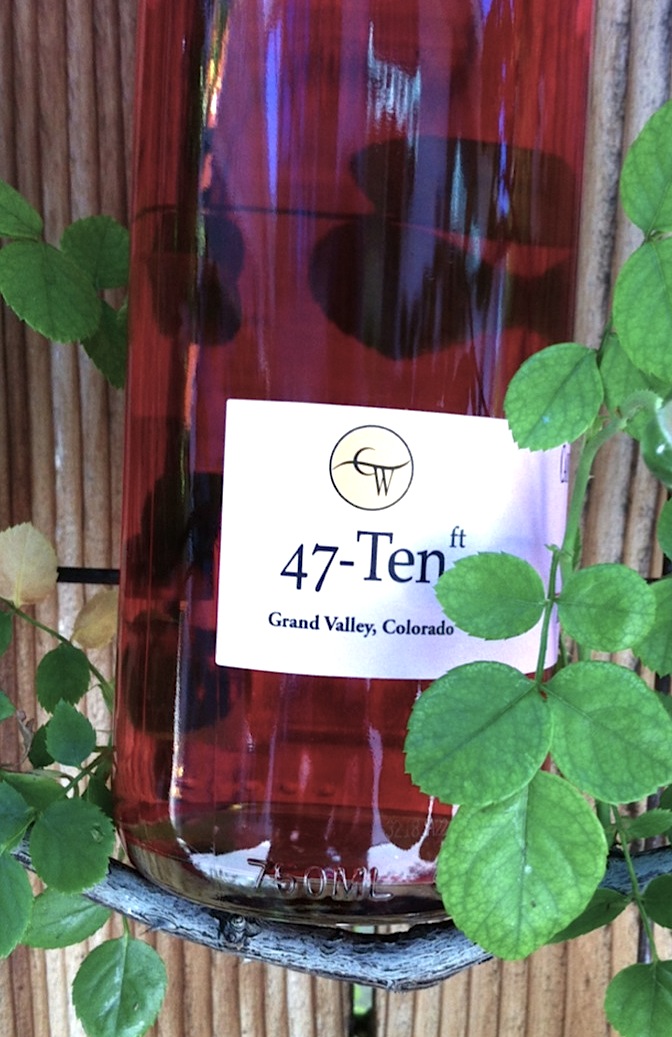
The 47-Ten 2012 Grand Valley Rosé is part of the 47-Ten line of wines produced by Canyon Wind Cellars in Palisade. The 2012 vintage was perfect, said winemaker Jay Christianson.
I’m on the road Thursday through Saturday, headed to Gunnison for a meeting and then on to Denver on Friday for the Governor’s Cup Awards Presentation on Friday night and the Colorado Urban Winefest (presented by Westminster Total Beverage) on Saturday, all part of the 2013 Colorado Wine Week.
Yay, to drink great Colorado wine and hobnob with the, well, hobnobbers.
But first, the important things, like Day 4 of the Colorado Wine Week Challenge.
You remember? Opening and sharing (that’s very important) a different Colorado wine everyday. Or night. Or day and night, if you wish.
Tonight’s wine (it’s 9:30 p.m., y’all, I just got home) is something special in a different way. It’s the 47-10 Grand Valley Rosé, a 100-percent merlot, tinted luscious deep-pink/salmon rose with a hint of oranges and strawberries on the nose and plenty of strawberries, citrus and acidity in the mouth.
47-Ten is the, well, maybe you could call it part of the “entry level” line of wines from Canyon Wind Cellars in Palisade, which also makes the Canyon Wind Cellars Varietal Series of wines (a bit more pricey) as well as the CWC Reserve and Dessert wines.
47-Ten refers to the elevation (4,710 feet) of the Canyon Wind Cellars vineyard from which this merlot came.
I was lucky enough to bump into co-winemaker and co-owner Jay Christianson (his amazing wife Jennifer shares both duties) and he said the 2012 vintage was superb.
“It was a great vintage for us,” he said. “We picked this off our older merlot vines and did something different this time.
“We picked, crushed and destemmed half of the crop early in the morning and then put it in tanks topped with CO2 for seven hours, to get more extraction.”
Then the other half was picked, crushed, destemmed, and added to the first half.
“So the wine has a great body and mouthfeel to it,” he said. “It’s very French.”
Which means it’s also really dry, which makes it special because it’s tasty, affordable and one of only two (that I know of) dry rosés produced in the Grand Valley.
“I think we need more dry rosés,” said Jay with a laugh. “I really like them.”
I agree, but only if they match the quality of the 47-Ten Rosé.
The 47-Ten Rose is $12.95 SRP and $11.01 to Canyon Wine Cellars wine club members.
 Wine Openers