Archive
Can one more wine-in-a-box be a step up?
With the wide selection of boxed wines available, you might wonder, “Why one more?”
Looking through the selection of boxed wines at a local liquor store, I’m struck by the choices facing the consumer.
A whole section of boxed wines, wines from around the world, at least the New World from Australia to New York and California, with all the familiar varietals represented.
Boxed wines usually are considered value wines, costing less because of the savings in packaging. Typically, producers put together a 3-liter box, the equivalent of four .750-ml bottles, using a plastic or plastic-lined bladder inside a cardboard box, all of which is less-costly than heavy glass bottles.
The value ranges immensely, from a few dollars to many dollars, depending on the level of wine being offered. Some boxed wines are awful, cheap bulk wines packaged and ready to sell to anyone whose only real concern is convenience.
Some boxed wines are surprisingly good, which isn’t really a slam against boxed wines but means initially it can come as surprise to find something drinkable inside a box instead of a bottle.
Finding these gems makes you feel you’ve really discovered something special – a decent wine at an affordable price in a package designed to let you drink a glass or two now and put the rest aside (or in the refrigerator). Three liters can be a lot of wine, as can a whole bottle when you’re not up to finishing it all at one sitting (not that that ever happens to any of us).
That you have to open the package by punching a hole in the outer layer and turning a spigot takes only a bit of getting accustomed to, and it’s really not much more work that twisting a corkscrew and pulling out a cork.
 Which brings us to Our Wine of the Week.
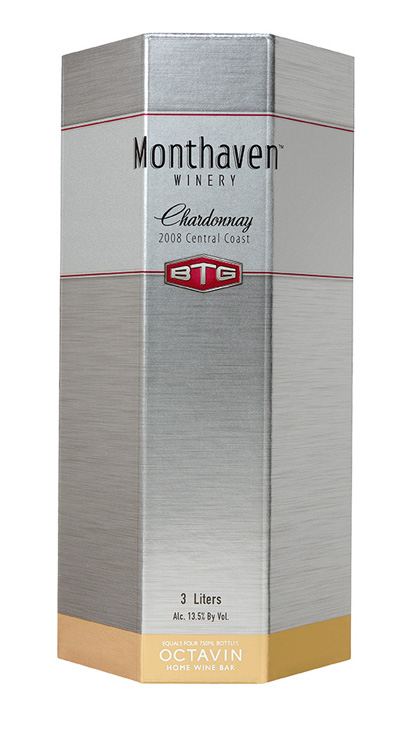
I recently received a sample of Underdog Wine Merchants’ Monthaven Vineyards Central Coast Chardonnay, a three-liter boxed wine in Underdogs’ unique eight-sided Octavin Home Wine Bar collection.
Priced at $23.99, it’s the liquid equivalent of four 750-ml bottles at roughly $4 a bottle.
(I edited this blog after being shown that this price isn’t equal to roughly $4 a bottle but rather $6 a bottle. Woe to my bad math and thanks to a watchful reader.)
The wine was bright and fruity, with a bit of green apple and grapefruit and good acidity, making it a delightful accompaniment for an outside lunch on the first day of spring.
The box protects the wine from light and oxygen, wine’s two biggest enemies, and the easy-to-use twist-open spigot allows you to pour one glass at a time.
Boxed wines aren’t new but Underdog is aiming to lift the bar of quality, offering 10 well-made wines, including a 2008 Central Coast Chardonnay and a 2007 Cabernet Sauvignon and Merlot, non-vintage pinot grigio and pinot noir from Hungary and Big House’s 2008 Big House Red and 2009 Big House White. All are in the $22–$24 range.
The wines, some of which previously have been available only in bottles, are made by well-known winemakers including Silver Birch Vineyards of Marlborough, N. Z., Big House Wines of Soledad, Calif., and Bodegas Osborne of Spain.
Distribution still is being worked out or at least it seems that way. Earlier this month I couldn’t find any of the Octavin line in local stores.
Unfortunately, the Web site doesn’t have a state-by-state list of where the wines are available.
Chilean earthquake rocks wine industry
The news of Friday’s 8.8 magnitude earthquake in Chile brought concern for many people and places. Reports filtering out of the country, where damage has severely interrupted all types of standard communications, are coming mostly through the social media sites such as Twitter, Facebook and many diverse Google sites. There’s a good story about these sites here.
Damage has been reported particularly heavy in wineries and infrastructure in the regions of Maule and Rapel (including Colchagua), reports Tyler Coleman on his excellent blog Dr. Vino. Also, the Wine Spectator’s Jim Molesworth has been tweeting reports here. If you are a member of the Wine Spectator’s Web site, you can get reports here.
Coleman said on his blog that witness reports to Molesworth say “One can smell wine along the roads in front of the wineries. Tanks laying, collapsed buildings, barrels and glass everywhere.” In some places, it’s been estimated that in addition to the widespread destruction and loss of life, millions of liters of wine have been lost.
Molesworth has been tweeting what he hears from wineries (follow his feed for the latest). Another source told him, “Big damage to the industry. Millions of liters on the floor.” He also tweeted that Montes and Lapostolle were hit hard in Colchagua, an area that had seen lots of investment in the wine industry.
We won’t downplay the sadness that accompanies the news that many friends and acquaintances stiill are missing and that homes and families have been ripped apart. As Susannah Gold reports in her blog avvinare, “It is quite distressing to think of all the work that has been destroyed and how many people are affected by the quake. Nature can be quite unforgiving but surely after the dust settles the Chilean wine industry will pick itself back up.”
It seems almost trite to think about wine so soon after the earthquake, but wine and winemaking was the life of so many wonderful Chileans, and we’ll celebrate this lives the best way we can, by toasting to their health and safety with a Chilean wine.
Many wineries was just preparing to harvest their white grapes, and without power, equipment and most important, the human aspect that means so much to the industry, much of these grapes and the many efforts to produce them may go to waste. We wish the Chileans well and “buena suerte.”
Words flow from VINO 2010
Along with many of my online colleagues, I spent most of a week recently in New York City for VINO 2010, Italian Wine Week, sponsored by the Italian Trade Commission and promoted as the largest Italian wine event held outside of that country. The regional sponsors of Vino 2010 were Tuscany, Apulia, Calabria, and the Veneto.
The week was full of seminars and tastings and “Buon Giornos” as you met literally hundreds of wine producers, wine writers and critics and thousands of fans of Italian wines. Some of my colleagues have written excellent blog articles on their experiences, so I’ll share some blog sites and some dialogue on ones I’ve found most entertaining.
Susannah Gold at Avvinare wrote eloquently about her good friend and excellent winemaker Susanna Crociani of Montepulciano. Crociani makes a delightful Vino Nobile di Montepulciano DOCG and several other lovely wines, including a wonderful Vin Santo di Montepulciano DOC. You can read that post here.
The two Susanna(h)s were panel members for a seminar on the impacts of social media (Twitter, Facebook, and blogs) reaching out to the estimated 80 million or so “millennials,” those between 18 and, what, 28 or so. This generation of wine drinkers already is using social meida more than any other generation and the people who will direct the path that wine writing, drinking and conversation will take in the near future.
Other members of the panel included Alder Yarrow of Vinography,Doug Cook, Head of search at Twitter and founder of Able Grape, Steve Raye of Brand Action and Anthony Dias Blue. You can see the panel here, but you have to wade through a commercial before the panel video begins, and then you should fast-forward a few minutes to get past the crowd shots.
I attended a seminar/guided tasting on wines from Calabria led by Italian Wine Guy Alfonso Cevola. Titled: “Gaglioppo the Great: The New Generation Of Southern Reds”, the seminar featured 11 wines, not all of them Gaglioppo, along with a producer or representative of each wine. Among the wines were some made with Malvasia Nera, Greco Nero, Magliocco , Nerello Cappuccio, Nerello Calabrese and two grapes new to me, Arvino and Lacrima Nera.
The next day, the inestimable Charles Scicolone led a tasting on the wines of Apulia, of which he wrote eloquently on the i-Italy site here. What I hadn’t realized until spending an afternoon with Charles at Cipriani for a tasting is his intense dislike of barriqued wines. He prefers wines that aren’t hidden by oak and it was illuminating to see how precise his palate was in detecting oak overtones in what otherwise seemed pretty nice wines.
As he mentioned, he sometimes has to hold his tongue when talking to winemakers. He played the discretion card several times during the Apulian wine seminar, where several of the wines were heavily oaked, which overrides the natural flavors of the wine.
Charles also mentioned that his wife Michele’s newest cook book, “The Italian Slow Cooker,” is out and doing well sales-wise, which reminded me of Michele’s article on the seminar entitled “Italian-American Food…Why Don’t it get NO Respect?”
As she notes in her blog, it was the only seminar in three action-packed days that focused on food. Tom Hyland in his Reflections on Wine blog wrote both a food-related column and a general view of VINO 2010.
And that should be enough reading for now.
Winemaker blends old and new
A recent blog discussion on organic wines by Susannah (Avvinare) and Terry Hughes reminded me how some Italian winemakers I met at last spring at Vinitaly talked about the pull between organic and biodynamic wines and the desire to make so-called “international” style wines that appeal to the U.S. market.
While some Italians are adopting organic winemaking, or at least publicizing their existing organic winemaking, in efforts to add more U.S. market share, others go that way because they think it’s better for the land, themselves and their wines.
Other winemakers admit their wines wouldn’t be possible without modern technologies including pesticides and fertilizers.
One argument is that “organic’ winemaking is little more than a marketing phrase since Italians (and European winemakers in general) have been using what we now label either organic or biodynamic techniques for centuries.
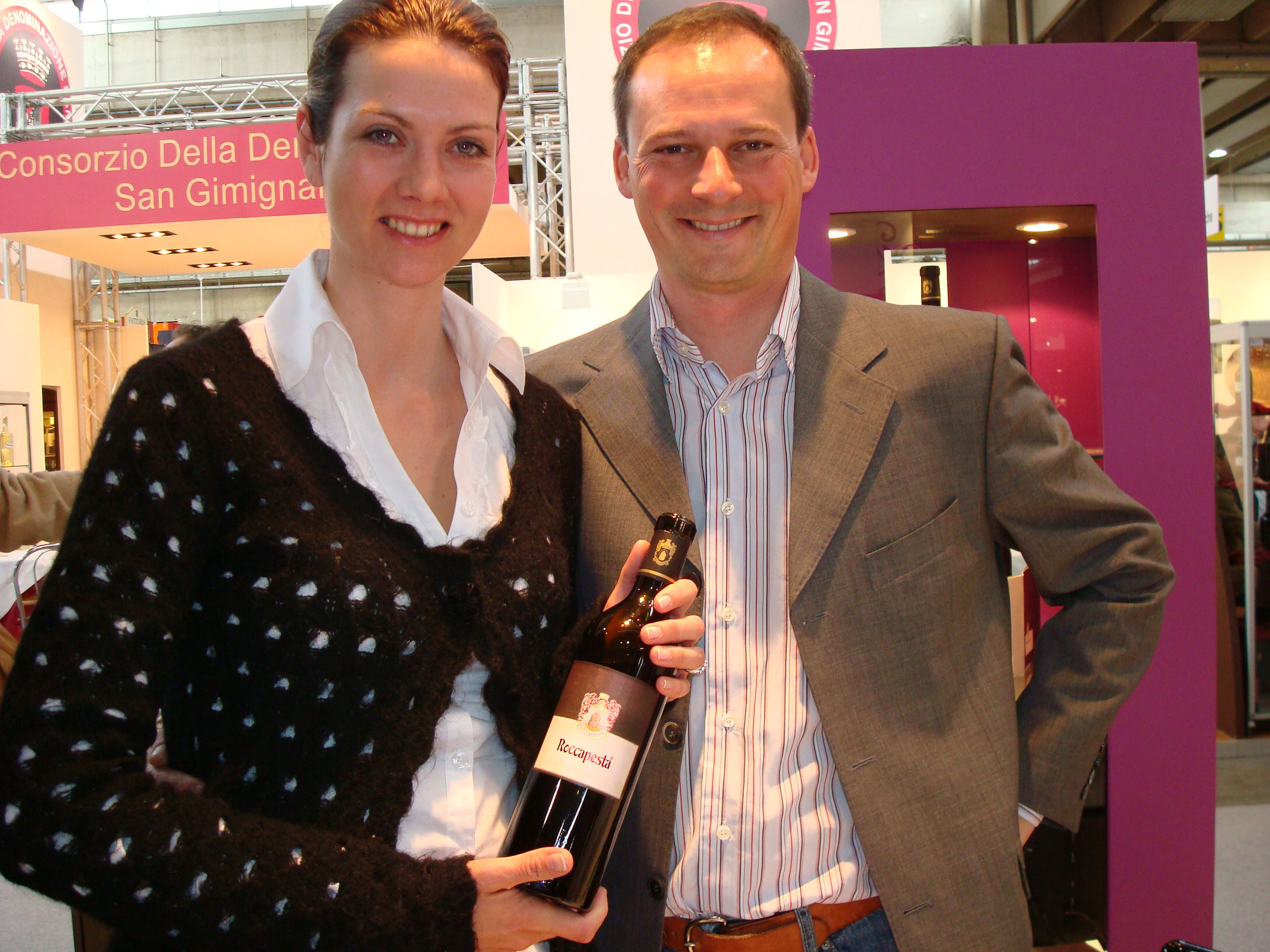
Maggie and Alberto Tanzini of Roccapesta
It’s only since the development of chemical fertilizers, pesticides and the like that more-traditional methods of winemaking have been noticed to be less-intrusive, which some people consider organic.
During last spring’s Vinitaly, Susannah Gold introduced me to young (mid-30s) winemaker Alberto Tanzini of Roccapesta. Roccapesta is in the Province of Grossetto, about 100 kilometers south of Firenze and about 20 kilometers from the Mediterranean coast, where Alberto and his wife Maggie (Margareta) make only two wines, both Sangiovese-based versions of Morellino di Scansano.
One is a “typical” (his words) Morellino with 96 percent Sangiovese and 4 percent Ciliegiolo and the other a Riserva (100 percent Sangiovese) aged for 36 months (24 in French oak, 12 in bottle) before release.
(My notes from our conversation at Vinitaly say he also producing an easy-drinking wine called Masca that is 85 Sangiovese and 15 Ciliegiolo but that’s not mentioned on the Web site.)
Albert came to winemaking in 2004, issued his first vintage in 2006 and plans a trip to New York (where else?) to sell his wines.
“An Italian selling Italian wines to Italians should be easy, right?” he asked, none of us knowing at the time the world economy was about to sink faster than the Lusitania.
But my point is Alberto uses some pretty traditional techniques – manually green pruning, harvesting and even an old manual press – along with modern equipment, including steel tanks and the latest French oak barrels, to make his wine.
“We are a combination of the old and the new,” he said. “It gives our wines a wildness. We make our wines in the vineyard, not in the office.”
His wines are reminders that traditional methods of winemaking can co-exist with new technologies, producing lovely wines that taste of the province and the winemaker’s love for his craft.
Starting anew after VINO 2010
The week of VINO 2010, called by the Italian Wine Commission (and anyone else who experienced the Grand Tasting at the Hilton) as the largest Italian wine show outside of Italy, brought hundreds of producers together with …, well, not enough distributors and importers.
Don’t think the D and I folks weren’t there, they just weren’t buying much. The soft economy, a broad improvement in Italian wines and the difficulty of simply finding something new, something exciting enough to replace what already is out there, made it hard for the hopeful among the winemakers to go home with any sort of contract.
Paul Whitby and Eric Brunson of Dancing Bear Cellars in New York City spent the week tasting and re-tasting hundreds of wines, but at the end there weren’t any containers heading their way.
“Right now the market is saturated with wines and my stores aren’t buying,” Whitby said. “People just aren’t looking for stuff right now.”
Which is saddening when you meet dozens of wine produttori seeking some entry into the American market, even though the U.S. already absorbs 30 percent of the Italian import business, according the Italian Wine Commission.
“I make good wines, I just can’t get them in the States,” more than one winemaker lamented. So at the end of the week they pack up one more time, carrying a few bottles home and hoping the world economy improves by the time VinItaly rolls around in April. Maybe spring will be the chance to start over.
 Wine Openers