Archive
Holiday wine lists really are meant to please
Like the swallows returning to San Juan Capistrano, Thanksgiving brings the return of the annual (anticipated/dreaded) holiday wine suggestions.
And just as there must be someone somewhere who dreads the swallows’ arrival, there are some who roll their eyes and look away when reading wine writer’s personal suggestions for what you should be drinking during the holidays.
A more entertaining duet of conflicting opinions would be hard to find outside of New York Times writer Eric Asimov, a fan of such lists, and blogger Cory Cartwright of Saignee, who feels, well, you can read how he feels here.
I tend to agree mostly with Asimov, that holiday wine lists are mostly well-received by consumers looking for something different and simply a suggestion they might not have considered.
I also think Cartwright has some excellent points to make, particularly his comment “Thanksgiving dinner changes enough from year to year to require us all to sit down and put serious thought into what we’re going to drink.”
Of course, for many people Thanksgiving is a rehash (or maybe that’s what happens with leftovers the next day) of last year’s dinner, which was a rerun of the previous year, which was a rerun of even earlier years.
Even so, if you’re sitting at the table staring at the same old bird, or a new bird in the same condition as last year’s, the probability is you might be looking for something different to drink. Especially if last year’s choices weren’t the hit of the party.
So holiday lists can provide ideas, even if the ideas are some you’ve heard before.
Pinot Noir for the red, Riesling for the white? And plenty of affordable ($15 and under) sparkling wine beforehand?
Whew, that list is finished.
But what if Thanksgiving isn’t the same this year? New York Time food writer Florence Fabicrant responds to a reader’s memorable Thanksgiving dinner here and hopefully your’s, too, will be memorable but in a positive way.
What if the dinner features a roast beast, or goose, or ham? Or all three? Ever heard of a turducken?The same old turkey wine might not be the match you want.
So you peruse various writers and see how they handle the wide-ranging flavors, and wide-ranging guests, to find something, anything, that’s going to please at least some of the guests.
And in the end, you head to the cellar or, if you’re like most of us, the liquor store and see what values are available. You purchase a couple of bottles (or a case if it’s affordable) of something red and something white that you know you can drink and head back home, secure in the knowledge that at least one person will be pleased with your holiday selections.
After all, wine is a personal thing, no?
Subpar vintage means no harvest for Hidden Ridge
Here’s something you don’t read every year: A top-quality Napa winery has decided to not harvest its grapes this year.
According to a release from Kathy Jarvis at Jarvis Communications in Culver City, Hidden Ridge Vineyard owners Casidy Ward and Lynn Hofacket have opted to not harvest any fruit from their 60-acre vineyard on Spring Mountain due to what Ward and Hofacket call an “inconsistent growing season.”
Several writers and bloggers have commented on the difficult 2010 vintage for northern California (including Alder here) but this is the first report I’ve seen that someone decided the grapes weren’t good enough to pick. While Ward and Hofacket said it was difficult decision to go without a 2010 vintage wine for their Cabernet Sauvignon the choice is in line with their commitment to produce only the best wines possible.
According to a statement issued by Ward and Hofacket, the fruit simply wasn’t up to their tight standards.
“The wonderful thing about our Hidden Ridge Vineyard is that we’re able to capture the flavors of this rare and special place in a bottle from year to year,” said Ward. “Our vineyard truly expresses each year’s growing season and all of the wonderful variants each year brings. Our wines may not taste the exactly the same every year, but they do need to taste great.”
He said the decision to not harvest was made with the approval of his winemaking team of Marco DiGiulio and Timothy Milos.
Hidden Ridge includes some high elevation (up to 1,700 feet), extremely steep vineyards (up to 55 degrees, according to the winery’s website, which puts them in the almost-as-steep-as-Switzerland category) which even in the best years don’t overproduce grapes.
You’d think this Cabernet Sauvignon would reach the stratospheric prices demanded by other Napa producers but at $40 a bottle, Hidden Ridge remains in the affordable range.
Because it’s so difficult and labor-intensive to harvest the grapes in this remote vineyard in the Mayacamas Mountains between Sonoma and Napa counties (access is by foot, 4-wheel truck or helicopter), the owners and winemakers decided to simply leave the grapes instead of harvesting them and trying to sell them on the bulk market.
While it’s not unheard of for a winery to skip a vintage or two, it must have been a difficult decision in the ultra-competitive world of California Cabernet Sauvignon.
Winemaking is an endeavor where you get but one chance a year to make your reputation.
Ward and Hofacket are counting on their previous vintages, along with the mystique of being daring enough to not make a wine when the grapes aren’t of quality, to keep their reputation intact and their wines in demand.
Local peaches featured in new wheat beer
I’m straying from the wine trail this week to focus on another Grand Valley product – peaches – available in beer form.
Thanks to a stray email, I was turned on to Breckenridge Brewery’s new Peachfork Wheat, an unfiltered beer featuring fruit from Peachfork Orchards and Vineyard on East Orchard Mesa.
Peachfork (the vineyards, not the beer) has long supplied grapes for local winemakers but this time it was their peaches that attracted a brewer’s attention.
“I’ve always wanted to marry the Palisade peach goodness with our brewing style,” said Todd Usry, general manager and brewmaster for the Breckenridge-based brewery. “It seems a natural fit.”
Peachfork Wheat is available on tap locally at the Ale House Brewery and Pub, 2531 North 12th.
Ale House general manager Brian Oliver said the peach beer fits well with his establishment’s buy-local philosophy.
“Buying locally is what we’re all about,” said Oliver. “We try to buy as much locally as we can and finally our (main) company did something using local ingredients.”
Peachfork Wheat isn’t a peach-flavored beer. You have to concentrate to pick up the barest aroma of peaches and you might discern just a hint of peach flavor, way back in the palate.
But it wasn’t meant to a peach-dominated quaff, said Oliver. Like an Oscar-winning supporting actor, the peach is there to enhance the beer, not steal the show.
“The peach sweetens and lightens up the wheat texture,” he explained. “Wheat beers can be a bit heavier by nature and our brewmaster takes the sweetness of the peach and softens the beer.”
Also, it’s an unfiltered beer, and like an unfiltered wine whose cloudy face may initially turn off some customers, that first taste will reveal the difference between an unfiltered beer and a filtered beer.
“There’s so much more depth and layers in an unfiltered beer,” said Oliver, who has 18 years in the bar and brewery business. “You get so much more out of an unfiltered beer and it’s amazing how many people prefer unfiltered beers.”
The new offering is immensely popular, Oliver said, and he had to fight off other Breckenridge Brewery pubs for his share of the much-in-demand special production.
“There’s only a limited number of kegs and I had to go the brewery and argue that I needed the lion’s share because it’s my backyard,” Oliver said. “I got 16 kegs, enough for about a month and a half.”
The Ale House can go through four to five kegs a week (each keg holds about 110 pints) so the supply won’t last forever.
“It’s just blowing out the doors,” Oliver said of the Peachfork Wheat. “This is great time for this sort of thing.”
For those readers still unsure about their beer knowledge, and that includes this writer, Oliver offers a free beer tasting and pairing class the first Wednesday of every month.
“We cook with beer and pair it with different foods and explore it in depth,” said Oliver. Each class includes 11-12 beers, about a third of the 32 beers the Ale House has on tap.
“We have a lot of fun and end up learning a lot about beer,” said Oliver.
The next class is 6 p.m. Wednesday (Nov. 3). Call the Ale House at 242-7ALE (7253) for more information.
It’s clear why unfiltered wines are popular
Last week I joined 36 other eager grape pickers to spend a day harvesting Chambourcin grapes for my friendly winemaker Yvon Gros of Leroux Creek Vineyards, which is near (sort of, within 8 miles or so) of Hotchkiss, Colorado.
Hotchkiss is a small (pop. about 1,000) farmer/rancher town in the North Fork Valley of western Colorado. The entire valley is rapidly changing as well-to-do folks retire elsewhere and discover the joys of living in a small friendly town where land prices still are reasonable. You can meet someone who looks as if they’ve spent their entire life on a farm and it turns out they’re a retired nuclear scientist, former university prof or well-known author or musician, all of which I’ve met in the past few years.
In recent years, the North Fork Valley has become known for its growing wine industry, and valley’s 11 wineries compose the entirety of the West Elks American Viticultural Area.
Yvon and his wife Joanna about six years ago started the Leroux Creek Inn, a B&B, spa and winery. True to his roots (Yvon is a trained executive chef and hails from Provence), Yvon planted French hybrid grapes, Chambourcin and Cayuga.
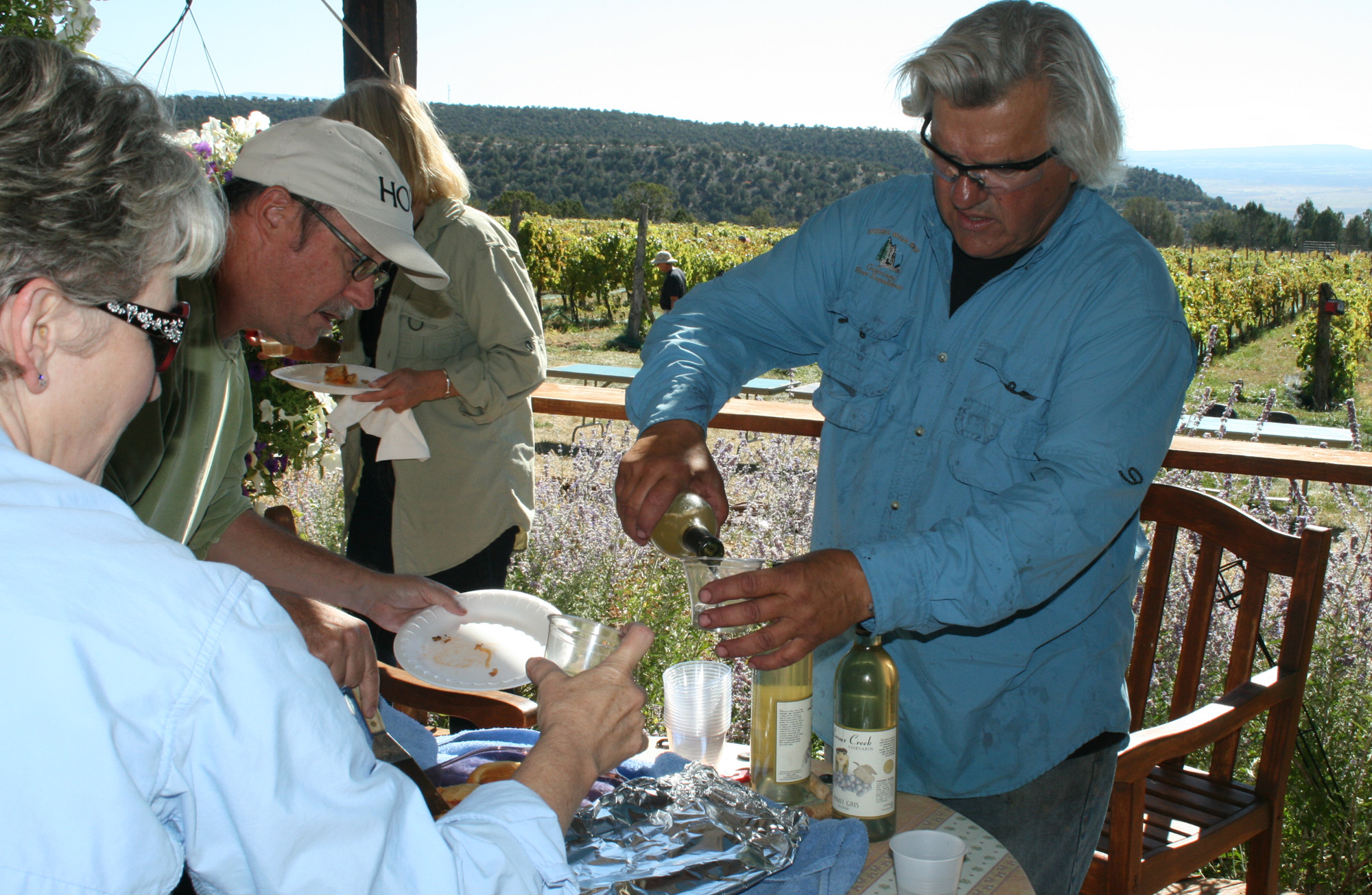
Yvon Gros of Leroux Creeek Vineyards, still wearing his safety glasses after a morning of operating the crusher/destemmer, pours his unfiltered 2009 Pinot Gris for his guests and workers during the recent harvest.
But he was surprised during the Colorado Mountain Winefest in September that it wasn’t his Chambourcin, Cayuga, Merlot or Chardonnay that proved to be the crowd favorite but rather his 2009 unfiltered Pinot Gris.
He wasn’t expecting so much demand for the Pinot Gris and only made 15 cases, most of which sold in one day at Colorado Mountain Winefest. Now, he’s hoarding the last of the Pinot Gris, selling it only at the winery tasting room and occasionally doling out a bit for friends. He generously opened a few bottles during our mid-day break while harvesting and said he regrets not making more since the vineyard the Pinot Gris came from was killed off in an April frost.
“There won’t be anymore for a while, until the vines come back,” lamented Yvon. “I was surprised at how popular this was because many people don’t like unfiltered wines.”
Americans generally want their wines, red and white, crystal clear, without the sediment and small particles seen in unfiltered wines. But fans of unfiltered wines, and you can count Yvon and this writer among them, say filtering wines strips out the flavors while unfiltered wines have more character, better flavors and a more-luscious mouthfeel than do filtered wines.
Which make sense – If you leave those all those small particles in the wine, they add weight and increased texture to the finished wine.
In an article in the San Francisco Examiner, Saint Helena (Cal.) winemaker Chris Millard compared filtered and unfiltered wines to drip coffee vs. French press coffee. “In a nutshell, leaving the wine in a natural state and using gravity to it settle out we get a richer, more intense wine that is balanced naturally,” Millard said. “The important difference is that drip coffee has oils that add structure and you cannot get that balance running it through a filter.”
In their efforts to produce a clear wine, winemakers fine and filter wines in a variety of ways, including micropore paper filters, membrane filters and sending the wine through a filtering agent such as diatomaceous earth or cellulose powder. Fining is sending a coagulating medium (egg whites, bentonite) through the wine which attracts the sediment which in turn falls out of the wine.
But clarity is not the only reason to filter a wine. There’s also the concern that an unfiltered wine might still contain live yeast, which may cause unwanted secondary fermentations in the bottle. There are hundreds, if not thousands, of stories of home winemakers waking in the night to the sound of corks exploding out of bottles after their unfiltered wines restarted fermentation.
But winemakers can (almost) clarify their wines without using filters. Racking (siphoning the wine from one barrel to another, leaving the sediment behind), cold stabilizing and other Old-World techniques are effective in killing off the yeast and getting rid of much of the unwanted sediment. There still will be some particles left in the wine, and Yvon is happy to see them.
“Look at that,” he said, holding up a glass of his Pinot Gris and letting the late-October sun illuminate the hazy wine. “There are so many layers of flavors in that glass.”
There’s also a bit of fizz, indicative that not all the yeast succumbed. But that’s OK, too, he said.
“I like that, it’s like a real <a href="“>Vouvray,” he said with a smile.
Several Colorado winemakers make unfiltered wines. Eames Peterson crafts his elegant and unfiltered Pinot Noir and Syrah in Paonia and he constantly is racking his wines, tranferring some of them four or five time. He, too, prefers the taste and presence of an unfiltered wine and has never had any problem with unwanted fermentations.
There’s also the pragmatic reasons for not filtering a wine. Neal Guard and Diane Brown of Avant Vineyards don’t filter their wine because A) they like unfiltered wines and B), they don’t want to spend several thousand dollars on a filter.
“I probably wouldn’t filter my wines, anyway, because I really like unfiltered wines” said Neal last summer, “but it doesn’t matter because I can’t afford a filter.”
Leroux Creek harvest party brightens fall day
Saturday was spent at Leroux Creek Vineyards clipping ripe Chambourcin grapes and trying not to cut myself with the clippers I recently sharpened. It’s harvest time for winemaker Yvon Gros and each fall he summons friends and family (this year his brother Joel came over from the Eagle River Valley) to pick his 5 acres or so of Chambourcin, a red-grape hybrid that does well in Colorado’s cool climate.
Yvon and his wife Joanna own and operate the Leroux Creek Inn and Spa, a classic French-style B&B reflecting Yvon’s roots in Provence and Joanna’s warm hospitality. Leroux Creek Vineyards typically produces two hybrid-grape wines, Chambourcin (red) and Cayuga (white) in addition to Chardonnay and Merlot. Yvon grows the Chambourcin and Cayuga and gets his other grapes from local growers.
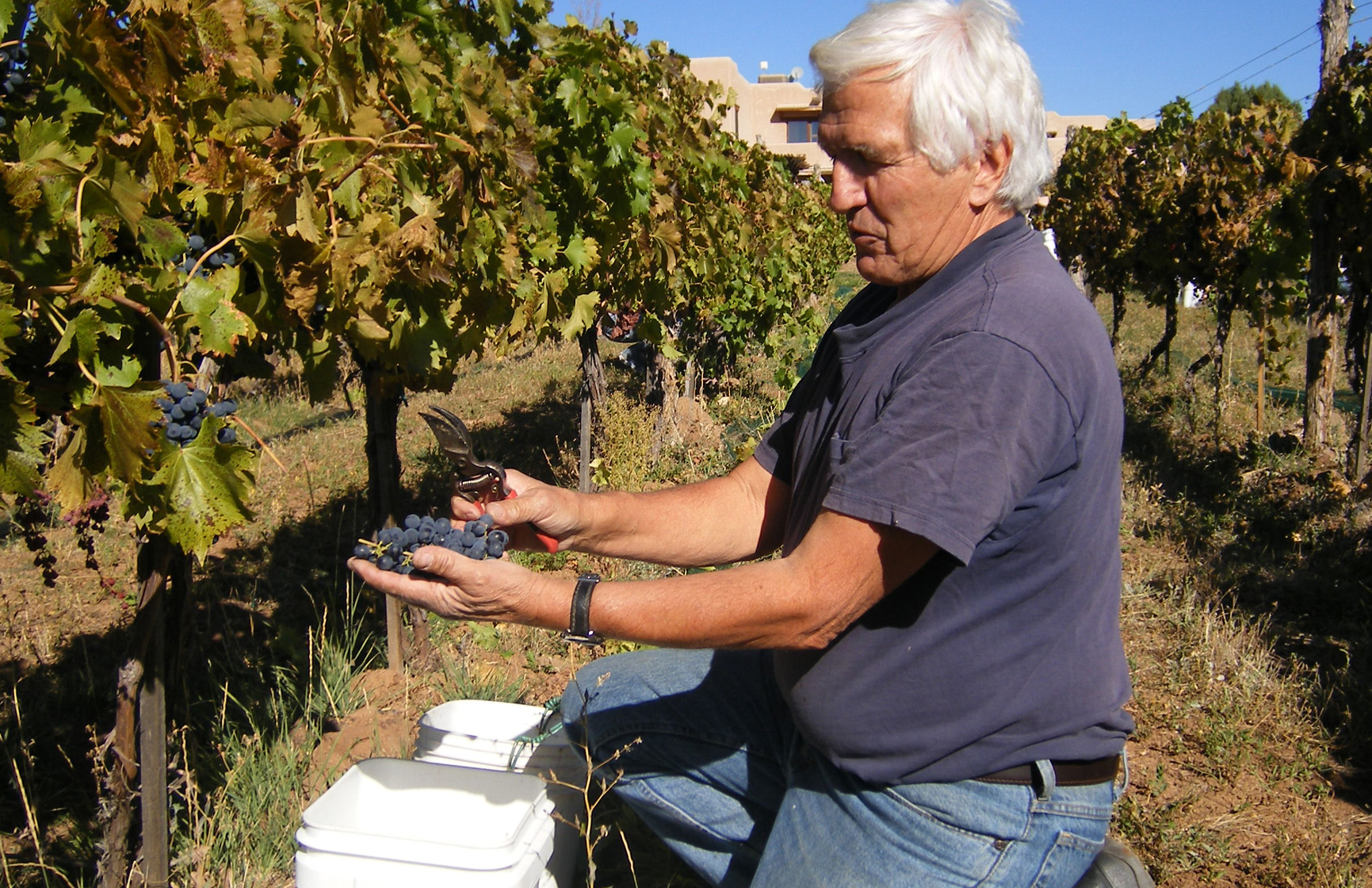
Joel Gros of Eagle, Colorado, admires some of the Chambourcin grapes harvested Saturday at Leroux Creek Vineyards.
Hybrids aren’t as delicate as the vinifera grapes (you know, the familiar European varietals such as Merlot, Cab Sauvignon, Chardonnay, etc.) and among other advantages manage to hold up to the early fall frosts and late spring frosts that kill the other grapes. This year that was important, as Yvon was able to make wine after many local wineries (he’s in the West Elks AVA along the North Fork of the Gunnison River) were struck by a spring frost that destroyed their grapes.
Maybe some of it was luck, though. Dick Noonamaker, a grape grower a few miles away in Cedaredge, lost all of his Pinot Gris and Merlot this spring when an April frost dropped temperatures in his vineyard to 28 degrees for several hours. Noonamaker said the frost came at the worst possible time for his grapes.
“If it had come a week earlier or a week later, the grapes wouldn’t have been so affected,” said Noonamaker. “Or if it had lasted only one hour instead of four, I might have saved some grapes.”
Yvon, however, said the temperature never got cold enough at his vineyard to harm his grapes.
The loss of the Pinot Gris means Yvon won’t be able to repeat the delightful 2009 Pinot Gris he made from Noonamaker’s grapes. Unfiltered, with a bit of a light fizz on the back of the palate, this fruity and floral Pinot Gris was totally Alsatian in style, “like a Vouvray,” Yvon remarked.

Still wearing his safety glasses, Yvon Gros of Leroux Creek Vineyards serves some of his 2009 Pinot Gris during a mid-day meal for his hungry grape harvesters.
But not filtering a wine has its dangers, including leaving some live yeast in the wine that may start a second fermentation at the most unexpected moments. Like, when your storing the wine in your basement.
More than one home winemaker who hasn’t completely fermented his wine or didn’t cold-shock it enough to kill the yeast has woken in the night to sound of exploding corks deep in his cellar.
And although Yvon said he had fermented the Pinot Gris far enough there wouldn’t be any problem, I noticed he was very careful when opening the bottles.
“I really like that style of wine but you have to be careful you don’t blow out a cork,” he said. He took sip of the straw-gold wine. “This is really good, very nice.”
He didn’t make much of the Pinot Gris, about 15 cases he said, and he nearly sold out his supply when the wine proved to be a crowd favorite at Colorado Mountain Winefest in September.
“I was surprised it sold so well, I almost haven’t anything left,” he said, although he managed to find a few bottles to serve his hot and hungry grape pickers for a mid-day pick-up.
He had picked his Cayuga a week before and 37 of us part-time pickers had his Chambourcin picked and in the bin by sundown.
Most of the pickers left after the splendid afternoon meal, which included pit-roasted lamb, a selection of salads including garden-fresh tomatoes, sauteed carrots and young squash, and plenty of crisp, hot-from-the-oven French bread.
Plus lots of wine, which might be why so many pickers went home for a nap after a morning of working in the hot Colorado sun.
I just stuck a couple more bandages on my wounds and plugged on. I figured the Chambourcin was enough to replace whatever little blood I lost.
Newest intruder might bug state wine industry
We’re fortunate in the Grand Valley to have access to so many of Colorado’s finest wines.
Recent events, ranging from the Governor’s Reception at the Boettcher Mansion and the Colorado Mountain Winefest continue to build an audience for Colorado wines, which is good for the entire industry.
And good for those of us who enjoy the results of the winemaker’s efforts.
Of course, for every celebration there’s inevitably a bug in the wine bottle, and this week’s special flying guest is a tiny fly that may cause great impact.
Because of the several damaging frosts suffered over the last year, many of Colorado’s winemakers this year are looking out-of-state for grapes.
That’s not uncommon since some varietals aren’t grown in commercial quantities in Colorado and there’s always California’s massive grape industry to help a winemaker put some juice in his or her barrels.
But there are fears that this year winemakers buying grapes from Oregon and Washington might bring an unwanted pest into Colorado along with those grapes.
The Spotted Wing Drosophila fruit fly is an invasive species that first was noticed in the Pacific Northwest late last summer.
Colorado already has several species of fruit flies, which you know if you’ve ever left a peach on your counter to ripen.
The big difference between our resident fruit flies and the Spotted Wing is its larvae infest ripe and ripening fruits, unlike most fruit flies that feast on rotting fruit.
The Spotted Wing’s mouth is like a rasp, which allows it to cut through the skin of ripe fruit.
According to the Oregon Department of Agriculture, once the larvae hatch and begin feeding, the fruit completely disintegrates.
The department says it’s almost impossible to detect damaged fruit until it is too late.
Winemaker and consultant Bill Muscnung of Paonia, who spent years in the Pacific Northwest wine industry before moving to Colorado, is pushing for a moratorium on Oregon and Washington fruits.
He wants to hold off on bringing in that fruit for fears it will be contaminated with the Spotted Wing and until it can be determined what level of threat the Spotted Wing poses.
Because once it’s here, there’s no getting rid of it.
The Oregon Department of Agriculture says “Eradication is not a viable option. Control is the best chance Oregon has in protecting crop yields and maintaining markets.”
Colorado state viticulturist Horst Caspari said no one in Colorado is quite sure what to make of the Spotted Wing’s feared appearance.
“We don’t know if it will be a concern or not,” Caspari said. “It certainly seems a big concern for people in Oregon but we’re not sure what impact it may have here.”
It won’t be the first non-native bug brought into Colorado on plant material.
What’s saved Colorado from previous invaders is the climate, which isn’t as hospitable to the bugs that thrive in California’s benign climate.
Colorado’s best defense, said Caspari, is the long-standing vigilance of the state’s agriculture industry.
“We don’t want to have to adopt (special pesticide treatments) to deal with another bug,” he said. “If it’s a real threat, we’ll have to adapt our strategies to deal with it.
“In the long run, we hope we won’t get it, and the longer we keep it out of the state the better.”
Matt Kramer’s new book offers insights on wine and wine writing
The world of wine writing is filled with voices clamoring for attention, most of them claiming to be the last word or the best word or both on the latest offerings and what they mean (or should mean) to you.
There are few places to turn where a wine lover isn’t hard-pressed to feel comfortable, as if studying or simply drinking wine no longer is a pleasure but more a tedious endeavor rewarded with a pass/fail/no-hope-for-you grade. Do you focus on the flood of new vintages from around the world, do you explore what’s already on the shelves or do you dig deep into the cellars, looking for something forgotten or overlooked or simply not yet universally acclaimed?
Is there a “right” path to follow? And dare there be a voice to lead?
I would guess Matt Kramer would say no to both, although he is one of the few whose advice I would bother to heed.
Kramer has been observing and writing about wine for more than three decades, a span of time in which he’s established his voice as one of well-considered reason and insight in a profession where emotions, not intellect, often comprise the main arguments for and against a wine’s success.
A long-running contributor to Wine Spectator Magazine, columnist for the Portland Oregonian newspaper and author of several well-done books (his “Making Sense” series is worth the investment), Kramer now gathers his years of observations into a new book titled “Matt Kramer on Wine” (Sterling Publications, New York, 2010, 334 pages, hardcover, $19.95).
It’s the subtitle that gives away the farm: “A Matchless Collection of Columns, Essays, and Observations by America’s Most Original and Lucid Wine Writer.”
I’m ready to quit writing this review, for these aren’t some immoderate ad-copy hype but a rather accurate description of Kramer’s role in modern wine writing.
Kramer isn’t a fan, so to speak, but rather a sharp-eyed observer, as his book notes front and center. There’s a big difference between waving blindly the foam No. 1 finger and being able to comment clearly on what wine is, what it should be and, when necessary, where it fails both itself and the consumer.
The book is a retrospective, a hand-picked collection of what Kramer considers his best work over the past 30 years. That’s a tall order for anyone to fill, particularly someone with so much from which to choose.
Consider some of the quotes chosen at random from Kramer’s vast reservoir of wit, acerbic comments and enlightening philosophy:
– “To marvel about fine wine is not to romanticize it, but to grasp its real meaning. Fine wine, like birdsong, is fundamentally wild.”
– “The purpose of fine wine is not to give pleasure, but to give insight.”
– “My rule of thumb for old wine is this: if you can’t tell what the hell it is, it’s too old.”
– “This is the giveaway to great wine: It does all the work, yet you feel like you’re the genius.”
Of all the writers, bloggers and self-styled wine experts I read on a regular basis, Matt Kramer is one of the very few I’d really care to share a bottle of wine with, not simply to sit and listen but also to delve into his insights about the fascinating world of wine. Until then, his book “Matt Kramer on Wine” will have to fill the void.
Put a cork in Aussie “Champagne”
This year, Labor Day marks more than the traditional end of summer, it also brings an end to what we’ve come to know as Australian “Champagne.”
Not to worry, you’ll still be able to purchase your favorite down-under bubbly but with the official enforcement of the EU-Australia Wine Trade Agreement beginning Sept. 1, you’ll no longer see Australian wines labeled Champagne, Port or Sherry.
“This agreement between Australia and the European Union is a step forward for protecting consumers,” said Sonia Smith, director of the Champagne Bureau. “When consumers buy a bottle of wine, they should be able to rely on the truth of the label.”
According to its Web site, the Champagne Bureau is the “official U.S. representative of the Comité Interprofessionnel du Vin de Champagne (CIVC), a trade association which represents the grape growers and houses of Champagne, France.
According to the Champagne Bureau, more than half of all sparkling wines sold in the U.S. are mislabeled Champagne.
”It’s only Champagne when the wine is from Champagne, France,” Smith said. “Australia joins the European Union and a long list of nations, all of which have agreed to recognize and protect wine regional names such as Champagne.”
You can’t label a sweet wine as Port unless is comes from the Porto region, Sherry has to come from Jerez and Chianti Classico must be from Chianti, among the many wines and regions now protected under various international agreements.
However, as you might notice by reading between the lines, in a loophole in an existing law, American vintners still can label their sparkling wines as Champagne.
A Dec., 2006, Congressional action banned the use of 16 European place names and asked that domestic sparkling wines should be labeled just that, sparkling wines.
However, a grandfather clause sidestepped the issue by allowing an exception for some older brands which still use the word Champagne on their labels.
Since then, the Champagne Bureau has pushed their “Unmask the Truth” campaign, which features a Zorro-like mask over a bottle of American Champagne. Or “Champagne” in quotes, as the bureau likes to write it.
“U.S. consumers deserve the same protection as Australians”, lamented Smith.
According to the Champagne Bureau, there are seven U.S. winemaking regions Napa Valley, Sonoma, Oregon, Paso Robles, Walla Walla, Long Island and Washington State) supporting the effort to protect Champagne.
Together with seven international regions (Jerez, Porto, Chianti Classico, Tokaj, Victoria, Rioja, Spain and Western Australia), the American regions signed a Joint Declaration to Protect Wine Place & Origin, which Smith said recognizes the importance of protecting wine locations and their names.
Will it make consumers quit asking for “Champagne” when ever they feel like something bubbly?
Hardly. Whether it’s legal or not, “Champagne” has become a near-generic term for anything bubbly, whether it’s a Spanish Cava, Italian Prosecco or French Champagne.
We don’t disagree with the protection of place names, we simply recognize it’s a long uphill battle to convert the vocabulary of someone simply looking for a delightful refresher.
Boxing yourself into a new adventure
There always is an adventure waiting when it comes to trying new wines.
While the adventure occasionally proves to be one you’d just as soon miss next time it’s offered, most of the time it’s an adventure worth repeating.
Although I’m not sure it’s considered an adventure the second time around.
Maybe it’s more like falling in love for the second (or third or 20th) time, when it’s the promise of something new and exciting that keeps you on track.
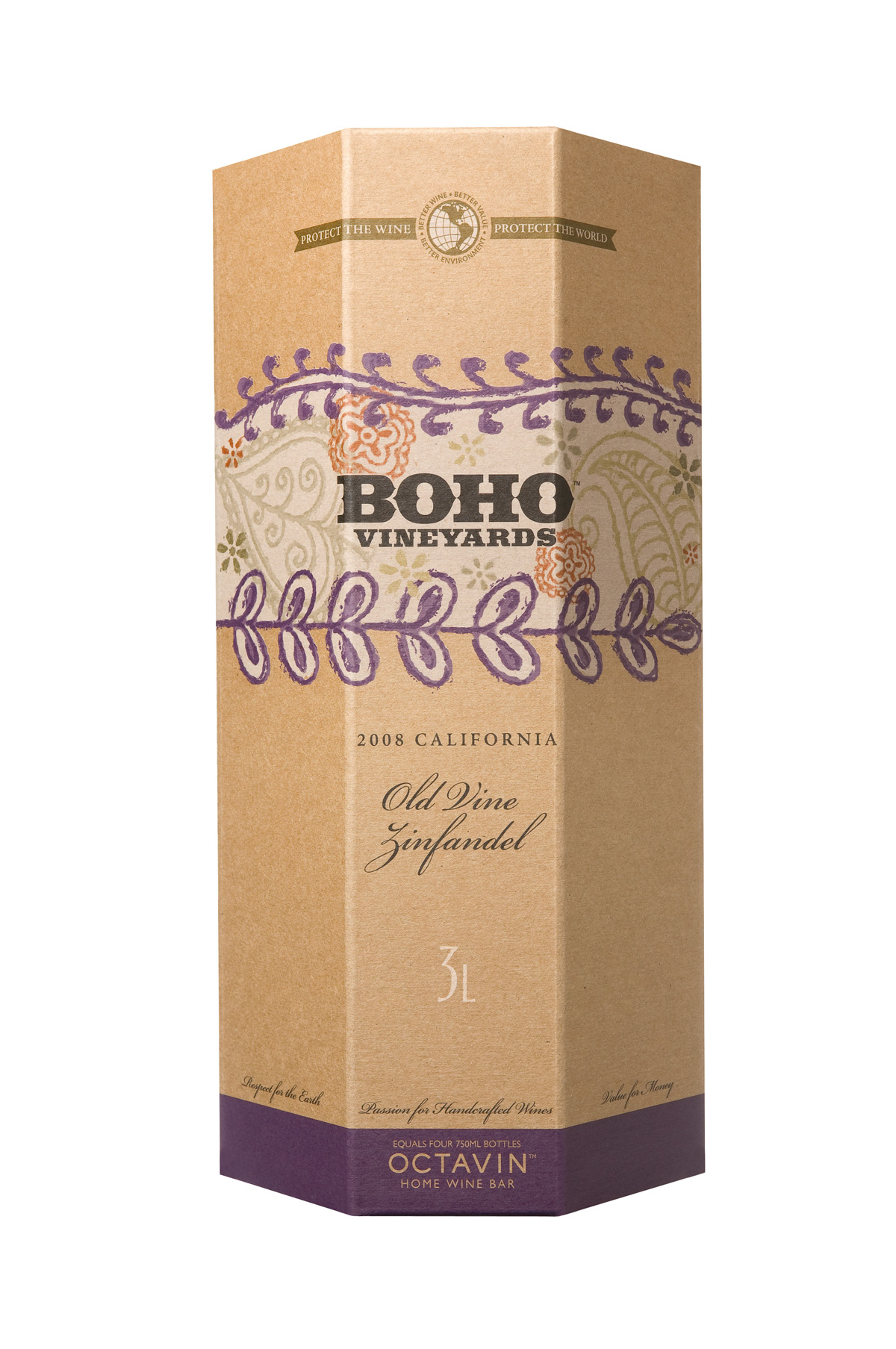
This latest adventure began last winter, arriving in an eight-sided box containing the first of several selections from Octavin’s new Home Wine Bar system of boxed wines.
So far, and six wines into the adventure, it’s been an enjoyable and tasty ride.
Octavin wines (the wine is in a heavy plastic bag, which is inside the eight-sided cardboard box) is produced by Underdog Wine Merchants of Livermore, Cal., who, according to their Web site, are dedicated to offering “unique, esoteric wines that are distinctly characteristic of their origins and variety.”
There’s been a lot written about Underdog and their Octavin wines (check out the media section on the Octavin Web site) in the last six months or so as they’ve become better known and better distributed.
A month or so ago I received the Octavin Silver Birch (N.Z.) 2009 Marlborough Sauvignon Blanc, and then a few days ago, the nice FedEx lady dropped off a box of the Boho Vineyards 2008 California Old Vine Zinfandel.
I opened the Sauvignon Blanc almost immediately, had a couple of glasses, and then kept the wine in the ‘fridge for about 5 weeks. Honest, I didn’t forget it, I was benignly testing the wine’s shelf life, something most boxed wines love to brag about.
 Next to the Octavin box was an opened (and re-corked) bottle of SB from another producer, and when I tasted them side by side last week, the bottle was flatter than my 401(k) while the Octavin plastic-sealed wine was fresh and sparkly and wonderfully refreshing on a 98-degree afternoon.
As we all know, light and oxygen are the two greatest enemies of wine, and Octavin’s plastic liner and heavy cardboard box protected the precious liquid inside from both.
Even though I ignored the wine for most of a month, the wine forgave me, retaining its pear and green apple flavors balanced by the minerality (a neat wine-type word that really means something) and crisp acidity associated with the SBs from the cool regions of Marlborough.
The latest newcomer to my wine-storage area in the basement is the Boho Vineyards 2008 California Old Vine Zinfandel. I punched open the box last night and poured a glass, pleased with the big plum and jam fruit flavors and the easy-to-manage tannins that winemaker David Georges coaxed from the grapes.
Another plus is the typical (at least what I think are typical) alcohol levels (13.7-percent, in this case) that make American zinfandels not only food-friendly but also drinker-friendly.
Both wines are priced at $24 for the three-liter box (the equivalent of four .750-liter bottles), which makes this adventure affordable, as well.
Web site opens world of wine events
One of the challenges for a wine lover living not living in a major city is finding wine events to attend.
Not that they’re lacking, although someone in say, New York City probably can select from several events each week.
My friend Susannah talks here about having that abundance of decisions.
Here, I’m always looking for something other than the weekly “tasting” at one of the local liquor stores, semi-events with hand-picked limited selections that can turn into sales pitches for whatever the store has in overstock.
No matter where you live, though, if you don’t know about an event, you can’t attend it.
That’s why I was initially fascinated by the idea promoted by Eric V. Orange, founder and developer of the Web site LocalWineEvents.com.This site is a free listing service of wine events in your area.
And how do the events get listed?
By you, of course.
“Even after ten years online, I am surprised at how many people in the food and wine business do not know about LocalWineEvents.com,” Eric wrote in a recent e-mail. “I recognized years ago that the ‘industry’ folks are looked at as a source of reference from friends and family and the bigger base of the industry using the site, the broader it gets into the consumer world.”
His idea was to gather information on each event at one site and make that site available to everyone.
“It’s really a simple idea,” said Eric, whose wine background includes a five-year stint at Millbrook Vineyards outside of Poughkeepsie, former wine rep and certified sommelier who now lives with his wife and family outside Philadelphia.
He explained that LocalWineEvents.com is a free “post your own event” site, and once you’ve posted an event, future postings are easier since the basic information is on the site.
And keeping up with technology means developing an iPhone app, which includes a Geo-location feature (for those of us terminally direction-challenged) to show events within a pre-selected distance from your location.
Which means you don’t have to thread through events in San Francisco when you live in Atlanta (unless you’re headed to SF, of course).
And if you’re looking for an event, the site is remarkably easy to use. The main page offers you a click-on menu of states, which in turn opens a window listing all the sites in that state where events are planned.
The key here, of course, is that if you know of an event that isn’t listed, you can go ahead and make the listing and that event forever will be in your debt.
Or not.
Not just domestic events, either. LocalWineEvents.com is an international site, so if you’re heading to, umm, France, say, the current listings say you can choose from 26 events across the country.
Mais oui.
Oh, don’t worry about people reading your listings, it seems there’s a lot of demand for something to do.
Here are a few stats about LocalWineEvents.com, thanks to Eric: 115,00 subscribers to The Juice, the weekly events e-mail newsletter; 21,000 fans on Facebook; and 4,600 followers on Twitter.
Don’t you wish you had 4,600 followers on your Twitter site?
Eric said at last count, the site had listed 282,354 events and sold $3,987,629 worth of tickets.
I’d love to go on, there’s more (isn’t there always?) but the LocalWineEvents.com site has it all.
Take in an event near you, and spread the word on future events.
Who knows, you might save someone a boring weekend.
 Wine Openers