Archive
Day Two in Romagna
FORLI, Italy – Giovanna Drei Dona pointed toward the southeast, where a range of low hills lay nearly hidden in mist.
“When it’s clear you can see the Adriatic Sea from here,” said Giovanna, gazing from the back steps of her family’s winery in southern Emilia-Romagna. “We are only 15 kilometers or less from the sea, so you understand it has a big effect on our wines.”
Giovanna and her husband Claudio are the owners of Drei Dona Aziende Agricole and the winery Tenuta La Palazza.
Azienda Agricole designates a place that grows grapes and makes wine as compared to an Azienda Viticolo, which only grows the grapes and sells them to a winery.
About a dozen writers and bloggers are gathered in Giovanna’s presence, all guests of the Convito di Romagna and the Consorzio Vini Di Romagna, both organizations representing winemakers in the Romagna region.
The Convito is a small consortium of eight wineries, including Drei Dona and Fattoria Zerbina, founded in 2001 with the goal of raising the level of Romagna sangiovese to that of the better-known Tuscany.
Giovanna, whose son Enrico was one of the initial founders of the Convito, related how it’s only natural the Romagna sangiovese should receive the same respect as the Tuscan version since the land we are standing on, now well inside the border of Romagna, once was part of Tuscany.
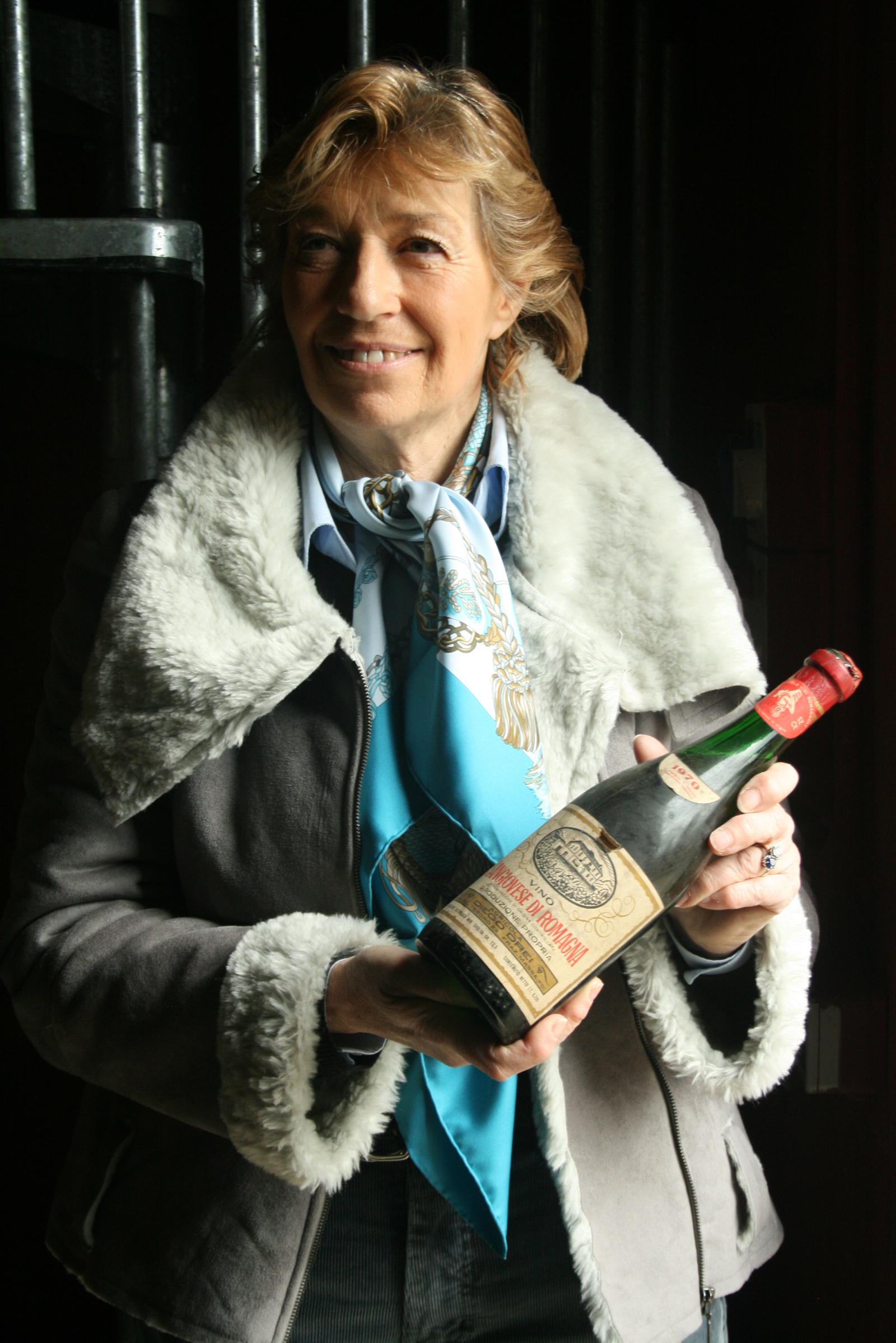
Giovanna Drei Dona shows a 1970 Sangiovese di Romagna, a now undrinkable wine "from the old days," she said, before the area winemakers started emphasizing quality.
“Sangiovese was born here in the hills between here and Florence,” said Giovanna. “We were in Tuscany until 50 years ago when they changed the borders.”
Later, during a presentation by Convito president Giordano Zinzani, it was explained that it was Benito Mussolini who decided to turn a sliver of Romagna into Tuscany.
“Mussolini was born about here,” said Zinzani, pointing on a map just about where we were standing Tuesday with Giovanna. “He wanted the headwaters of the Tiber River to be in Tuscany, so he changed the border to include this narrow piece of Romagna where the river flows. Of course, later, when he left, the border was changed back.”
Also, the Medici family, that powerful 15th Century family that dominated Tuscany’s banking and politics, once owned this part of Romagna, Giovanna said.
She admitted the winery today doesn’t look very Tuscan except for the olive trees scattered around the 23 hectares (approximately 57 acres) of property.
“We like the tree and the olives but they are more a diversion than a way to make money,” she said.
This winery, part of which was a watchtower built in 1481, has been in the Drei Dona family nearly a century.
It was Giovanna’s husband Claudio who took the big step to raise the quality of the wines, which before his efforts simply weren’t very remarkable, said Giovanna.
“Sangiovese once was made tro be drunk early, not a long-lasting wine,” she said. “It wasn’t what we look for in a wine now.”
We heard a similar tale Monday when visiting the winery Fattoria Zerbina.
“Thirty years ago, my husband had the idea to bring the sangiovese of Romagna among the best in the world,” Giovanna said.
The Drei Dona land is planted mostly in sangiovese with some albana and small sections of chardonnay, riesling, malvasia and sauvignon blanc for the whites and cabernet sauvignon, uva longanesi and cabernet franc in red.
The climate this close to the Adriatic Sea is very humid and cooler than that of Tuscany, Giovanna said.
“It’s more like Sicily,” she said.”It never rains in the summer and sometimes, maybe one year in 10, we have to give irrigation to keep the acidity.”
Cooling breezes in the summer (cool enough in mid-summer to require a light cover) and moderating breezes in winter keep the wines fresh, she said.
“We never have bad storms, there are no problems for the vines,” she said.
Some of the vines are pre-phylloxera, that vine-killing louse imported from the U.S. that nearly wiped out Europe’s vineyards.
“That one down there, the one that curves off like a bridge, is pre-phylloxera,” Giovanna said, pointing to an ancient looking vine. “It gives us a white grape but it’s so old we don’t know what it is.”
The Tenuta La Palazza wines are lead by the riserva Pruno (all the wines are named after horses kept by the Dona Drei family), the 100 percent sangiovese flagship.
Other wines, such as the Notturno, Graf Noir and Magnificat, include international style grapes but they are made more because the customers want them.
The wine we tasted was a 2007 Pruno Sangiovese Riserva, very dark red, with the dried cherry nose typical of sangiovese. Unfiltered, with 18 months in wood and another year in the bottle, it still was young, with plenty of time ahead of it to settle down.
Maybe there was a hint of the sea, we thought.
Giovanna shrugged.
“Our idea is not to make an international wine but to work on our specialty, sangiovese,” Giovanna said. “We want you to remember these wines and the places they came from.”
Day One in Romagna
FAENZA, Italy – The second thing Cristina Geminiani does, after shaking hands all around while needlessly apologizing for her excellent English, is issue the 10 or so of us visiting journalists a pair of plastic covers for our shoes.
“It’s nice today but it’s been rainy,” said Cristina, winemaker and grandaughter of Vincenzo Geminiani, the founder of Fattoria Zerbina, where we are visiting today (Feb. 19). “You’ll see you need these to keep your shoes clean when we walk in the vines.”
The soils of this hilly country only 25 miles or so from the Adriatic Sea are mostly clay, underlaid with a chalk or limestone shelf.
“It’s good for the vines because it holds the moisture,” said Geminiani, pointing out the 80 steep hectares of vines on which she raises (mostly) sangiovese, albana (the white grape of the Emilia-Romagna area) and small amounts of trebbiano, cabernet sauvignon, merlot and riesling. “The soil holds the moisture for the vines, even in the hottest times.”
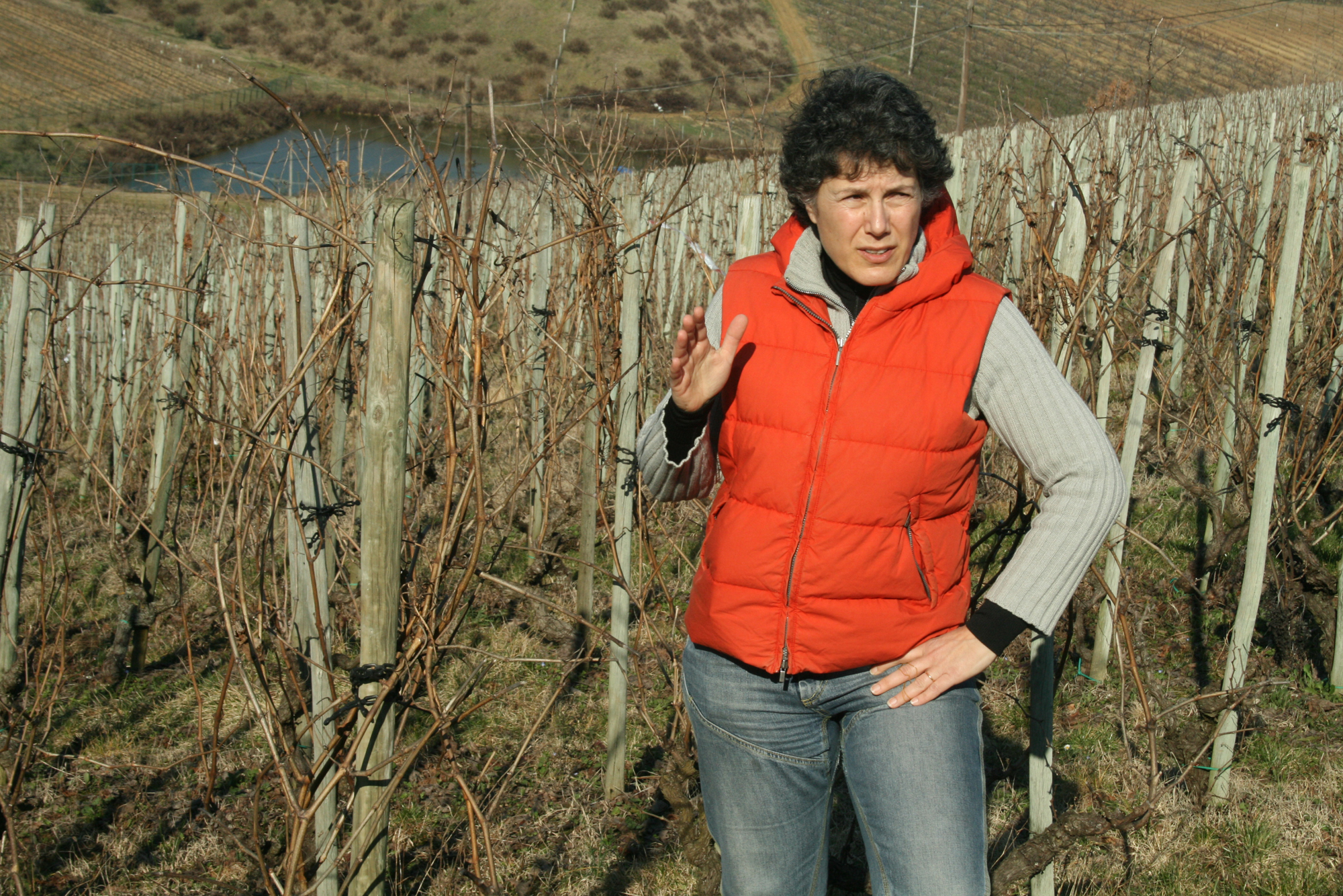
Winemaker Cristina Geminiani of Fattoria Zerbina talks about growing and making world-class Sangiovese di Romagna. The name "Zerbina" in the local Faenza dialect refers to the breeze off the Adriatic Sea that moderates temperatures year-round.
Which is good, since the Consorzio Vini di Romagna (the local winemakers organization) must give winemakers special permission to irrigate.
“We do it maybe one year in 10, and then only up on the top, where the soils are bit different,” Cristina said. “And then it’s only the albana and it’s not to make the bunches larger but to retain the acidity.”
Local lore says sangiovese was first discovered by the Capuchin friars in Romagna, on Monte Giove (Mount Jupiter) near Rimini, a few kilometers to the east of where we were standing.
“The history of sangiovese goes back 500 years but it’s been cultured only since 200 years ago,” Cristina told us.
This area is trying hard to increase its exposure and its reputation for making high-quality sangiovese, which is why the Convito di Romagna and the Consorzio Vini di Romagna sponsored this trip for us.
Think of sangiovese and what comes to mind for most of us is Tuscany and Chianti Classico, often considered the gold standard for top-quality sangiovese.
What we’ve heard repeated during our brief time here is “We’re as good as Tuscany,” an argument also heard in the U.S. when wine-growing areas compare themselves to Napa or Sonoma.
That’s not say the winemakers in Romagna want to be another Tuscany, except in acceptance and sales.
Until very recently, we are told, Romagna sangiovese was made fast to drink fast.
“By February it was no good, but by then it had all been drunk,” one winemaker (not Cristina) told us.
But a generation of Romagna winemakers, including Cristina’s grandfather, decided sangiovese had more potential and worked hard to better the local wine, pushing it to unprecedented levels of quality, acceptance and yes, profits.
It took years and in the 1980s the wines started improving, Cristina said.
“The first ‘quality” sangiovese was in the 1980s and my first harvest was in 1985,” said Cristina.
At the time the winery was blending some cabernet, merlot and syrah with all their sangiovese but today the Pietramora Sangiovese di Romagna superiore riserva is 100 percent sangiovese while the IGT wines continue to be blends.
“We phased out the international grapes (for the riserva) and went back to the indigenous sangiovese,” she said.
Indigenous referring to stories of how sangiovese was first discovered in the Romagna region. That Tuscan version is a more-recent offshoot, so the stories go, taking advantage of the sangionvese-friendly conditions in the area about 90 kilometers to the east of Romagna, just over the Appenine Mountains.
Cristina said the 1997 vintage is generally considered a great vintage for the region but her favorite is the 1998.
And the hot year of 2003 holds a special place for her.
“It was very hot but the wines were very beautiful,” Cristina said. “It was a very difficult and challenging year for us but when it’s that difficult and the wines come out so well, you know the winemaker has done a good job.”
We are tasting all her wines Monday during the Vini Ad Arte tasting, along with wines from another 12 or so wineries. The bus taking us to dinner is waiting, so more news later.
(This post was amended to clarify which wines are 100 percent sangiovese.)
Grey day in Munich
MUNICH – This dynamic city is cowering under a heavy grey shawl of clouds, clouds without any promise of the snow my seat mate said she and friends flew for 10 hours to find. A dozen eager cross-country fliers (and skiers) are headed to Garmisch-Partenkirchen and then maybe Austria if the Internet photos of bare ground in G-P prove true.
I’m grounded, waiting in a dim, near-deserted terminal for yet another flight, the fourth in, umm, let’s see, 20 hours or so as I get closer to Bologna and then Faenza, along the Via Emilia and the Consorzio Vini di Romagna, protectors, producers and purveyors of Sangioivese di Romagna Riserva, which is to be presented this weekend.
So many legs to this trip it feels like I’m sneaking up on Italy, although that might be the last thing Italy needs.
Silvio Berlusconi. ‘Nuff said.
This country has some incredibly talented winemakers and each week I seem to meet or hear about yet another. Recently it seems many of the newest names are women, from the multi-talented Barbara Tamburini to Susanna Crociani and most-recently Cristina Geminiani of Fattorina Zerbina. More about her after Saturday’s tasting.
They aren’t new to winemkaing, each of them already having established a solid reputation, but there’s still so much to learn.
The world is out there, only temporarily hiding behind that curtain of fog and rain.
Marilisa Allegrini at VINO 2011
I mentioned in my last post that while I was in New York for VINO2011NY I had the opportunity to talk briefly with Marilisa Allegrini of the Veneto wine producer Allegrini.
We were attending a charity wine tasting benefiting the American Cancer Society where Marilisa was pouring some her wines alongside Cristina Mariani-May of Castello Banfi.
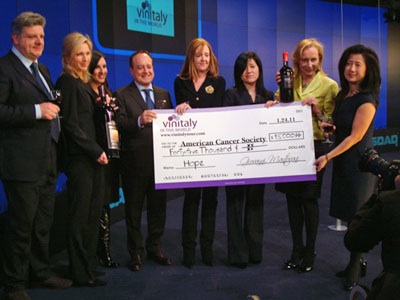
After closing NASDAQ, Marilisa Allegrini (second from right in yellow, holding magnum bottle) joined Cristina Mariani-May (second from left) when Giovanni Montovani, the CEO of Verona Fiere, home of VinItaly, donated $45,000 to the American Cancer Society.
In spite of being close to the end of a long wearying day, with plenty of New York’s finest snow to negotiate and a late dinner yet to attend, I found Marilisa delightfully charming and eager to educate consumers about her Corvina-based (along with rondinella and molinara) Valpolicella wines.
Valpolicella, which translates to “valley of many cellars” (perhaps because of the area’s long history of winemaking) is a DOC wine-making region west of Verona and east of Lake Garda.
The Allegrini winery makes wines using a system where a single vineyard of locally grown fruit goes into each wine.
Marilisa said all of the Allegrini fruit is estate grown, she said, coming from 70 hectares of vineyard in the communes of Fumane, Sant’ Ambrogio and San Pietro, all within the Valpolicella Classico DOC.
When I asked her to explain the difference between her basic Valpolicella Classico (made of Corvina Veronese, Rondinella and Molinara grapes) and the deeper, more concentrated Palazzo della Torre (Corvina Veronese, Rondinella and Sangiovese) and the intense Superiore La Grola (Corvina Veronese, Rondinella, Syrah and Sangiovese), she said it starts in the vineyards, where green cropping lowers the fruit load on the vines dedicated to the Superiore.
Her brother Franco is the winemaker, and Marilisa said he adds to the wine’s intensity by using variations of the ripasso (double-fermentation) technique.
“This gives the wine more intensity and concentration as well as a longer aging potential,” said Marilisa, whose family name has been making in the area for at least 500 years and today is synonymous with fine Valpolicella wines.
She also described the Superiore as “halfway” between the basic Valpolicella and the Amarone.
Those at the tasting also had the chance to sample Allegrini’s La Poja, a 100-percent Corvina wine aged in barriques. Very dense and complex, it’s full of dark fruit and round tannins and a silky finish. A great wine for a snowy evening in New York City.
Stories from VINO2011 (2)
What a week in New York City.
Snowcapolypse.
Snowmageddon.
Snowverdose.
Snowmore.
And on and on.
Lucky to get out only 24 hours late.
Here are a few highlights from the four days of Vino2011, also known as Italian Wine Week, presented by the Italian Trade Commission and one of the best weeks of the wine year for fans of Italian wines.
One of my highlights was heading through the storm to NASDAQ and watching Cristina Mariana-May of Castello Banfi, Marilisa Allegrini of the Veneto wine producer Allegrini and Giovanni Montovani, the CEO of Verona Fiere (organizers of VinItaly and the VinItaly WorldTour) ring the closing bell.
Also along for the event were representatives (I’m sorry I can’t find their names in my notes, made soggy by the constant snowfall) to accept a $45,000 donation to the American Cancer Society by VinItaly.
Why would an Italian corporation make such a hefty donation to an American group?
Montovani said simply that he and others who spend their days in the world of Italian wine “feel very fortunate and it is our honor to share our good fortune with those in need.”
And to show how serious about sharing the Italians are, last September they gave an additional $25,000 to the ACS after a “VinItaly Day at Eataly” benefit.
Part of the ceremony too was the unveiling (at least for me) of the video campaign (which first was announced last November) for the commemorative 150th anniversary wines (one white, one red) with grapes from all 20 regions of Italy.
The 150th anniversary commemorative wine concept was conceived by Ettore Riello, president of VeronaFiere, after an idea from Giorgio Napolitano, the president of the Italian Republic. Folks at Vinitaly embraced the idea and the blends were created by a group of Italy’s leading winemakers.
The actual wines (don’t get excited: only a handful of bottles will be produced and, no, you don’t get one) will be introduced on March 17, the anniversary day of Italian independence.
I believe it was the VinItaly PR department that came up with the memorable “1 Nation, 2 Bottles, 20 Regions, 40 Grapes, 150 Years” campaign. You can see a list of the varietals here, with thanks to Serge Lescouarnec.
No one is saying just what the blends are nor how the wines taste, so that will remain a mystery until the first bottle is opened, if it ever is opened and not put in a showcase somewhere.
Later the same day of the NASDAQ festivities (which closed up for the day, probably due to all the great karma) a charity wine tasting was held at the ACS Hope Lodge featuring Banfi and Allegrini wines.
I had the opportunity to chat with (interview) Marilisa during a brief quiet moment toward the end of the tasting, just before she had to leave. It had a been a long day for everyone and she was off to dinner.
I’ll write about our conversation tomorrow.
Making the best of Bergamo wines
On the second night of New York City’s Snowcopalypse 2011, about 20 winter-hardened wine veterans huddled at Enoteca Di Palo, a wine shop in New York City’s Little Italy, to meet and chat with winemaker Vanessa Verdoni of Cantina Sociale Bergamasca.
Most of those present were in town for VINO2011, also known as Italian Wine Week, produced by the Italian Trade Commission.
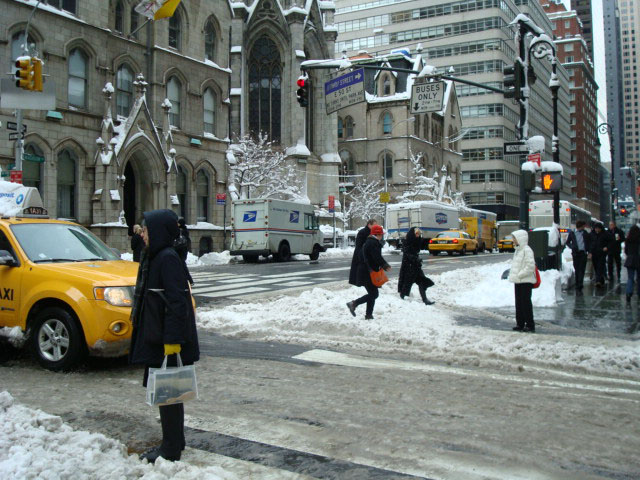
A winter's day in New York City, January, 2011
You never know who you’re going to meet during this week of tastings, seminars and special dinners, and even after a hectic week, Vanessa Verdoni was a charming and intriguing as anyone I met during the week.
At 32, she’s yet one more of the immensely talented winemakers Italy is revealing to the world. My friend and fellow blogger Susannah Gold has written many posts about italian women winemakers but as fast and as well as she writes, it seem there always is someone new springing up somewhere in that immense land of wine. Susannah also has an informative post about Bergamo here.
Verdoni is different from most of the other winemakers in that she does not come from a wine-industry background.
“My father really wasn’t that interested in wine, we didn’t have a wine cellar when I was growing up, and when I told him I wanted to be a winemaker, it was like, ‘Oh, no, what are you thinking?”‘ recounted Vanessa with a laugh. “But now he accepts it and gives me all the support he can.”
 Among her hands-on learning were stints at wineries in Italy (Montalcino, Verona) and New Zealand and then working for several years with the Bergamo-based Valcalepio Consorzio.
She said her first vintage was in 2000 and today she’s the second or assistant winemaker at Cantina Sociale Bergamasca, a co-op winery in San Paolo d’Argon, just east of Bergamo, in the heart of Lombardy. Situated right at the base of the Italian Alps, the area sees tremendous variations in climate from hot summers to very cold winters.
Bergamo is known for its hard-working citizens and for having the best “muratori” (brick masons) in Italy.
Most vineyards are split 50/50 with cabernet sauvignon and merlot and most of the region’s wines are table wines.
This isn’t said disparagingly. Bergameschi love their land and their food-friendly wines and for years they really haven’t cared that the big “rank-by-the-number” wine critics ignore their wines.
But as the world gets smaller and the economics demand more markets, we’re starting to see more Bergamo wines available, and hurray for that.
Verdoni let us taste several of her red wines from the Valcalepio DOC, including her 2009 Bergamasca IGT Merlot, fermented in stainless steel. The wines have vibrant fruit (red cherries and blueberries) and my notes from the evening remark that this is a delicious merlot that reminded us why the varietal was so immensely popular (before the merlot-phobic movie “Sideways” came out, anyway).
We also tasted the Bergamasca 2008 Valcalepio DOC Rosso, a blend of 60 percent cabernet sauvignon and 40 percent merlot. Silky tannins, great fruit from the merlot and the heft of a classic cabernet sauvignon.
Finally, there was the 2005 Akros, a Valcalepio DOC Rosso Riserva, 50/50 cabernet and merlot. Vanessa said the winery puts only the best grapes into the Riserva, which sees two years in large (25 hectoliter, about 660 gallons) French oak barrels plus six months of bottle aging before release.
The oak was evident but not overwhelming, providing good conterpoint top the vibrant fruit.
Bergamasca also makes a Valcalepio DOC Bianco (40 percent chardonnay, 30 percent pinot bianco and 30 percent pinot grigio) and an IGT pinot Bianco but I can’t find my tasting notes for thee. Maybe the snowplow ate them.
Even as the storm grew in intensity, everyone agreed meeting Vanessa Verdoni and tasting the wines of Bergamo was a great way to wrap up VINO 2011.
Stories from VINO 2011
It’s Day Two back home, away from VINO 2011, also known as Italian Wine Week and the amazing blizzard of Snowcopalypse 2011 that turned New York City into a winter wonderland and La Guardia Airport into a near-deserted ghost town.
Actually, it wasn’t all bad, since this country boy thought all that snow muffled much of the incessant noise of NYC and softened all the angles, making the architecture and the shapes stand out against the big city background.
The Italian Trade Commission did a great job of seminars, trade discussions and tasting opportunities during the four-day fest, which I attended as a guest of the ITC. A working guest, that is, spending countless hours (well, i could count them, I suppose, if I really wanted to remember all of them) getting to know Italian winemakers large and small.
So many stories to tell, so few words. I ran each day into winemakers who took one look at my badge (“journalist” it reads, taking some liberties for a guy who’s nothing more than a reporter) and immediately started badgering quizzing me about finding them an importer. I really couldn’t help them, although I also spent hours badgering quizzing importers about what they were looking for in the way of new wineries and wines.
I mentioned this on the second morning to blogger extraordinaire Alfonso Cevola and he mentioned he had written about that very topic just before arriving in NYC. So I read his well-considered and finely balanced advice and went out to tell those winemakers they, too, should heed Alfonso’s words.
He’s right, you know. I also know Strappo (see the comments at the bottom of the “How to sell…” blog) makes a good argument, and to a certain point I heard similar comments from other small importers. But listen: Ace is right when he says there’s more than just having a lovely wine and the desire to tap the American pocketbook.
I tried some fantastic wines, whites that were light and fruity and sharp with plenty of acid to balance the palate and intense red wines with brooding depth and heft and heavyweight knockouts.
“Quanto di questo si fa a fare? (That’s supposed to mean ‘How much of this do you make?’ ” but my Italian sucks, I know.
“Umm, circa 18,000.”
“Cases?”
“No, bottiglie.”
Ugh.
Talking to a small importer (meaning not Republic National or Glazer’s), I asked if he would take a delightful vermentino from a family-operated winery.
“Yeah, but I already got one vermentino, I don’t need two …”
How do you tell a delightful young couple to go back home to Italy and build their fortune there?
“… unless you are willing to sacrifice your first born to come to America, to become an American and work and live and make it happen, don’t dream any further.” Those are Cevola’s words, and he speaks with experience.
I can only hope those were snowflakes melting on their cheeks and not the tears of disappointment.
New York, New York, an Italian (wine) type of town
It’s late Saturday and all my bags are packed, I’m ready to go…
Surely John Denver didn’t have me in mind when he wrote this song and the sentiment isn’t quite the same, since I’m not leaving a relationship but instead renewing one.
A relationship with Italian wine, anyway, since I’m headed for New York City and Vino 2011,the main feature of Italian Wine Week. I do hope this link works because Bresnan, the tyrant supplier of cable Internet service here in Grand Junction, can’t seem to find the website.
As it happens all too often, I get the “other suggestions” page from Bresnan, something totally useless for this. But that’s just a glitch.
The good news is I’m headed for a week surrounded and immersed in Italian wine culture, from seminars, tastings and lectures to interviews, tastings, meals, and more tastings.
As the title of this post says, this is the week Italian wines take over a town that already has plenty of Italian connections.
This is my third VINO and each year I return home with great memories and more wine-loving friends both Italian and want-to-be Italians.
Italian Wine Week doesn’t actually represent all 20 Italian wine regions but rather the regions of Apulia, Friuli Venezia Giulia, Lombardy, Tuscany and Veneto. That’s enough for one week, though.
As sort of pre-Vino preparation, I’ve been sipping some delightful Italian wines I received over the past month or so in anticipation of the coming week.
Although the wines of Arnaldo Caprai of Montefalco in Umbria won’t be at VINO 2011, I recently received a sample of his 2007 Montefalco Rosso ($23 srp), a blend of 70 percent sangiovese, 15 percent Sagrantino and 15 percent merlot.
Dark, dense, with pleasantly bright red fruit and a luxurious feel on the palate. It’s a lovely wine, a delightful introduction to wines from Montefalco and a treat to be sipping as the evening comes and snow drifts through the skies of western Colorado.
I also have tried Caprai’s Sagrantino di Montefalco 25 Anni, a DOCG wine developed initially in 1993 to celebrate the winery’s 25th anniversary.
I wasn’t very familiar with Sagrantino and find it makes dark, ruby-black wine with plenty of dark fruit (blackberries and what one friend insists is the mythical “bumbleberry“) and “hints of spice and vanilla transcended from the barriques,” as the tasting notes say.
Caprai has done in depth research and development with the Sagrantino grape, which may date from 1 BCE when Pliny the Elder mentions what might be an early Sagrantino varietal. According to the website, “As Sagrantino does not show any resemblance with other varieties that grow in central Italy, researchers claim that Sagrantino’s origins are exclusive to Montefalco, while others believe that Sagrantino originally came from Asia Minor and it was taken to Montefalco by followers of San Francis of Assisi.”
Anyway, it’s a delicious, full-bodied red wine that will be even more outstanding after another decade of aging.
Finally, even though it’s late, I couldn’t resist opening the 2007 Lucente from Luce della Vite, a venture between the Marchesi de’ Frescobaldi family of Florence and the Robert Mondavi family of Napa Valley.
The 2007 Lucente ($30 srp) opens with notes of dark plums and blackberries, dark chocolate and coffee. It’s very round, showing great balance between dark fruit, tannins and hints of French and American oak.
This is a terrific wine and I’m sorry you aren’t here to try it, but then I have only four good wine glasses and two of them are busy at the moment. It’s very good.
Gee, that’s a lot of words just to say I’m off to New York for more great Italians wines.
See you next week.
(It’s now Thursday and since I’m still in New York City, waiting for someone to shovel the runways at La Guardia Airport, I updated this entry to reflect more accurate information about Arnaldo Caprai.)
Any night is New Year’s Eve with sparkling wines
While holidays are when most people open sparkling wines, there’s no reason to wait until the tinsel is falling off the tree to open something bubbly and fun.
With some friends over for a between-the-holidays midweek gathering, I gathered an assortment of various bubblies to share. I didn’t have enough of any one to make it the focus of the party but there was enough variety to open some eyes to the possibilities you can find in sparkling wines. Here’s what we tasted and toasted:
The Jaume Serra Cristalino, a Spanish Cava (I know that’s redundant but don’t tell; some folks don’t know that Spain produces Cava) made from Macabeo, Parellada and Xarel-lo grapes. I’ve written before about this light and refreshing bubbly but last week I saw a shopping cart full of this wine at a local store and it was selling for $5 a bottle. So I bought a bunch of bottles because you never know when something needs toasting. The taste and nose is reminiscent of a Prosecco, lots of green apple and mineral with more citrus than you’ll usually find in Prosecco. Crisp finish and did I mention it sells for $5?
The Nino Franco Rustico Prosecco ($12-$14) is a wine you rarely see in this town dominated by Mionetto and Zardetto, two fine Prosecco producers but not quite the level of Nino Franco’s better efforts. Franco makes a line of delicious Prosecco (or Prosecci) at his winery in Valdobbiadene in northeast Italy, where some of Italy’s finest Prosecco is made.
A touch of yeast, citrus, lively fresh fruits and melon. Quite nice.
Robert Mondavi has added a sparkling wine to his Woodbridge label of affordable wines. The non-vintage California Brut Sparkling wine (SRP is $10 but you can find it for less) is made in the Charmat method (same as Prosecco) with primary and secondary tank fermentation. Shows flavors of green apple, pear and citrus with a note of yeast. Pleasant and lots of bubbles.
The evening’s favorite, however, was a wine I smuggled in from the East Coast. Last year, during VINO 2010, the four-day all-Italian wine fair in New York City, I had the pleasure of meeting winemaker Riccardo Ricci Curbastro from the Franciacorta DOCG in the Lombardy region of northeast Italy.
Blogging colleague Susannah Gold, also enchanted by Franciacorta, has a wonderful article on Curbastro here and a fine article about Italian sparkling wines for New Year’s Eve here.
Franciacorta is another of Italy’s largely unknown (outside of the larger cities) but entirely worth the effort to find sparkling wines, of which you can read more here from Gregory Dal Piaz on Snooth.
Many things contribute to making Franciacorta such a delightful wine. The winemaker’s talent, of course, but also the use of the methode champenoise with the wine undergoing secondary fermentation in the bottle instead of the tank (the Charmat method). Our party enjoyed the Brut (60 percent Chardonnay, 30 percent Pinot Bianco and 10 percent Pinot Nero) but Curbastro also offers an Extra Brut made 50/50 of Chardonnay and Pinot Nero (Pinot Noir to all you Anglophones out there).
You can take it from here. There are plenty of opportunities to open a sparkling wine on New Year’s Eve without breaking the bank. And don’t just wait for a holiday, because nothing makes any occasion a festive occasion more than the POP of a cork. As Curbastro would say, Tanti Auguri e Felice Anno Nuovo.
Chardonnay still a good starter
Dreaming of a white Christmas means so many things but I’d like to start with a Chardonnnay, please.
Maybe winter (actually it’s still really, really late fall) isn’t traditionally considered Chardonnay time but let’s be real. A good (affordable) Chardonnay is hard to find.
The always entertaining W. Blake Gray, in his blog The Gray Market Report, earlier this week commented that many people disrespect Chardonnay because it’s become the phylloxera of the grape world.
“But there’s also contempt from the knowledgeable about Chardonnay’s kudzu-like takeover of the world’s vineyards,” write Gray. “It’s like phylloxera; it escaped its home in Burgundy and has caused the uprooting of native vines in Greece, Portugal, Italy, Spain — basically, any country where grape farmers are trying to make a living.”
His premise being that great Chardonnay is out there but it’s not produced everywhere the grape is grown.
And it’s grown nearly everywhere, largely due to wine makers eager to share in the wine’s immense popularity.
So why not write about Chardonnay, no matter how loud the cries from the ABCer’s (you known, Anything But Chardonnay).
During my Thanksgiving break (which was about 4 hours) I enjoyed the St. Francis 2008 Sonoma County Chardonnay, which lists for around $10-$12.
According to the winery, most of the grapes (65 percent) grapes come from the Russian River Valley, the very sort of cool climate that produces terrific Chardonnays.
This wine certainly reflects the mellowing influence of the Pacific Ocean, showing ripe fruit flavors and sharp acidity, which made it a fine pairing for the Thanksgiving table.
Snooth.com provides further reviews here, if you’re interested in reading more.
St. Francis Winery, located in Santa Rosa, Cal., also produces some delightful red wines, including a Cabernet Sauvignon, Syrah and a couple of fascinating Zinfandels, including the Wild Oak Old Vines Sonoma County Zinfandel.
I tasted through these wines during the holiday (the Old Vines Zinfandel was the red wine at the Thanksgiving table) and I’ll write more about these later.
 Wine Openers