Archive
La. chef John Besh picks up SE Asia influences
ASPEN – The last time we ran into New Orleans chef John Besh, he was occupied with rejuvenating that city’s restaurant scene following the disaster of Hurricane Katrina.
But then came the BP oil spill and Besh, who runs six restaurants in and around New Orleans and one San Antonio, again found himself working overtime (or better, still finding himself working overtime) to remind people how great Louisiana seafood can be.
During his 40-minute cooking seminar Saturday morning on the second day of the 2011 Food & Wine Classic in Aspen, Besh said the two storms (one physical, the other economic) helped him discover something more of his city.
The seminar was titled “The New New Orleans” and while on stage Besh prepared a shrimp creole, simple and familiar enough for anyone knowing Louisiana cuisine, but this version incorporated the strong Thai and Viet Nam influence found in that city.
Not many in the audience admitted they knew of New Orleans’ vibrant Southeast Asia populations, but those populations were boosted when people from Southeast Asia moved to the U.S. for work in the energy industry.
It took Katrina for Besh and others to discover and assimilate the Viet and Thai cooking styles into traditional Deep South cuisine.
The Vietnamese immigrants were “segregated until Katrina brought the city together,” Besh said.
It was during the rebuilding, when so many cultures came together, that many chefs discovered the culinary styles and ingredients that now grace the familiar-yet-now-different Louisiana dishes.
Besh said it’s not uncommon to find dishes using lemongrass or chili paste, both Southeast Asia influences, as well as the better-known cultures – French, Spanish, African-American and other – that have forged the New Orleans food scene prized today.
But the end of Katrina wasn’t the only the jumpstart given New Orleans’ rejuvenation. It took the ecological and economic disaster of the BP oil spil, which suddenly turned off millions of people to all that luscious Louisiana seafood, to get Besh pounding the podium of “Eat More Shrimp.”
The only losers in the lingering fears are those still uneducated about how far the Louisiana shrimp (and all seafood) industry has come, Besh said.
In typical Besh style, he wasn’t at all shy about urging the audience to eat more domestic shrimp and “Better yet, eat Louisiana shrimp,” he told the appreciative audience.
The Food & Wine Classic winds up Sunday with a morning lineup of seminars as well as the extremely popular and standing-room-only Quickfire Cookoff pitting star chefs Richard Blais against Kevin Sbraga.
Following the season(s)
It’s less than 30 hours until June and suffice it to say this spring has been confused and confusing.
Well, let’s say it anyway: Last time I walked outside, it was sunny and calm.
An hour before that, it was overcast, dust from Utah blowing in the west wind at 40 miles per and about 50 degrees.
Earlier today, it was snowing, temperature jumping from 35 to 45 and the wind laying trees down around town.
And real early this morning I was out in T-shirt and shorts, watering the lavendar I recently planted.
And, gee, tomorrow it’s forecast to be 75 and right back into summer.
It’s been like this all month, changing from spring to summer to winter to spring – no, winter, no, spring – all so fast it’s hard to keep the seasons straight.
Fortunately, my state has been missed by the truly impressive weather devastating parts of the Midwest and South.
While I follow the latest news on floods, tornadoes and other spring storms, I’m not unhappy to admit my biggest challenge has been trying to match my wine selections with the weather.
Is it spring? How about a crisp, floral Gavi from Vigne Regali, the winery owned by the Mariani family of Banfi Importers fame?
Gavi (actually it’s Cortese di Gavi from the Cortese grape) is a DOCG white wine from the Province of Allessandria in Italy’s Piemonte.
Mention Piemonte to most wine drinkers and they see red, as in Barolo (read what Tom Hyland has to say about the 2007 vintage) and Barbaresco, the critic-confounding wines from the better-know nebbiolo grape.
Nothing wrong with that, since there are many delightful Barolos, including the recently reviewed 2007 vintage.
But on hot summer nights, when the lightning bugs are chasing each other around the roses, I’ll take something white, light, and not too much alcohol.
Enter Gavi, often considered Italy’s premier white wine.
I’ve sampled some delightful Italian white wines in the last few months (Romagna’s Albana, for one) but this version of Gavi, with notes of apple and citrus and wonderfully crisp acidity, simply tastes like spring, even if the weather isn’t cooperating.
This charming version, the 2010 Principessa Gavia ($14 SRP but usually available for less, 12 percent abv) is perfect for sipping or light summer meals.
The Principessa also is available in a perlante style, which captures some of the final fermentation before being bottled (SRP $17).
Then, when the weather changes (note I said “when,” not “if”) back to winter, I change, too, to something burly enough to stand up to the elk stew warming in the ancient crockpot.
This afternoon, sometime between wind storms and rain/snow/sunshine, I dug up a 2006 St. Francis Pagani Vineyard Sonoma County Old Vine Zinfandel (SRP $45 but less to St. Francis wine club members).
Deep, rich and dark-fruity (is that a word?), with a nose of black fruit, chocolate and roses and so fruit deep that it’s 15.5 alcohol doesn’t overshadow the wine.
Actually, 15.5 percent might be considered moderate in these times when some Zins are running to 17-percent alcohol.
The St. Francis Pagani Vineyards (vines planted in the 1800s) spends 14 months in American oak which serves to add a spicy touch to the finished wine.
And heaven knows we could use some spice to warm things up when it’s snowing on May 30.
Going to WAR for a great wine
With the Alpine Bank Junior College World Series hard upon us, it’s a fine time to look closer at what might be the most statistic-oriented sport in human history.
You want numbers? Thanks to the never-tiring endeavors of such stats-happy fans as writer Daniel Okrent, who is credited with inventing Rotisserie League Baseball, and baseball writer and historian Bill James, author of more than two dozen books devoted to baseball history and statistics, there are baseball metrics for every conceivable event.
Which left-handed pitchers allow more steals with two outs? Which batters tend to strike out with one man on and two outs?
Some of the more-obtuse (for non-baseball fans anyway,) include James’ “Runs Created,” which tries to quantify a player’s contribution to runs scored and his “Pythagorean Winning Percentage,” which explains the relationship of wins and losses to runs scored and runs allowed and a team’s actual winning percentage.
All of the numbers, of course, are there for one reason: to determine why teams win and lose (or is that two reasons?)
But then I saw the category “Wins Above Replacement” and thought, “Here’s something I can use.”
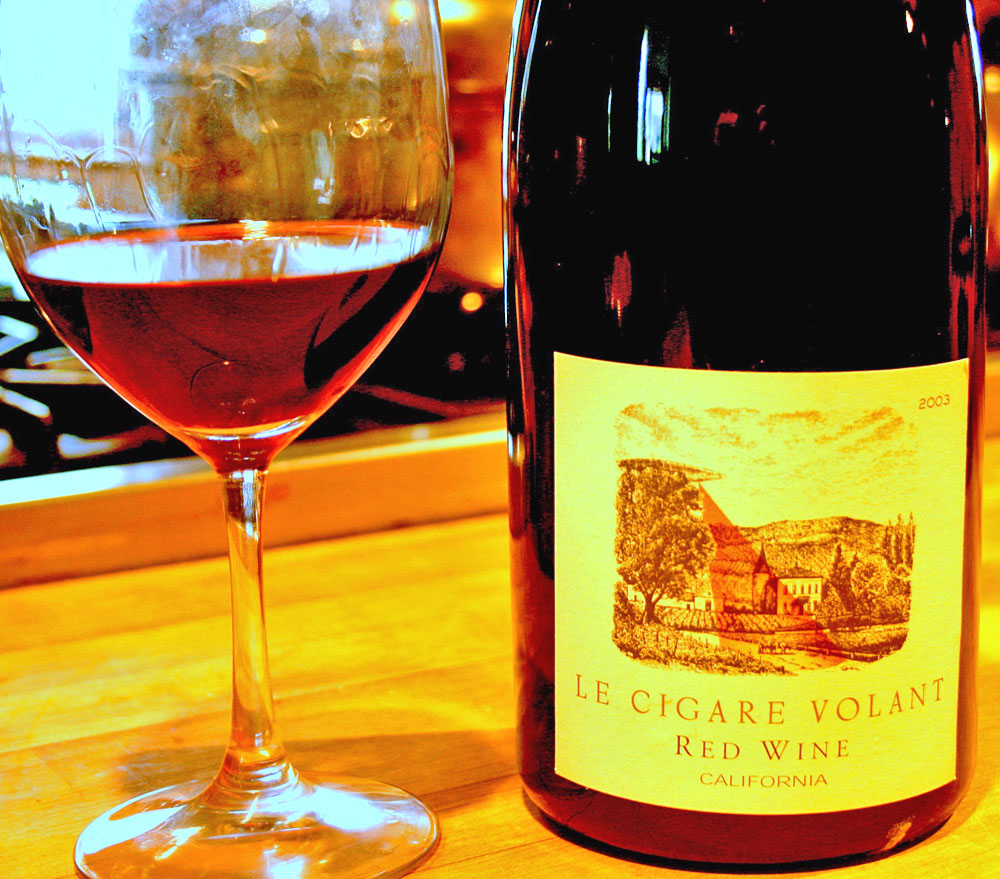
The 2003 Le Cigare Volant, an All-Star now with many years ahead of it.
The WAR metric can be explained (very simply) as considering a player’s total value and how much his team would be giving up if the player had to be replaced with a minor leaguer or someone off the bench.
Since this ostensibly is a column on wine and not baseball, we’ll tweak the WAR statistic to fit into your wine cellar.
During an Easter dinner, standing head and shoulders (literally) over the other wines on the table was a magnum of the 2003 Le Cigare Volant, the Rhone-style red from Randall Grahm of Bonny Doon, one of California’s original Rhone Rangers.
The wine, whose name literally translated from the French means The Flying Cigar or The Flying Saucer, is considered Grahm’s tribute to Chateauneuf-du-Pape.
According to several sources, the name derived from a 1954 ordinance adopted by Chateauneuf-du-Pape producers forbidding flying cigars/saucers from flying over the region.
Any transgressors, said the ordinance, would be confiscated. As far as known, the only flying saucer yet seen is the one on the wine’s label.
Le Cigare Volant traditionally (the first vintage was 1984) is a fruit-driven blend based on grenache, syrah and mourvedre, with smaller amounts of viognier, cinsault and carignane but 2003 was a bit of stylistic change for a wine Grahm has called Bonny Doon’s “spiritual center.”
In some winemaker’s notes, Grahm said, “We have upped the ante and given the wine a little more grip. I think that in doing so, we have enhanced this Cigare’s ability to age.”
This wine is a blend of 34 percent grenache, 33 percent Syrah, 27 percent mourvédre and 2 percent each of viognier, cinsault and carignane.
Here, though, the syrah and mourvedre are dominant with the grenache hanging back a bit.
We weren’t sure what we’d find on opening the bottle since some reviewers have given the 2003 a definite thumbs down but the large bottle disappeared well before dinner was served.
Eight years of not-great but decent cellaring produced a wine with soft tannins and lots of red-raspberry and dark cherry fruit along with the spicy tang of the syrah and the dark flavors of the mourvedre.
We wished we had one more bottle stashed away to open in another eight years.
Which brings up the wine’s WAR rating.
You can’t keep this wine in your cellar forever, but if you had two bottles, what would you lose by drinking the second right away?
Seriously, this wine was so good we would have popped the second, if it was available.
But that would mean losing (bad WAR rating) the future of this wine, which from the one bottle we had, seems quite promising.
Do you stutter and stammer and bring up a substitute from the cellar, all the while knowing there’s a All-Star in its prime begging for a chance to shine?
You could wait until that “Special Occasion” calls for a particularly impressive wine, and let that baby slam one out of the park.
Or you could play like the 1919 White Sox, shrug your shoulders and say, “I don’t know what happened.”
Maybe the solution is to check the bank account and make a big trade, putting another winner in your cellar.
Thanks for notice but we’ve been here for a while
In case you haven’t noticed, which likely means A: You’re not from western Colorado; B: you’re not interested in Colorado wine; or C: You’re a Republican (or all three), our Democratic ( that’s the big D democrat) Gov. John Hickenlooper recently tabbed June 5-11 as “Colorado Wine Week,” a welcome but obvious political panegyric to the initial Colorado Winefest set for June 11 at the former and much-redeveloped site of Stapleton Airport in Denver.
Gee, the sudden attention being paid to Colorado wine is great and oh-so welcome but where has (have) Hickenlooper (and other politicos) been for the last 20 years while the Colorado Mountain Winefest in Palisade has been rocking the state’s wine world?
It’s not like the Colorado wine industry hasn’t been around for some 40 years (the first commercial winery was begun in 1968) or Colorado wine hasn’t been winning awards since those early years.
Or that there might not even be an ever-growing state wine industry if weren’t for the grape growers and winemakers in the state’s two (count ’em, two) American Viticultural Areas, both of which happen to be on the Western Slope.
Of course, we’re certainly not coarse enough to say bad things about the state’s top politician taking some time out of his busy schedule running for re-election to make an expected but as-yet-not-confirmed appearance in Palisade to repeat his nice remarks about the state wine industry.
Giving the Guv as much credit as he deserves, here are some of the encomia the Governor’s proclamation laid out at the feet of the Colorado wine industry:
– Colorado’s wine industry “has .. a well-deserved reputation for creating … premium quality wines;”
– The state’s wineries, “many small family-owned estates, produce award-winning wines often using locally grown grapes, fruit and honey;”
– And the state’s wine industry “provides jobs and adds value to our quality of life.”
Well, yes, we quite agree, don’t we?
And we hope the message gets out to everyone else who might wonder if there’s life west of the Eisenhower Tunnels on Interstate 70.
Just please, Gov. H., don’t take another 20 years to acknowledge there’s a whole bunch of great things happening in the state’s wine industry.
No sense in keeping this great secret to ourselves.
Sleepless weekend for fruit growers
Sunday morning reading:
We expect late frosts here in western Colorado. It’s not really spring without the mutable weather giving us a thrill now and then, just to see who jumps first in response to possibly losing all of the (pick one or all) peach, cherry or grape crop.
I’d add apricots to the list but we so rarely get an apricot harvest because they bloom early and long-term (I suppose 30 years can be considered long term unless you’re a tree) weather data the historical last freeze around here occurs April 23.
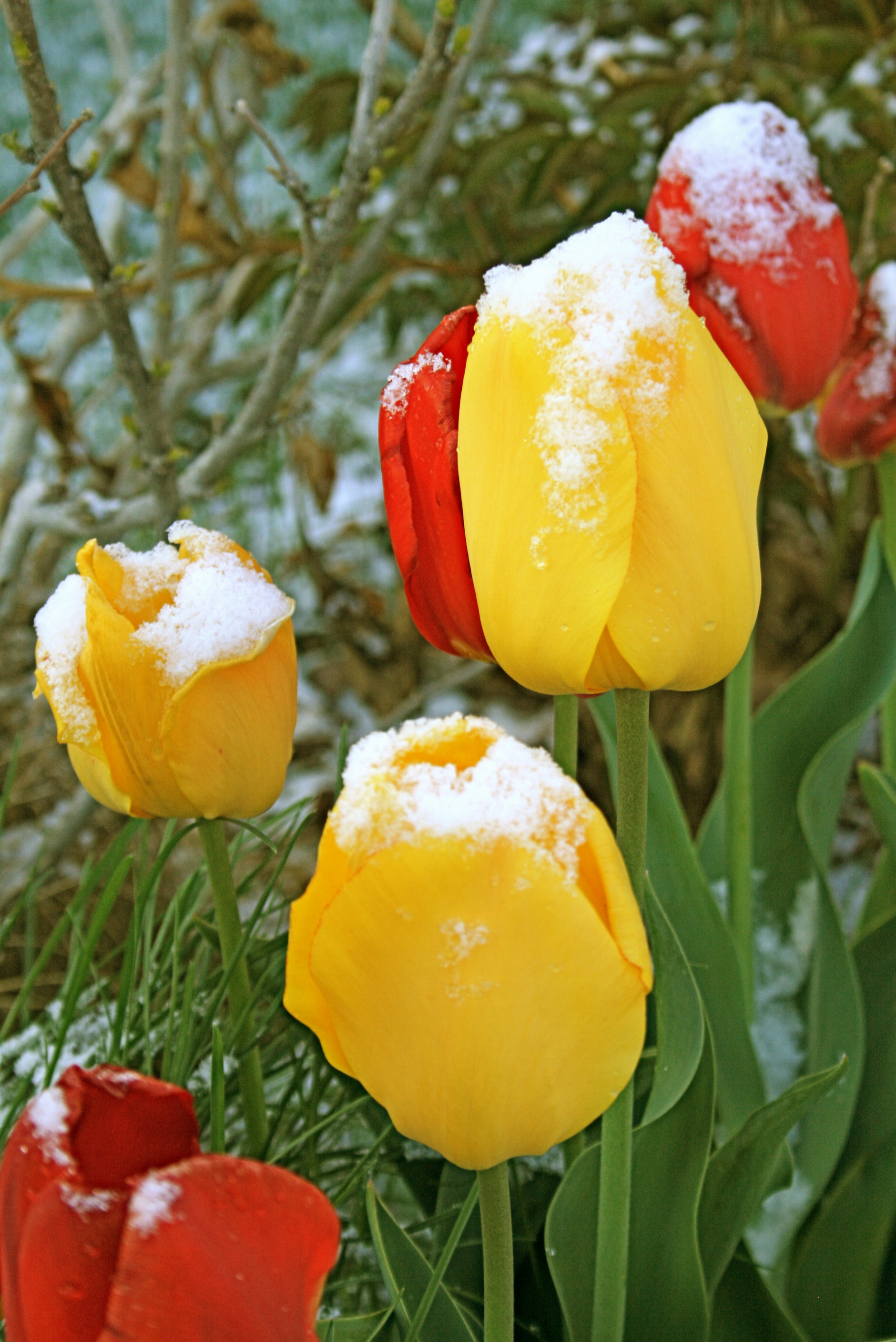
Winter's last fling, April 30, 2011
The second shoe fell early this morning when the low at my house dipped to 26 and around the valley you could hear the wind machines roar to life.
Such is the sleep-deprived life of a fruitgrower.
Royal nuptials: Susannah has an interesting post about watching the royal wedding (or is that Royal Wedding?) and thinking of British sparkling wine, which apparently can be quite good.
I guess in an historical situation such as this, I’d forgo any thoughts of nationalism and go with Champagne, which is what reports said the Palace served for the occasion.
Sabering the bubbly: Alfonso Cevola, aka The Italian Wine Guy, has a fine post about his latest adventure in the Texas wine and fine food scene. Among the great photos are a series of Claudine Pepin sabering a bottle of Veuve Clicquot, one of the event sponsors (and probably why someone had a bottle of Champagne to play with.)
BTW: The Wikipedia site on Veuve Clicquot has a fascinating picture of the formidable Madame Clicquot herself, who according to one source didn’t drink. I read this somewhere and in a weak moment failed to note where it was. I’ll get back to you on that.
Anyway, seeing the photos of Claudine Pepin saber the bottle reminded me of the several times I’ve watched her do the same during her presentation (with her father, the immensely talented and popular Jacques Pepin) at the Food & Wine Magazine Classic in Aspen.
Claudine does this in-stage, indoors, and insists there’s a) little danger; b) it’s easy to do once you’ve determined the weak seam in every bottle; and c) if you keep the blade moving along the bottle neck.
The glass shards are forced out of the bottle by the pressurized Champagne rushing out from inside.
You could try it, if you feel daring. If you don’t have a saber lying around the house, any long-bladed, hefty knife will do.
For all you DFYers, here is an interesting piece on YouTube.
Notice the erudite and educational clues the video provides, such as “never saber while intoxicated.”
Maybe start with a $7 Spanish Cava, though, instead of a $130 Veuve Clicquot Grande Dame.
Hey, how else will you find out about these things?
And speaking of the F&W Classic, this year’s event runs June 17-19. The basic consumer ticket is $1,185 for events, seminars, demos and the various Grand Tastings.
Info at the website above.
Sangiovese by any other name …
What do you think of when you hear “Sangiovese?”
Chianti, perhaps, since that region and its wines often are recognized as the pinnacle of Sangiovese winemaking.
Whether or not you agree with Chianti’s status, Sangiovese remains Italy’s widest-planted red grape and it follows there are many delightful wines being made from this at-once complex and yet malleable grape.
Romagna, of course, is making some wonderful Sangioveses, wines ranging from easy quaffers to those with depth, great balance and spicy tannins, particularly the Riserva level of wines.
Colleague Michael Franz wrote this after several of us recently spent a week touring vineyards in Romagna.
It’s not surprising that excellent Sangiovese are being made by many Italian winemakers and recently I tasted some Sangiovese from Montalcino, where the local Sangiovese clone (sangioverorosso) is better known as Brunello.
The area has a long history of winemaking and in 1980 Montalcino received Italy’s first Denominazione di Origine Controllata e Garantita (DOCG) designation.
As an aside, Italy recently named three new DOCG and DOC wines, bringing the seemingly never-ending list of DOCG areas to 61 (or 62.) It’s enough to make your head spin and understand why the wine gods are also confused.
CastelGiocondo Brunello di Montalcino 2005 DOCG ($50) is 100 percent Sangiovese (according to DOCG regulations) and brings an attractive nose of red berry, dark fruit and a hint of violets along with dark chocolate, tobacco and espresso.
Bright flavors and fine tannins, carrying a hint of the extended oak aging (a mix of Slavonian oak casks and French oak barrels), and the wine’s acidity make this an extremely food-friendly red with a lingering, lovely finish.
Wine Spectator listed the 2004 vintage as the 15th Best Wine in the World.
Marchesi de Frescobaldi, producer of the CastelGiocondo Brunello di Montalcino, also makes a Riserva ($100), produced in limited amounts only in the best vintages. The wine is aged for 5 years (at least two in barrique, one on the large botti and at least one in bottle), yielding a warm, intensely structured wine with a long finish.
The wines are imported by Folio Fine Wine Partners of Napa.
Covering VinItaly on the cheap
For various reasons (like, 2,000 of them, about what the trip would cost me) I’m not getting to VinItaly this year. It’s not that I’m not interested in seeing Verona, Italy or too busy to taste a couple thousand wines or anything, I’m just not there.
Instead, I’m following the action through the ether: reading press releases sent from the VinItaly press office and on some favorite blogs, including those by Susannah Gold and Alfonso Cevola, aka The Italian Wine Guy.
Susannah speaks impeccable Italian (including several different dialects, which comes in handy when dealing with Italy’s 20 wine-making regions) and during a recent visit to New York City for Italian Wine Week Susannah introduced me to Kris Kim, VinItaly COO and a charming, hardworking spokesperson for all wines Italian. All of which means that even though I stay here in the States, the contacts in Italy are among the best.
One recent release that Susannah wrote on concerned a seminar (actually, a series of related seminars) on the question, “Do Italians still love wine?”
That’s a question you might never expect to hear voiced out loud, particularly when it’s voiced at VinItaly, the world’s largest gathering of Italian wines and winemakers.
However, that was the very question on many lips last week at one of the trade seminars offered during Vinitaly’s four-day run that ended Sunday in Verona, Italy.
To be blithe, the answer is yes but maybe not as much as in the past. Forty years ago, Italians managed to down 100 liters (about 133 of those .750 liter bottles, about 26 gallons) of wine per person per year.
Today, that’s dwindled to a comparatively meager 42 liters per year. But it’s positively W.C. Fieldsian compared to Americans who, according to the Wine Institute, choke down just under 9 liters (less than seven bottles, about 2 gallons) per person.
According to some 2009 numbers from the Wine Institute, the leader in per-capita wine consumption is Vatican City State where the 932 or so residents down 70.22 liters (18.5 gallons) per person each year.
That’s not as much as it sounds. It comes out to about 1.35 liters (less than two of those .750-liter bottles) per week, which won’t nearly keep up with most of my friends.
Italy’s 42 liters per person is sixth in per person wine consumption while the U.S. at 8.96 liters per person is far down the list, behind such notable wine countries as Finland, the Cook Islands and New Caledonia, the French Territory in the South Pacific where residents drink almost 21 liters per person per year.
But here’s the biggie: Even though American drink less wine per person that Italians, there are WAY more of us drinking our share.
Last year, for the first time the United States surpassed Italy in terms of total wine consumption, Wine Institute said.
Wine Institute reported that in terms of total consumption the U.S., drinking 2.75 billion liters, is second only to France (2.9 billion liters). Italy now is third, at 2.45 billion liters.
Which doesn’t necessarily support any theory purporting Italians losing their love for wine. What it might indicate, though, is how world economics and the changing demographics of Italian wine drinkers are affecting that country’s wine consumption.
Contrary to what the dreamy-eyed Italophiles among us might think, only 40 percent of Italians say they drink wine everyday, said a report from VinItaly.
Many Italians are saying they have reduced consumption due to economic or health concerns.
Curiously, wine industry consultants Gomberg, Fredrikson & Associates in Woodside, Cal, reported earlier this year that year the U.S. surpassed France as the world’s largest wine-consuming nation as wine shipments to the U.S. from California (leading a reader to believe California no longer is part of the U.S.), other states and foreign producers grew to nearly 330 million cases, a record high for the industry.
Gomberg, et al, said the estimated retail value of these sales was $30 billion, up 4% from 2009.
The French, meanwhile, consumed 320.6 million cases of wine in 2010, Gomberg said.
Robert Koch, president and CEO of Wine Institute, said U.S. wine-market conditions remain “highly competitive”, which usually means lower prices for consumers, and he expects the growth in wine consumption to continue.
“Americans are increasingly interested in a lifestyle with wine and food, demonstrated by the presence of wineries in all 50 states and 17 consecutive years of growth in U.S. wine consumption,” Koch.
Other countries to watch include China, which last year increased its wine consumption by 36 percent, and Russia, where wine consumption last year jumped by 30 percent.
The panelists at VinItaly had a handful of suggestions for developing new consumers, including marketing campaigns aimed at women and at young people just developing their interest in wine.
Italian wine producers also are exploring ways to increase sale in supermarkets, which currently account for 60 percent of that country’s wine sales.
Many states in the U.S. allow food stores to sell wine but Colorado isn’t among them. Buying wine in a food store generally is a “caveat emptor” experience, since few stores (none, in my experience) offer the level of expertise found in dedicated wine and liquor stores.
‘Queen of the Sun’ tells of crisis killing honey bees
If you eat, you should see “Queen of the Sun.”
The story of the crisis killing American honey bees isn’t new to most of us. But the cause of Colony Collapse Disorder, where worker bees simply disappear in mass numbers from their hives, has no clear or generally acceptable explanation.
According to Wikipedia, such disappearances have occurred throughout the history of apiculture. The term colony collapse disorder was first applied in 2006 when a drastic rise in disappearances was seen in Western honey bee colonies in North America.
Similar disappearances have been noted in Belgium, France, the Netherlands, Greece, Italy, Portugal, and Spain, Switzerland and Germany. Recently Ireland reported some hives suffering 50-percent losses.
Theories ranges from mites and insect diseases to climate change, malnutrition, pesticides, genetically modified crops and even cell-phone radiation (I didn’t even know they made cell phones that small).
According to the U.S. Department of Agriculture, bee pollination is responsible for $15 billion each year in added crop value and nearly one mouthful in three in your diet directly or indirectly benefits from honey bee pollination.
In an area such as this that still has strong agricultural ties – economically and socially –it’s important to learn what’s happening to our honey bees.
The movie “Queen of the Sun” takes a interesting and eye-opening look at the bee crisis. Director Taggart Siegel, who searched the world for passionate beekeepers, takes as inspiration a quote from Albert Einstein, who said, “If bees disappear from the Earth, then man will have only four years to live.”
In the movie, Siegel juxtaposes the disappearance of bees with the mysterious world of the beehive, weaving a story around beekeepers, scientists and philosophers.
A release from the movie says Queen of the Sun “reveals both the problems and the solutions in renewing a culture in balance with nature.”
“Queen of the Sun” is being shown this week at the Paradise Theater in Paonia. Showings are set for 6:30 p.m. tonight and Thursday, 8:15 Friday and 3 p.m. Sunday. Some area beekeepers will be hosting a Q&A session after Sunday’s movie.
(Special thanks to Jim Brett of the Western Slope Chapter of Slow Food for this notice.)
Pork it up Sunday in Denver
Forget for now the Broncos, this weekend the porkers take over Denver.
Lovers of heritage-breed pigs are sure to enjoy Cochon 555, a unique culinary competition Sunday in Denver featuring five pigs, five chefs and five winemakers.
The event will be at the Ritz-Carlton in Denver, 1881 Curtis St. The VIP program begins at 3:30 p.m, general admission is at 5.
The chefs, who include the fabulous Kelly Liken of Restaurant Kelly Liken in Vail (she, you remember, was the featured headliner who wowed the crowd at the 2010 Colorado Mountain Winefest), will be challenged to use the entire pig – head to tail, the squeal is optional – while the heritage-type winemakers will be pairing their small-production wines.
Other participating Front Range chefs include 2008 James Beard Foundation Award winner Laughlin Mackinnon of Frasca Food & Wine in Boulder; Alex Seidel of Fruition; Frank Bonanno of Luca D’Italia; and Jennifer Jasinski of Euclid Hall & Rioja.
Winemakers will include Domaine Serene; The Scholium Project; Elk Cove Vineyards; Failla Wines; and Chase Family Cellars.
Whew, what a lineup.
The premise behind Cochon 555, which makes similar appearances in cities across the nation, is to “promote sustainable farming of heritage pig brands,” according to PR whiz Lori Lefevre.
It’s not surprising that pork farming, like all industrialized farming practices from apples to zucchinis, has taken the “easy road” to mass production, breeding pigs that grow big quickly in what are euphemistically called “concentrated animal feeding operations” (CAFOs), which translates to factory farms (even to docking the pigs’ tail because cramped pigs will eat the tails off their pen-pals).
That mass-production means losing the flavor and appeal of heritage-breed pork in favor of lower production costs.
However desirable they may be, heritage pork breeds are not suited for today’s intensive farming techniques, says the website LocalHarvest.org, and some of the older breeds are in danger of being lost.
But there’s hope that events such as Cochon 555 (“cochon” is French for pig but I’m sure you already knew that) will remind pork lovers of the delights of eating real pork.
The winning chef (attendees pick their favorite) will compete in the Grand Cochon at the Food & Wine Classic in Aspen in June.
General admission tickets start at $125 per person, VIP tix are $175 and include special wine tasting along with artisan cheeses, caviar and oysters.
Information at www.cochon555.com.
Zerbina says ‘checkmate’ to passito doubters
Another memory from the recent trip to Emilia Romagna as guests of the Convito di Romagna and the Consorzio Vini di Romagna:
We spent almost two hours one sunny morning chatting with Cristina Geminiani, winemaker and grand-daughter of the founder of Fattoria Zerbina near Faenza in Romagna.
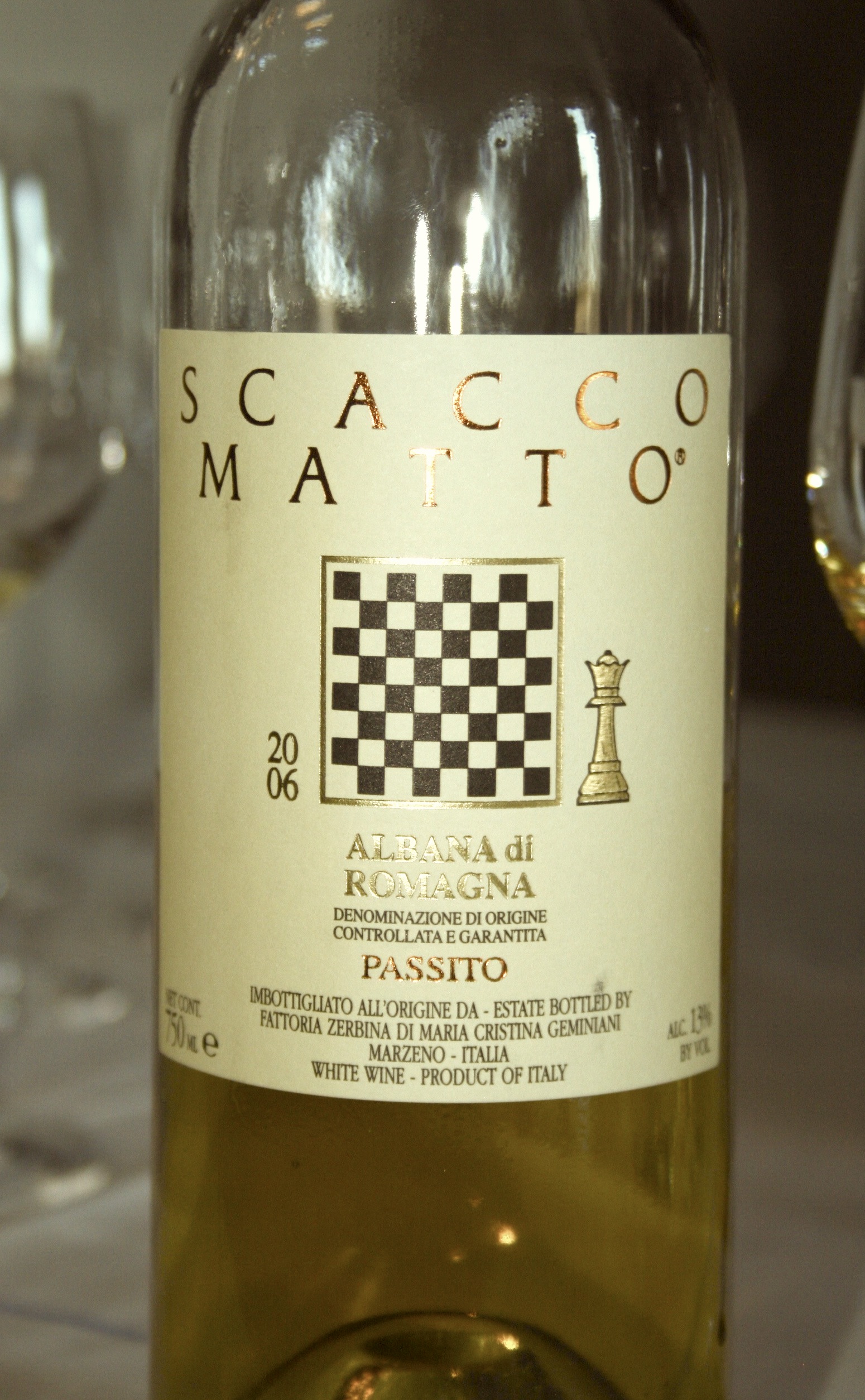
2006 Albana di Romagna Passito
It’s the color of a lion’s mane and sweet, of course, but not cloying, with ample acidity and a nutty undertone to balance the high sugar level.
The label is an illustration of a chessboard under the name “Scacco Matto.”
One of the non-Italian speakers asks Cristina what it means and she laughs.
“It means ‘checkmate’ because everyone told us we wouldn’t be able to make a great passito from albana,” she said.
“They were wrong, so we named it this.”
A great story, made even greater when we got home and discovered the wine received Tre Bicchieri from Gambero Rosso. Zerbina’s award was one of only 13 Tre Bicchieri given to the entire Emilia Romagna region.
 Wine Openers