Archive
Oh, Susannah, you’re so right
Where now, Italy? The national economy is in turmoil, the politics are in turmoil, the future of the euro is in turmoil.
Sadly, Italians – sincere, hardworking, always eager to share their joy in life – are watching their country become the laughingstock of the Eurozone.
Perhaps Susannah says it best: “the times they are a-changin’.”
Tackling a grape even the winemaker doesn’t like
Ken Dunn laughs when you ask him about rkatsiteli, the curious white grape he grows in his Hermosa Vineyards on East Orchard Mesa.
He pours a glass of the pale-gold wine but refrains from one himself.
“I’m not a big fan of rkatsiteli,” he says with a shrug, happily admitting he prefers red wine. “I can’t stand it but the customers seem to like it.”
A bit of a lukewarm endorsement for this ancient grape whose roots go back more than 3,000 years to ancient Greece.
It’s a cold-hardy varietal, popular in the Northeast and a subject of speculation in California and Colorado, where some winemakers are looking at winter-hardy grapes to replace the popular but less cold-tolerant vinifera grapes such as cabernet sauvignon, cabernet franc and merlot.
In spite of his antipathy, Dunn makes a delightful rkatsiteli wine, with floral notes on the nose and hints of almonds, dried fruit and herbs and a bit of spice on the tongue.
It’s reminiscent of gewurtztraminer and viognier, two other floral-spicy varietals Dunn grows among the 17 he has scattered across his two vineyards east of Grand Junction,Co.
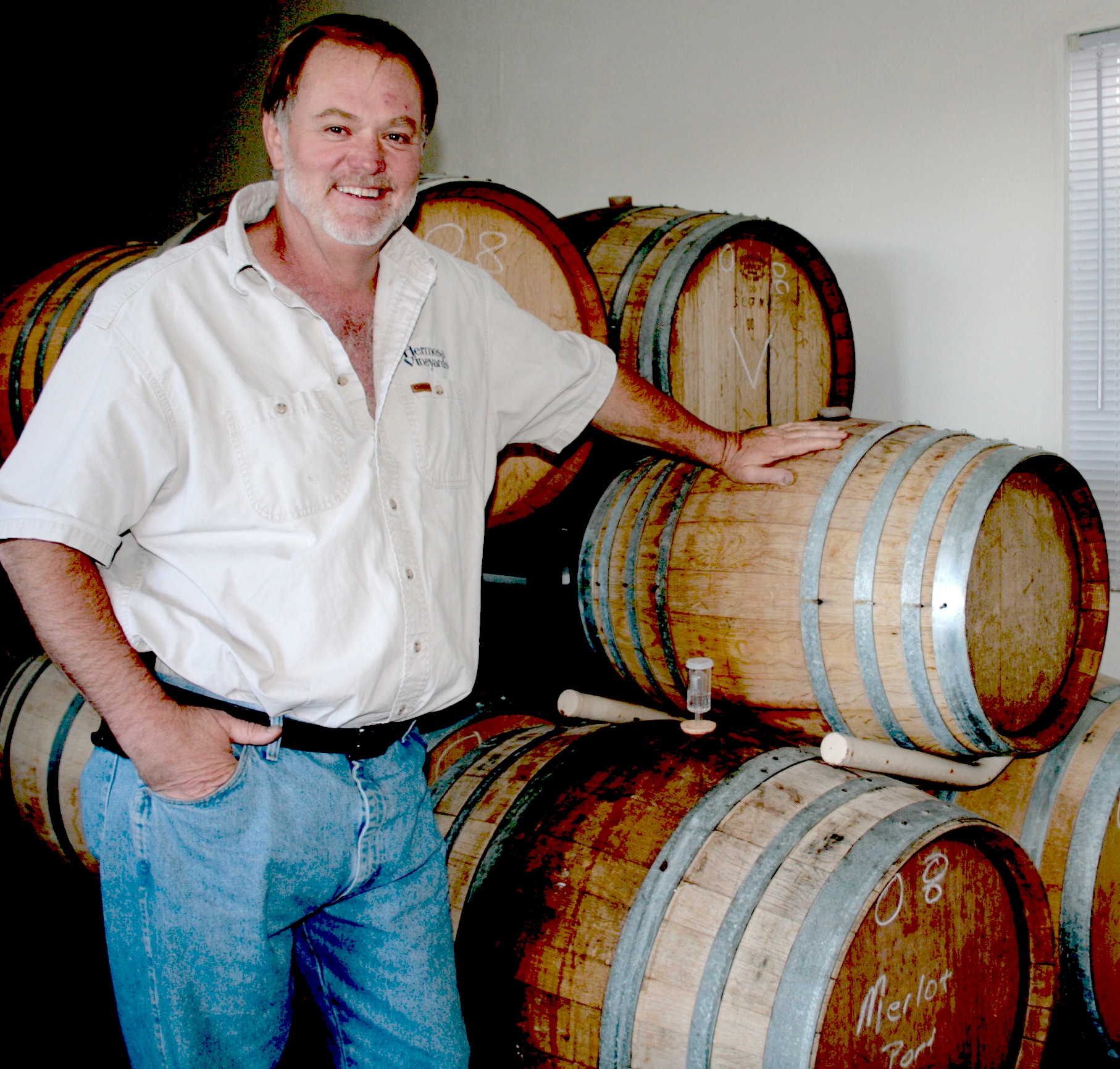
Winemaker Ken Dunn of Hermosa Vineyards shows a 12-gallon oak barrel of cabernet franc, the sum of his 2010 vintage which was limited by the vine-killing deep freeze of late 2009.
According to the Oxford Companion to Wine, rkatsiteli was the most planted grape variety in the pre-break-up Soviet Union and once may have been the most-common white wine grape in the world. It’s also found in China, where it’s known as baiyu.
So why does Dunn have rkatsiteli?
“When we first planted this (in 1993), we weren’t sure what would grow here,” he said, leaning comfortably against the well-polished bar in his cozy tasting room that doubles as his winery and barrel storage off C Road. “That’s why we have 17 varietals.”
For the first eight years or so he supplied grapes to commercial and home winemakers but that changed abruptly shortly before the 2001 harvest.
“Two days before harvest I called the guy who was to buy my grapes and he said, ‘Oh, I forgot to tell you, I can’t take them this year,” Dunn said with a laugh and shake of his head. “I didn’t have much choice. Two days later, my (application for a winemaker’s license) was in the mail.”
The grapes needed to be picked, so Dunn picked and crushed the grapes and stored the wines “in every used chest freezer I could get my hands one.”
When his license finally arrived in late December, it was in time for that frozen juice to become Hermosa Vineyards’ 2001 and first-ever vintage.
The years haven’t all been easy. He dodged complete destruction during the vine-killing deep freeze of Dec. 2009 but the damage was enough there wasn’t much hanging for the 2010 vintage.
“That’s it, all of it,” said Dunn, pointing at a small oak cask of cabernet franc perched atop two of the regular-sized 60-gallon barrels lining the walls of the converted garage. “Twelve cases plus three gallons.”
He laughed again, as if amazed at the good fortune that allows him to make and sell good wines, even in the years when nature isn’t cooperative.
“There are a lot worse ways to spend your time,” he said.
No Colorado wines? Try another excuse
I’m inserting this post from my other wine blog in recognition of Regional Wine Week, which for some of you ends Sunday, Oct. 15 but really never ends for those of us who post regularly about local wines.
A few selected excuses for not carrying/serving Colorado wines in your restaurant or liquor store.
Excuse No. 71: “I used to live in Carmel and I got spoiled drinking California wines.”
Excuse No. 35: “I had a Colorado wine four or five years ago and wasn’t impressed.”
Excuse No. 64: “They don’t taste like wines from California.”
Excuse No. 11: “They’re too hard to sell: Our customers don’t know anything about them.”
Yeah, yeah. I heard these excuses within the last two weeks during some travels around western Colorado. Being the nosy sort, and since I get paid for it, I make it a point to look at wine displays and check out wine menus wherever I go, and I’m certainly not opposed to asking restaurant staff and liquor store clerks about their sales and stocking of Colorado wines.
It rarely surprises me to find a lack of Colorado wines, given how small most of the state’s wineries are, how difficult distribution can be and how stores and restaurants depend on a reliable supply of wines to sell their customers. But in some cases, having no or only a tiny collection of Colorado wines makes no sense.
When a friend and I recently enjoyed dinner in Palisade, we found the meal delightful but were disappointed to find the wine menu listed only six Colorado wines among the 24 offered. We were told by the server that most customers didn’t understand Colorado wine and rarely ordered them.
With only six local wines (four whites and two reds) on the menu and little encouragement from the staff, we can understand why few people order a locally made wine. Sadly, this came from a restaurant in the heart of Colorado wine country, less than 10 minutes from several of the best wineries and a restaurant regularly patronized by the winemakers and owners of the wineries.
Of the two Colorado reds on the menu, we selected a Plum Creek Cellars 2008 Palisade Red ($24), a delicious blend of merlot, cabernet franc, cabernet sauvignon and sangiovese.
During another dinner, this at the Twisted Fork bistro in Gunnison where the wine list was right out of a distributor’s sales book, restaurant owner Jay Harris said he tried a Colorado wine “four or five years ago” and wasn’t impressed. “They didn’t taste like a California wine,” he said.
But to his credit, Harris did say he had recently dropped his national distributor (“They forgot to deliver my order, again,” he told me) and instead was hooking up with a Denver-based distributor. While that alone may not improve his selection of wines, particularly Colorado wines, he did say would be open to carrying a Colorado wine, if he could get a salesman to visit and he found a wine he liked. “But my other distributor doesn’t carry those wines,” he said, hoping to find a winery or two that made house calls.
And finally, during a stop at Acme Liquors in Crested Butte, I spotted a small display of Colorado wines but the clerk at the checkout said he knew nothing about them.
“We just started carrying those and I haven’t tried any,” he said, hardly a way to increase his sales. His excuse was No. 71 (see above).
So Colorado wines don’t taste like California wines. Nor should they, given the differences in soil, climate, growing seasons and that elusive quality known as terroir. They also don’t taste like New Zealand wines or French wines or even New York or Virginia or Argentina wines. That’s what makes them so special.
And you’ll find something special about all those other wines, too, which is why they are popular and why they sell in stores and restaurants. But if a popular restaurant in Boulder can devote half its wine list to Colorado wines, it seems restaurants on Colorado’s Western Slope, which produces 85 percent of the state’s wine grapes, might want to give the local wineries a try as well.
Unless, of course, you’re “spoiled,” for which I would suggest a little vacuum packing and storage in a cool, dry place.
Another round of notes from Colorado Mountain Winefest
Still more Reporter’s Notebook from the 20th Colorado Mountain Winefest:
There was quite a bit of applause but not much surprise when Tyrel Lawson of Kahil Winery of Grand Junction won Best of Show with his 2009 Mesa County Malbec last week at the 20th anniversary Colorado Mountain Winefest .
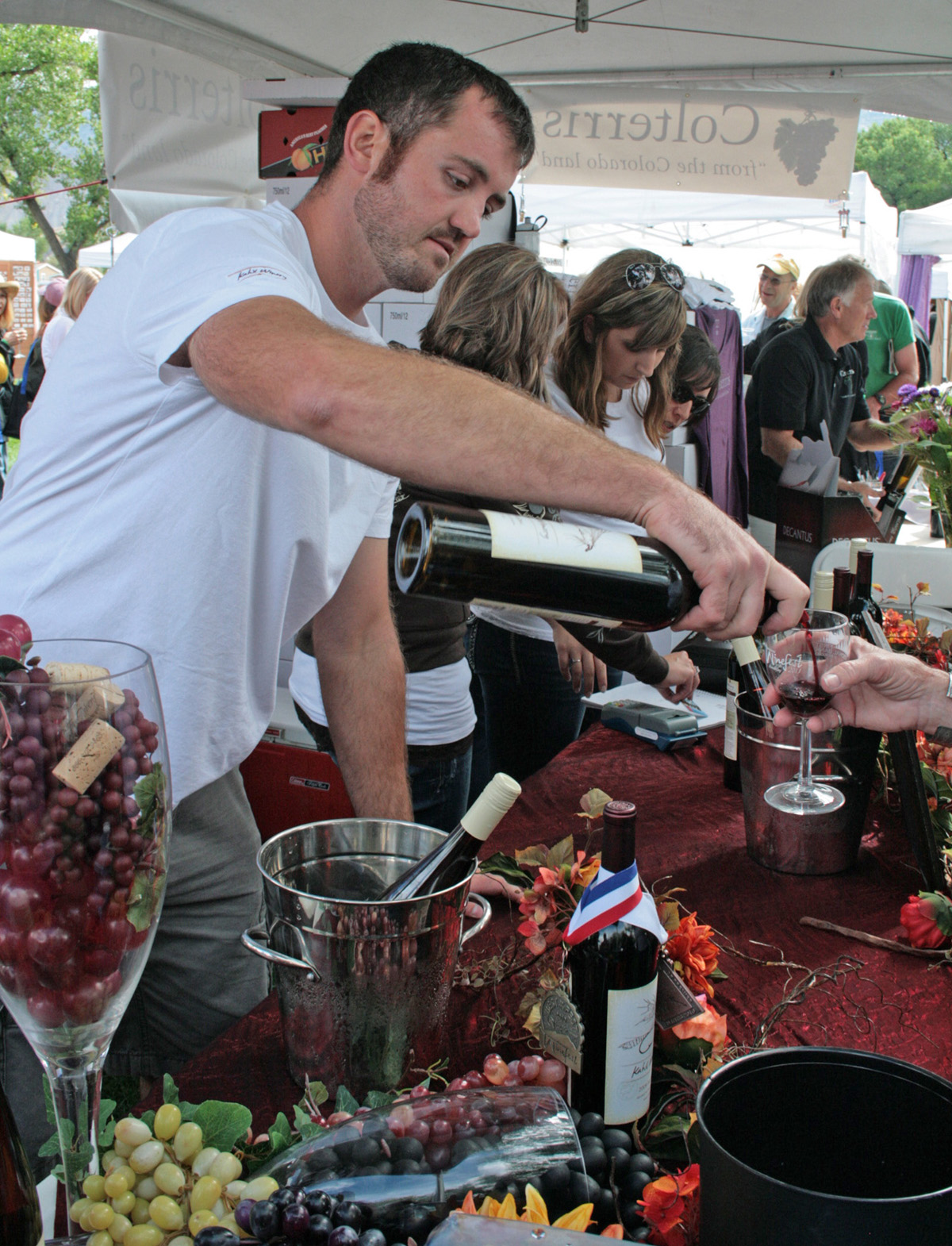
Winemaker Tyrel Lawson of Kahil Winery was busy pouring his Best of Show 2009 Malbec for his fans at the 2011 Colorado Mountain Winefest.
But every vintage is followed by another and no one expects Tyrel to rest too long on this wine. He also makes a mean white: his 2010 Snipes Mountain Pinot Gris earned a gold medal this year, and now we’re all waiting to see what the talented 25-year old will produce next.
The rage about hybrids – Hybrid grape varietals, the non-vinifera kind, are ho-hum in the Northeast and Midwest but something of a odd duck to most Colorado wine drinkers. But hybrids – and we’re not talking Prius here – were the talk of Winefest whenever state viticulturist Horst Caspari or sommelier and wine instructor Max Ariza hove into view.
Caspari, particularly, was taking the message to the masses in the early hours of the Festival in the Park. Clutching a wine bottle with the label carefully hidden, he was urging everyone he encountered to sample his mystery wine and try to guess its composition.
Full-bodied and rich with black fruit, spice and plum flavors, obviously a blend of some sort but the exact varietals were hard to nail. Merlot and Syrah? Cabernet Sauvignon plus the first two? Tempranillo and Syrah? No, no and close but no, laughed Caspari, finally showing his hand. Tempranillo, Syrah and Noiret, the latter a hybrid grape developed by Cornell University and released in 2006.
Caspari has been urging Colorado winemakers and grape growers to adopt cold-resistant hybrids and made this Noiret blend to show how a hybrid that on its own is, well, undrinkable comes to mind, can change completely when blended with the right grapes.
Meanwhile, Ariza, a popular culinary arts instructor at Johnson & Wales University in Denver, was preaching the hybrid gospel during a well-received seminar on lesser-known grapes. He put several wines in front of the attendees and was delighted to find most of them receptive to wines made from other-than-vinifera grapes.
Ariza loves to argue with winemakers that their main reason for not using hybrids is because the grapes are hard to sell to customers expecting the more-familiar European grapes.
“That may be true, but it’s all about education,” Ariza emphasized. “If you make a good wine and can get (the customer) to try it, they’ll like it. If it says ‘Colorado red wine,’ they won’t care that it’s a blend.” A fine example of that was the Baco Noir wine produced by winemaker Guy Drew of Cortez. The grapes were dry-farmed in the desolate pinyon/juniper mesa/canyon country of Yellow Jacket Canyon in southwest Colorado. The wine was similar to a Grenache, with berry, plum and hints of leather.
Ariza used the bottles for his seminar and gave the wine a high grade. “It’s good, and it shows the potential of this grape,” he said.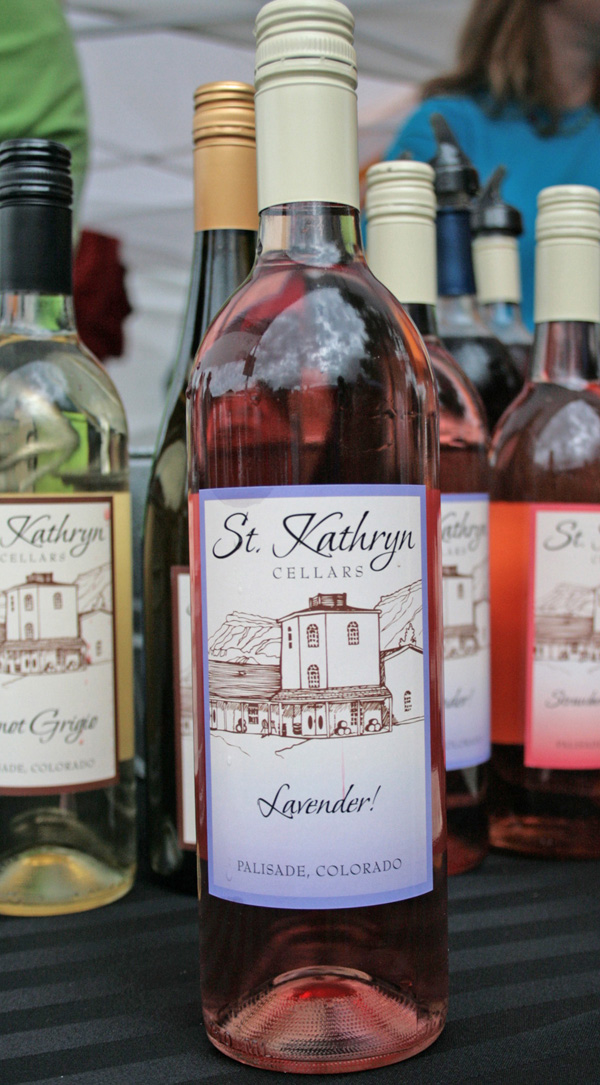
Surprise, it’s Lavendar! – The most-unexpected wine of the fest came from the talented Glenn Foster of Talon Wines, who produced a lavendar wine under his St. Kathryn’s Cellars label in Palisade. “You got to try this,” urged Foster, saying it took him six months of tinkering with the blends to get the flavors he wanted.
The rosé-based pale-magenta wine has a hint of lavendar on the nose and a similar pleasant blush of lavendar on the palate. Foster was careful in his application, making sure the lavendar was noticeable but not overwhelming. As one taster mentioned, “It’s really good if you’re a honey bee looking for a buzz.”
And the VIP tent, now in its third year and definitely one of the more-popular venues of the daylong Festival in the Park, was buzzing, too, thanks the lineup of wines and the matching menu conceived by Dan Kirby, Executive Chefs Wayne Smith and John St. Peter and the culinary arts students from Western Colorado Community College.
The lineup of 40 top Winefest wines included Alfred Eames’ 2009 Pinot Noir, Balestreri’s 2010 Sangiovese, Boulder Creek’s 2010 Chardonnay and Colterris 2010 Cabernet Franc. We told he’s talented and hard-working: Tyrel Lawson of Kahil Winery also makes wines for Colterris and Two Rivers Winery and Chateau.
A reporter’s notebook from the 2011 Colorado Mountain Winefest
Reporter’s only slightly wine-stained Notebook from the 20th Colorado Mountain Winefest:
Oh, my. So many wines to taste and stories to tell.
The crowd was late-arriving Saturday for the opening bell of the 20th annual Colorado Mountain Winefest but don’t dare call it a fashion statement. Unless your fashion tastes include gum boots and Gore-Tex jackets.
The morning rain doused but didn’t deter the riders on the Tour of the Vineyards and certainly made many people hesitate before committing to the Festival in the Park. “We got rain early and then it really dumped in the middle but the end of the ride was beautiful,” said one rider, her hair wet but her smile bright as the sun came through the clouds.
No official attendance tally yet from Winefest officials but one unofficial observer (me) said it appeared overall numbers were a bit down from last year when 6,800 people came through the gates. The morning attendance (under still-threatening skies) seemed were a bit lighter than in past years but when the sun came out in the afternoon, the crowds came with it.
You couldn’t tell anything was amiss from looking around the chatty-happy VIP tent, where nearly every seat was occupied and it was evident many wine enthusiasts figured once again the $190 VIP tix were the best buy of the Winefest. The VIP tent, with its special wines and a menu to die for, certainly was the place to be and be seen and showed once more that the conveniences of the special area are something people want and are willing to pay for.
In addition to some special wines (the wineries were invited in later to pour some favorites as part of the 20th anniversary celebration), VIPers enjoyed a terrific brunch/lunch thanks to some innovative thinking and menu design from the culinary arts staff and hard-working students at Western Colorado Community College. Thanks and a tip of the chef’s toque to Dan Kirby, head of the school’s culinary arts program, and executive chefs Wayne Smith and Jon St. Peter of WCCC.
And speaking of paying for it, those $190 tickets make a difference when figuring the bottom line for the Winefest. Winefest director Sarah Catlin mentioned that even though ticket sales dropped in 2010 compared to 2009, overall revenue was up. Expect similar news this year, since more than 300 of the VIP tickets were sold, the most ever, Catlin reported.
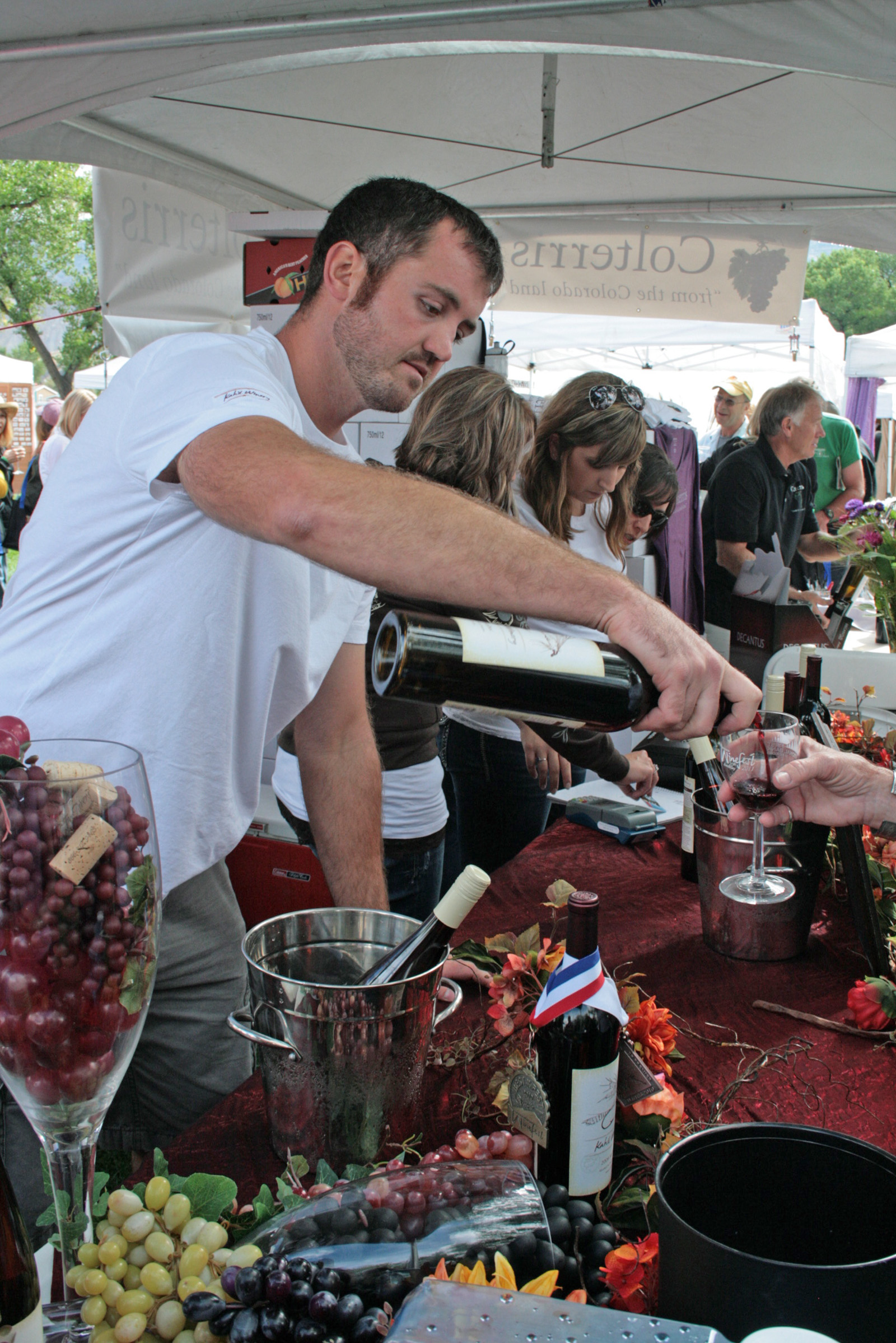
Winemaker Tyrel Lawson pours his award-winning 2009 Malbec for an appreciative crowd during the 20th Colorado Mountian Winefest in Palisade.
The big story, of course, was winemaker Tyrel Lawson of Kahil Winery (no Web site), whose 2009 Malbec won double gold, the Best Red Wine and ultimately Best of Show in the Best of Fest competition. It’s hard not to be impressed by Lawson, a personable sort who also is winemaker for Two Rivers Winery and Chateau and for Colterris on East Orchard Mesa.
“I knew it was a good wine but you never expect anything like this,” said Tyrel early Saturday, a few minutes before the crowds broached his tent. His logo is of an elegant fishing fly known as the Cahill. Lawson changed the spelling a bit, adding a “K” to honor his wife of six months, Katherine. The rich Bordeaux-style wine is bold and dark, with hints of black cherries, berries and fig.
The same wine won double gold at the 2010 Winefest, indicative of how one more year in the bottle really added to this wine. What’s next for the 25-year old vigneron?
“I think I’d like to do it in all French oak,” said Lawson, flinching a little just thinking of the cost. Let’s see. Lawson made 411 cases of his 2009 Malbec, and there’s about 24.6 cases in a barrel, so he would need 17 barrels for one vintage of Malbec. And a new French oak barrel costs around $1,000. My head hurts doing the math.
Napa growers say 2011 harvest to be late, light
Late-season rains and mild summer temperatures have Napa Valley grape growers anticipating an even-ripening crop but a light-than-normal harvest.
A release Thursday from Napa Valley Grapegrowers (courtesy of Alison Stout at Glodow Nead Communications in San Francisco) said the even temperatures and the recent moisture means growers this year can let the grapes hang longer and achieve the full-ripening otherwise cut short by hotter and/or drier growing conditions.
“We have seen a steady growing season allowing for even ripening over the last few weeks,” said Matt Lamborn of Lamborn Family Vineyards and owner of Pacific Geodata, a mapping and analysis technology company which uses weather data from previous years to analyze and illustrate weather trends and comparisons from year to year.
Bill Hanna of Hanna Vineyards in Sonoma County said the later than usual harvest is due in part to late-spring rains arriving just as bud break was starting and vines were blooming.
While rain during bud-break can lead to mildew, non-pollination and other problems, growers this year were able to address those challenges, Hanna said.
Also, late-season rains brought needed moisture to carry the vines through the summer.
“We are blessed to be in a region that affords us the opportunity to be innovative with technology. It is extremely important to be able to monitor the various microclimates in the Valley in order to be proactive instead of reactive,” said grower Paul Goldberg of Rutherford Vista Vineyards.
According to the release, Goldberg uses a remote-control irrigation system to monitor every aspect of irrigation including well levels, water pressure, soil moisture and more. Changes in the system or water needs are sent to Goldberg via his cell phone, allowing him to respond as soon as necessary.
Pinot noir and chardonnay (sparkling wine) have wrapped up harvest with sauvignon blanc expected next. Many growers are reporting harvest starting 10 days to two weeks later than last year with the potential for a lighter-than-normal harvest.
Breckenridge Brewery serves up Autumn Ale, Vanilla Porter and brings back the Peachfork
We expect mid-September to bring a change in weather, but with a week or more of summer officially remaining, it’s unlikely anyone expects to see a forecast for up to 6 inches of snow for the higher mountains of Colorado. We won’t see the white stuff down here ( although we may see it from here) but it reminds us that as the seasons change, so do our diets and the way we drink.
Salads and light meals aren’t discarded but they become less frequent as more substantial fare – coq au vin, soups, stews and the like – take center plate. Gone, too, are the lighter wines and beers, particularly the light-bodied and mostly tasteless beers that kept us cool and hydrated but unsatisfied on those sweltering summer afternoons.
Breckenridge Brewery (the Ale House, to those beer lovers in Grand Junction) recently released two seasonal-oriented brews, the Autumn Ale and the gold-medal winning Vanilla Porter, and re-released (relax, it’s a new batch) of the delightful Peachfork Ale, made with Palisade peaches.
The Autumn Ale, said brewery spokesperson Terry Usry, “was inspired by brewmaster Todd Usry’s memories of fall in Virginia where he grew up.” The ale has some fall-like aromas of smoke, roasty and earthy tones reminiscent of fall afternoons. There’s a comfortable mouthfeel and heft (derived, in part, from the ale’s 6.7 percent alcohol) that makes drinking this a pleasure. Available in draft and 12-ounce bottles. Try it with braised short ribs, a side of acorn squash, and a medley of root vegetables. Think Oktoberfest & sausages with sauerkraut.
This is the first time we’ve had the Vanilla Porter outside the original brewery in Breckenridge where the porter was concocted by brewer Trevor Potter. Apparently, it took some convincing to get Breckenridge brewmaster Usry to take a chance on a vanilla-flavored porter.
“They kept asking, ‘When are you going to make Vanilla Porter down here (at the Denver production brewery)?’’ And I kept saying, ‘Never,’” Usry said. He eventually relented but warned his staff, “Fine. I’ll make it and you’ll see. People really don’t want vanilla in their beer. Well, I was completely wrong.”
Now, the Vanilla Porter is the second-best seller behind Avalanche Ale. Oh, yes. The pleasant hint of vanilla comes from steeping whole-bean New Guinea vanilla for 45 minutes just prior to fermentation. The brew was awarded the gold medal for the flavored/specialty beer category at the 2011 Denver International Beer Competition (Breck’s Agave Wheat and 72 Imperial also won awards).
So while this really isn’t a seasonal brew, it’s a perfect fit with the segue from summer to fall and early winter. Pair it with fall menu items including roasted or smoked foods, barbecue, sausages, or blackened fish, or in Vanilla Porter milkshakes.
And, yes, there is a new batch of Peachfork Wheat, featuring the peaches from Peachfork Orchard and Vineyards on East Orchard Mesa. This release, one of Breckenridge’s “Field to Fermenter” series, is a tribute to the Colorado harvest season, said Scott Thibault, director of marketing for Breckenridge Brewery.
“We really like partnering with small and local providers where possible,” Thibault said. “Our relationship with the Peachfork is a personal one; one of our employees is the granddaughter of the owners and recently left us to join the family farm. We’re excited to bring Peachfork Wheat around again, and this year we’ve doubled up on the peaches.”
Last year, this unfiltered beer caught our attention with its bright flavor and arresting nose carrying a hint of fresh peaches. There’s not really a lot of peach in the mouth, but more a refreshing flirtation of fresh fruit that lifts this ale above the ordinary. It will be available in draft by early October.
Hybrid varietals a growing factor in Colorado’s wine future
When I die …,
Chances are things won’t be this good.
Telluride Ski Resort and Rodney Strong Vineyards of Sonoma County have teamed up, bringing together world-class skiing with world-class wines. What’s not to like?
According to Telluride spokesman Tom Watkinson, Rodney Strong Vineyards and Telluride will partner for special events at Telluride’s flagship restaurant Allred’s and at the “who-needs-alcohol-when-you’re-already-this-high” Alpino Vino wine bar, located at 12,000 feet near the top of Gold Hill. Other events and activities are still being planned, Watkinson said.
“We’re looking at special events for our Ski & Golf Club members as well as some public events such as the local winefest and public wine tastings,” he said.
Rodney Strong Vineyards is perhaps best known as the first Sonoma County winery to release a single-vineyard cabernet sauvignon and the first to plant pinot noir in the Russian River Valley. Under the direction of winemaker Rick Sayre, the winery’s Alexander’s Crown Vineyard Cabernet Sauvignon and Chalk Hill Vineyard Chardonnay have become well-known favorites.
We likely won’t see a Telluride appellation, but that leads us into the next subject.
What do Baco Noir, Marquette, Marechal Foch and Vidal have in common, other than you don’t know them as wine grapes?

Picking Chambourcin grapes at Leroux Creek Vineyards near Hotchkiss. Chambourcin is a French-American hybrid varietal introduced in 1963 and better known along the East Coast and mid-Atlantic states.
You’re forgiven for not recognizing these grape varieties. They’re hybrid varietals, crosses between native North American grapes and better-known European vinifera varietals. For now, the hybrids are more familiar to Midwest and East Coast wine drinkers, but that’s going to change.
The secret to hybrids’ success is their disease-resistance and cold hardiness, in some cases down to 5 degrees Fahrenheit and lower. Colorado’s climate protects us from the bugs and diseases you’ll find in California, France or other moderate grape-growing regions. But those cold winters also make a grape grower’s life a nightmare. Colorado grape growers have much in comon with grape growers in the Midwest and Atlantic states when it comes to needing a grape that survives bitter cold and still makes a decent wine.
State viticulturist Horst Caspari, who long has preached the economic benefits of raising hybrid grapes, has several rows of hybrids at the Rogers Mesa Research Center near Hotchkiss. Among those hybrid is auxerrois, a white grape from the cooler regions of France and Switzerland. Pinot blanc wines from Alsace commonly are a blend of pinot blanc and auxerrois.
“It’s been called a poor man’s chardonnay,” Caspari said. “It makes good wines, but it’s difficult to sell if you’re not familiar with it.”
That lack of familiarity is a marketing problem common to most hybrid varietals. Among the few local winemakers producing wines from hybrids is Yvon Gros at Leroux Creek Vineyards, who makes a Chambourcin (red) and Cayuga (white), grapes more familiar with East Coast drinkers.
“I’ve had guests from New York come here and when they see the Cayuga, the say, ‘That’s my favorite wine,'” Gros once told me. “Colorado wine drinkers just say, ‘What’s that?'”
Similarly, Guy Drew of McElmo Canyon near Cortez is turning to hybrids in an effort to have a full crop every year. Drew has a neighbor growing Bacon Noir, and recent blends of Baco Noir with Cabernet Sauvignon have proven not only tasty but marketable.
Drew and Gros are believers in what Caspari has been telling Western Slope and Front Range winemakers for several years: That growing hybrids, not vinifera,is the key to ensuring a crop in Colorado’s borderline grape climate. Caspari and others hybrid growers were able to produce a crop of grapes in winters when other growers were wiped out.
“The economics of the business say you need eight full crops in a 10-year period,” Caspari said. “With the current selection of varieties, they have three in 10 in Delta County, if they are lucky.”
Caspari, however, says his hybrids have produced a “crop every year since 2004,” when they were planted.
“In this valley you could (grow) vinifera and in most years get a decent crop and good quality,” Caspari said. “But along the Front Range it has to be hybrids.”
The major complaint is that hybrids as standalone wines don’t make good wines. But when blended with vinifera grapes, the wines can be quite good.
“Who says they have to be stand-alones?” Caspari asked. “With most of these hybrids, a few percent blended to something else changes it.”
The other argument is no one understands hybrid varietals, but since they do so well when blended with more-familiar grapes such as Merlot, Syrah and Cabernet Sauvignon, a smart vintner won’t reveal what grapes are inside.
“You could label it ‘Colorado Red’ and if it’s good and it’s affordable, who will care what the grapes are?” Caspari said. “And do we really need another Chardonnay or Merlot?”
A visit to the land of Freixenet
It catches me by surprise to realize my July road trip through Spain ended nearly a month ago. The memories of friends made, wines tasted and roadside attractions we were too busy to stop for remain fresh and vital.
The week-long trip was made possible and paid for by the Freixenet Group, a name in winegrowing that dates back to the 16th Century and today is the world’s ninth largest wine company and the world’s largest producer of methode champenoise sparkling wines. I enjoyed every moment (except when a gypsy in Barcelona helped herself to my cell phone) and surely wouldn’t have had such a memorable nor educational trip without Freixenet (pronounced fresh-eh-net) sponsoring my travels.
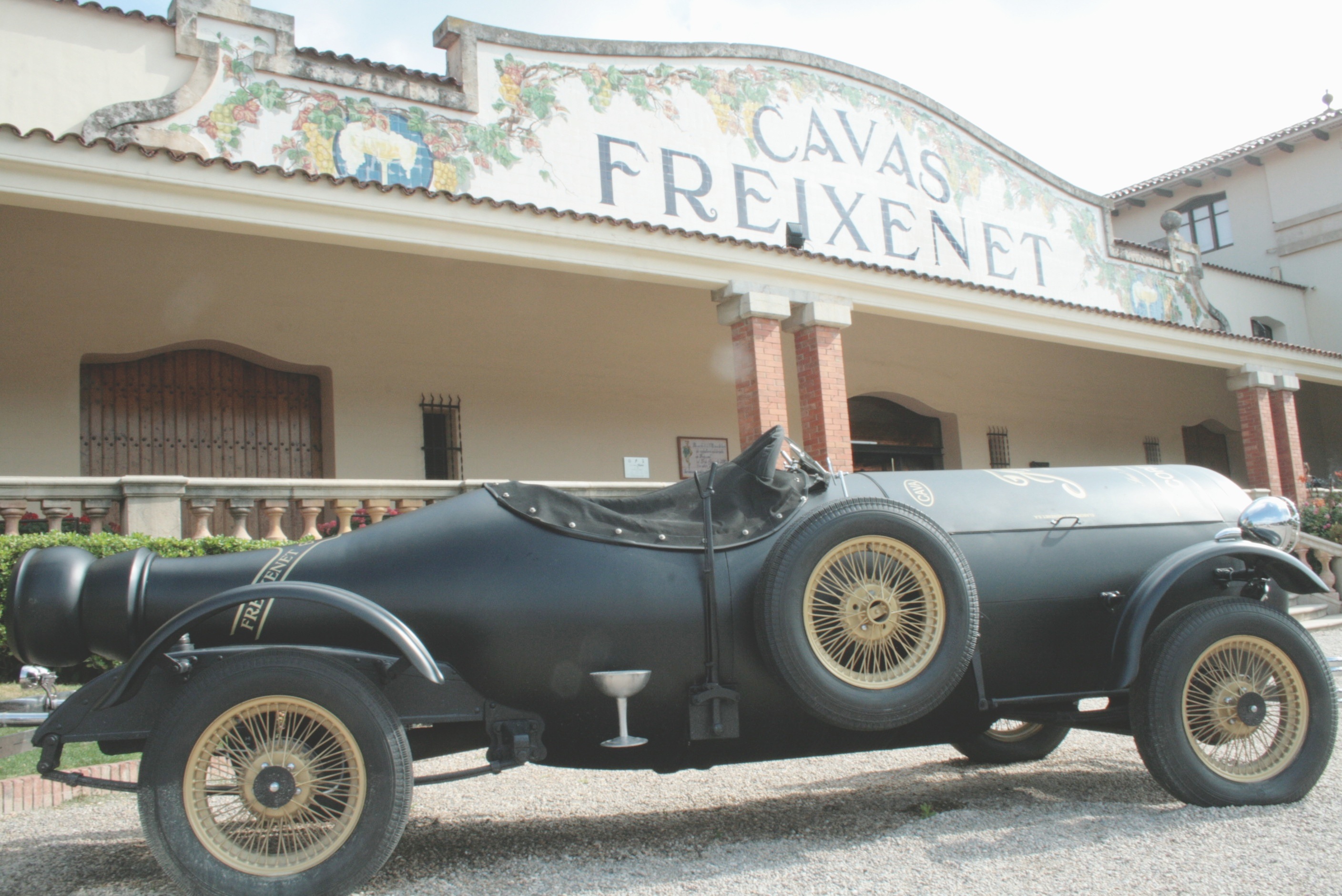
The Freixenet 'bottle car' designed for the 1929 World's Fair in Barcelona. It begins your introduction into the fascinating world of Freixenet sparkling wines.
The last leg of the journey wound up in Sant Sadurni d’Anoia, a colorful town in the Penedés region of Spain about 35 miles east of Barcelona. You first glimpse the Freixenet mother ship just off the Autopista del Mediterraneo and you take a roundabout way to get to the front door of the winery, where your first chore is to peer into the well-known black Freixenet bottle car created for the 1929 World’s Fair in Barcelona.
But it’s the immense building that gives you a sense of how extensive the Freixenet brand is. At anytime the eight-story building (including four storage and aging levels below ground) may be handling most of the 250 million bottles of sparkling wine produced every year.

The familiar red-capped Freixenet boy, another of the Freixenet promotional items initially introduced during the 1929 World's Fair and now recognized aroudn the world.
“And 75 to 80 percent of our business is during the Christmas holidays,” said Toni Domenech, Freixenet PR master and our tour’s do-everything handler, interpreter and all-around “Where-would-we-be-without-him.”
“You can imagine how busy this place is leading up to that.”
Domenech led us through the depths of the building where the bottom rooms, walls weeping from ground water seeps and a suitable feeling of ancient times, were hand-carved from limestone. The fortress, for that’s what it seemed, is so expansive that at one point we hopped aboard a small electric train to return to the ground floor.
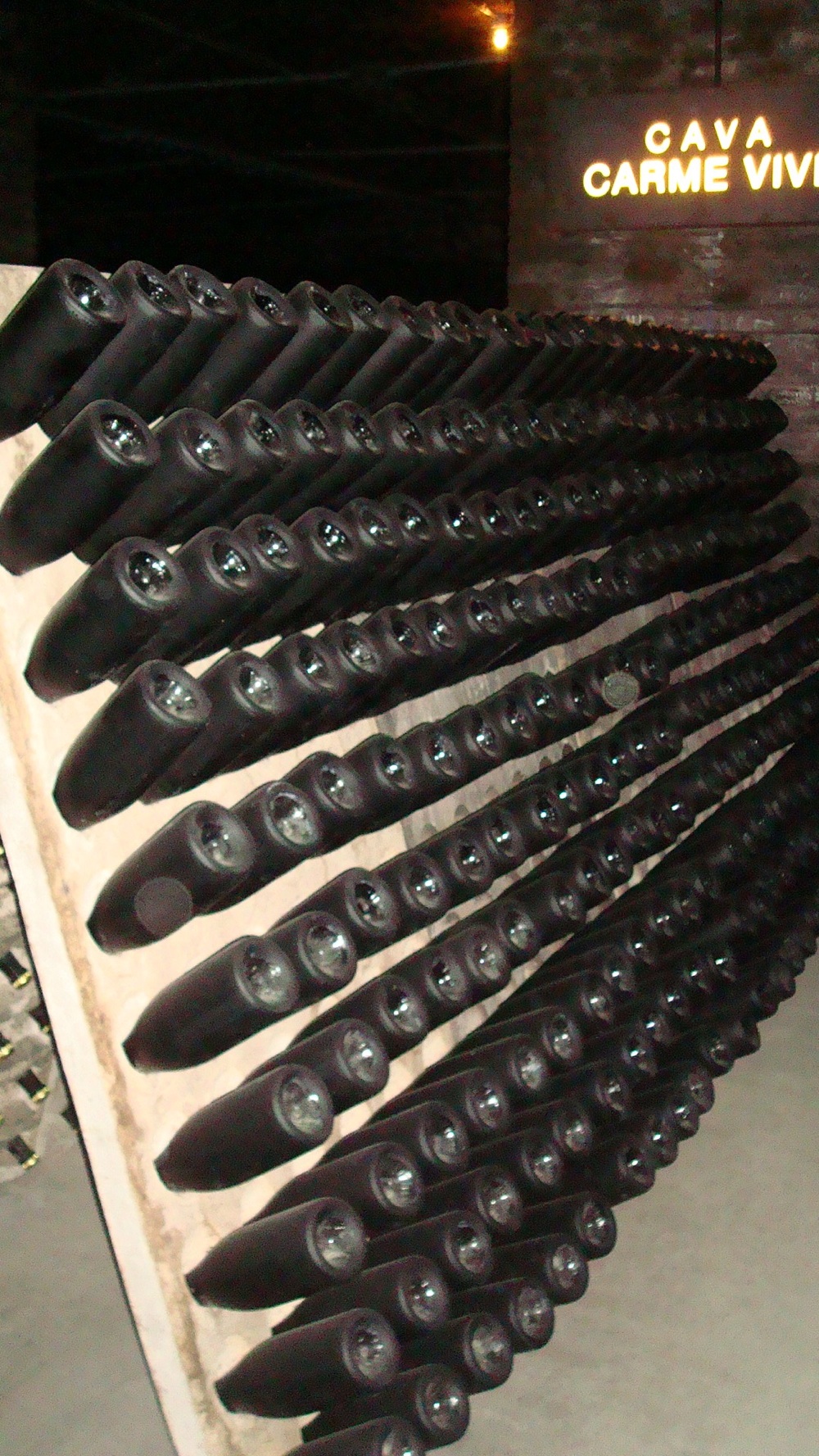
There are machines made for riddling but Freixenet insists on retaining hand riddling. These racks hold some of the 250 million bottles of sparkling wine Freixenet prodcues each year.
– Freixent still uses hand riddling, the practice of tilting and turning each bottle multiple times every day to move the sediment into the next. Yes, there are machines that do this faster and less costly but Freixenet holds on to the old ways.
Different cavas: Each of Freixenet’s cavas uses a different blend of grape and varying levels of sweetness. Among the samples we tasted was the Cordon Negro Brut ($12), the “black-bottle bubbly” most people associate with the name Freixenet. Cordon Negro, for example, is made from a blend of Macabeo, Xarel-lo, and Parellada grapes.
– Harvest: All grapes are hand-picked. This normally begins around the end of August (Macabeo) and runs through October when the Parellada is ripe.
– The place is huge: Nine levels of winemaking, including a new section holding six 1.2-million liter stainless steel, temperature controlled tanks. Those tanks are so big they were put together first and then the winery built around them. Along with some 600,000 liter tanks, the winery’s total capacity is 38 million liters.
– In addition to the Cordon Negro Brut, Freixenet also produces Vintage Brut Nature ($14); Cordon Brut Extra Dry ($12); the Carta Nevada Brut and Extra Dry (both $9); the Cordon Rosado ($12, Trepat and Garnacha);and a Spumante ($9, Macabeo, Xarel-lo and Malvasia). A special line called Elyssia – derived from the Latin terms for heaven – includes a Pinot Noir Brut ($18, Pinot Noir 85 percent, Trepat 15 percent) and Gran Cuvee Brut ($18, Chardonnay 40 percent, Macabeo 30, Parellada 20 and Pinot Noir 10).
The highlight of the visit was meeting during lunch Jose Ferrer Sala, son of Freixenet founders Dorothy Sala and Pedro Ferrer. He says he’s “semi-retired” now but it was under his 50 years of guidance that Freixenet became a world leader in cava production.
Wines we’ve been drinking, including a California surprise
Wines we’ve been drinking:
With the understanding that not all wines need an extensive post, these mini-reviews, as The Wine Curmudgeon calls them, cover a handful of recent tastings.
flipflop 2010 California Pinot Grigio; 2009 California Pinot Noir (samples) – These are part of the “inaugural release” for flip-flop wines (yes, they use lower case letters), a line distributed by Underdog Wine Merchants, the same people bringing you Cupcake (recently named the country’s top-selling wine brand), Fish Eye, and Big House, wines whose names you’ll remember even if the wine is forgotten.
The flipflop wines (the labels have an image of a beach sandal) are line-priced at $7. Both were light and enjoyable, with nothing too fancy. The Pinot Grigio had a hints of citrus and ripe fruit and just enough acidity to go with a light summer lunch. Ditto on the Pinot Noir, light-bodied, red cherries, certainly resembles a Pinot Noir, we had it lightly chilled on a day the temperature topped 95 and it held its flavors. Not very complex or deep but at $7, it’s pleasant and drinkable, you really can’t ask for much more.
Octavin’s Pinot Evil (sample) – A nonvintage Pinot Noir, available in a three-liter box ($24) and 750-mL bottle ($10). Speaking of Underdog Wine Merchants, this Pinot Noir is the latest offering in the Octavin Home Wine Bar’s line of international wines. We took this French-made Pinot Noir to a barbecue with some dedicated pinot-philes and most everyone was impressed by the ripe-cherry flavors, light acidity and decent finish. A value-priced and delicious Pinot Noir at a time when Pinot prices are skyrocketing.
St. Francis 2009 Sonoma County Chardonnay ($15, sample) – Summer rarely finds me drinking California chardonnay, which in the recent past all-too-often turned out to be oak bombs, for the same reason I dodge big, over-lush reds – they are uncomfortable to drink when the heat’s up. But this one from St. Francis, coming from top vineyards in the cooler climes of Sonoma County, surprised me. Lots of pineapple and green apple aromas on the nose with citrus, melon and more tropical fruits in the glass. A deft touch of oak brought out the nuances of this wine and there was a touch of honey on the lingering finish. Maybe I’m changing my mind about California Chardonnay.
 Wine Openers