Archive
Questing after tradition, one vintage at a time

Maria Teresa Mascarello, daughter of the late Bartolo Mascarello of Barolo and today the exacting and traditional winemaker at Cantina Bartolo Mascarello.
“I am trying to make an honest wine, one that reflects all of the qualities of our territory, both its strengths as well as its flaws.“ – Maria Teresa Mascarello. Photo by Tim Atkins on Flick’r.
There is something missing in the world of modern-day winemaking. Or maybe several somethings.
That’s the feeling I had, and still have, after listening to winemaker Maria Teresa Mascarello of Barolo on a recent podcast of Levi Dalton’s excellent “I’ll Drink to That.”
This daughter of legendary winemaker Bartolo Mascarello is not one to mince words or opinions, whether it’s about her refusal to visit New York City or her thoughtful belief that to know a wine, you first must know its vineyard.
Everything she does is in the traditional method, down to the unheated and uncooled cellar where her wines age for years before being released.
And while critics, writers and the rest of the world casually tosses about the word “terroir” without perhaps understanding what it is they are talking about, Moscarello sees a vineyard’s terroir as just the starting point for enjoying her wines.
And, as Dalton points out, she believes that one of the measures of a wine’s success is that people will stick around and work the vineyards that produce it.
But perhaps her most telling statement, at least for me, was her saying that she enjoys the different vintages, and even more when they prove difficult.
“Every year is different,” Mascarello said. “I don’t find the same elegance (in 2013, her latest to be bottled) as I find in the 2010 and the 2012 but I like the difference.”
She said that when she tastes a wine, first she tastes and recognizes the grape variety.
“And second, I recognize the weather,” she said.
“Every year is different, that’s important to me because I like different,” she goes on. “I have more affection for the difficult (vintages).”
Mini-reviews of some tasty summer wines
Among the samples we receive here at WO International occasionally are wines that are worth mentioning but don’t warrant an entire blog entry. This summer has been particularly good for new whites and rosés and I better catch up while I have time. All prices may vary.
13 Celsius 2015 Marlborough Sauvignon Blanc (sample) – The name refers to the recommended serving temperature (56 F) and the high-tech label changes to blue when that temperature is reached. Glitzy label aside, this is New Zealand sauvignon blanc at its best: good acidity and structure and flavors of citrus, nectarine and slight vegetal. $12-15 SRP.
Seghesio 2012 Sonoma County Arneis (purchased) –This ia traditional northern Italian white but instead of the 2015 vintage I was looking for, I found this 2012. I was happy I did. A bit of age added some flavors of dried apricots and little nuttiness. $15 SRP.
Puligny Montrachet “Les Enseigneres” 2012 (purchased) – I normally wouldn’t purchase a wine normally priced at $55 but there is lot of this on sale. A knockout white Burgundy with power, balance and the white flowers, pear, apples and minerality (there’s that word) for which the area is known. $45.
Guigal Cote du Rhone 2015 Rosé (sample) $14 SRP. – Is rosé season over already? Not hardly if you are a lover of rosé and looking at the markdowns in the stores, it may be time to stock the pantry. This is a fine food wine to serve year-round, a blend of mostly Grenache with Cinsault and Syrah, with cherry and floral notes. $14 SRP.
Eat An Amatriciana Per Amatrice
Some ideas from Avvinare for those who feel incerto di cosa fare by the earthquake in Italy…

Like most Italophiles and people the world over, I am thinking of what to do to participate in helping the area devastated by the recent earthquake in Italy. While there is no way to repair the loss of life, one can lend economic support. Watching the Rai last night ithey mentioned that that is what is crucial right now.
So in that vein, here is the information for the Red Cross:
The IBAN number is:
IT40F0623003204000030631681
BIC/SWIFT CRPPIT2P086
Beneficiary: Associazione italiana della Croce Rossa
Subject: Terremoto Centro Italia
Additionally, Carlo Petrini, founder of Slow Food, has suggested that everyone encourage restaurants to put l’Amatriciana on their menus and then each restaurateur will devolve part of the proceeds from the sale of that dish to those in need. In Rome this is already happening. I think that’s a great idea and one I actually had thought of as well the night…
View original post 40 more words
It was ‘Dante’s Inferno,’ says survivor of central Italy earthquake.
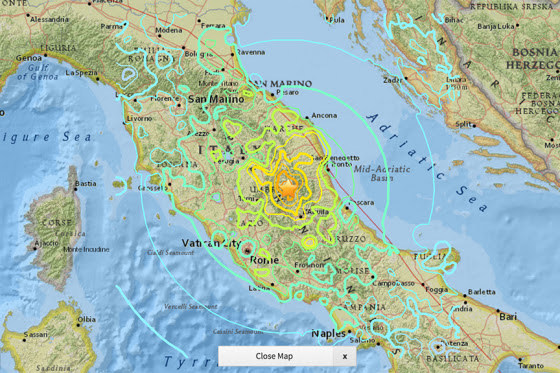
Map courtesy USGS.
The world, at last that part which still hadn’t been shaken awake, awoke Wednesday morning to find parts of central Italy devastated (I can’t think of a better word) by a series of earthquakes.
Tremors of up to 6.2 magnitude still were being reported Thursday across parts of three regions – Umbria, Lazio and Marche – with the greatest damage and most casualties said to be centered in the small mountain town (population about 2,000) of Amatrice, which a report in the New York Times said resembled a “war zone.”
Other jolts were being reported as far away as Rome and Bologna.
“It was Dante’s ‘Inferno,’ it was apocalyptic, I don’t know,” said one survivor in the Times.
Today’s edition of La Repubblica reports at least 250 people have been killed, many of them caught in their beds when the earthquake struck at 3:36 a.m. It’s feared the death toll will reach that of the 2009 earthquake in and around the town of Aquila which claimed an estimated 309 loves.
I’ve been watching and reading with the help of other Italophone bloggers, notably Jeremy Parzens and Susannah Gold, both of who speak fluent Italian and both of who have strong ties with the people and culture of Italy.
An interactive map of the earthquake zone from the U.S. Geological Survey is available here. A link to the Italian Red Cross and a site for donations is here.
State wine contests remain nothing to take for granted
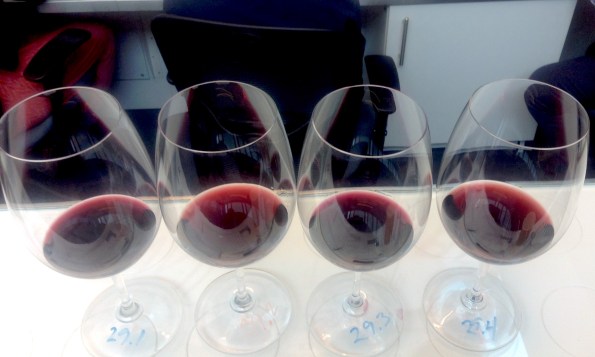
Judges at the 2016 Colorado Wine Governor’s Cup competition praised many of the red wines and said they showed well-developed completeness. Photos/story by Dave Buchanan
Having the opportunity to sit in judgment of Colorado wines, or wines from any region or country, for that matter, is a privilege no one takes lightly.
At least, no one with whom I’ve sat on any judging panel.
My most-recent judging experience came a few weeks ago for the 2016 Colorado Wine Governor’s Cup competition.
I’ve watched and reported on the Colorado wine industry since 1990, when it was a small (like four or five) handful of wineries.
Since then it’s grown to more than 140 wineries across the state and over the years the quality of winemaking continues to improve.
True, a few wines of the 250 or so wines we tasted this year should not have been bottled, but that can be said of any wine competition, and each year the unremarkable wines are fewer and fewer.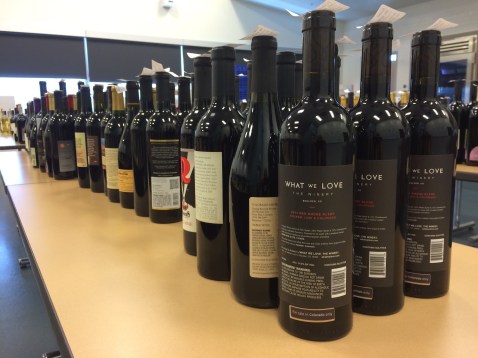
More importantly, the judges had opportunities to taste some amazing, beautiful and fascinating wines, sometimes all at once, in the same bottle.
Many of the red wines made from Grand Valley AVA grapes, particularly the Cabernet Sauvignons, were lauded as “Gorgeous, with completeness at all levels, beginning, middle and end,” by the esteemed Warren Winiarski, winner of the 1976 Judgment of Paris and a winemaker who knows a thing or a million about red wines.
Not as many white wines won double-gold medals as in years past but much of that had to do with some of the whites we might have tasted would have had to come from 2014, the second of two consecutive very poor harvests due to extraordinary winters.
And just when most of us totally were confused by the intense and multi-layered flavors of mead, it took Glenn Exline, director of the Mazer Cup International Mead Competition, to tell us that these “were (some of) the best examples I’ve ever tasted.”
But what struck me is that so many Colorado winemakers again sat out the only wine competition dedicated solely to Colorado wines.
Of the state’s 140-plus wineries, only 35 sent entries to the Governor’s Cup.
That’s about the same number as last year, and the year before, so while each year the number of Colorado wineries continues to increase, the number of wineries entering the Gov’s Cup stays about the same.
The reasons vary: some wineries didn’t have their wine bottled at the time entries were requested, others forget to sent their entries on time, and some winemakers simply don’t like contests.
And at least one winemaker has passed on the Colorado contest in favor of larger competitions with a national or international focus.
“Why would I want a gold medal from Colorado when I can get one from San Francisco?” she said. “It has more marketing value.”
As more than one winemaker has said, customers like to see bling, and it’s arguable if the casual customer differentiates between the Governors Cup, the Eastern International or the San Francisco International.
Participating in the state’s namesake wine competition allows you to see where you and your winemaking skills are in relation to other Colorado winemakers.
And if you’re already an established and well-respected winemaker but feel the Colorado competition isn’t up to your level of winemaking, it may be that your participation and the wines you bring would be enough to raise the level of accomplishment in everyone’s wines.
A “rising tide” pertains to an ocean of wine, as well.
Grape wine? Fruit wine? Two sides share top award at 2016 Colorado Wine Governor’s Cup Competition

Colorado Governor John Hickenlooper (left) enjoys the occasion as Glenn Foster (in blue) of the Meadery of the Rockies and John Garlich of Bookcliff Vineyards share Best of Show in the 2016 Colorado Wine Governor’s Cup Competition.Photo courtesy Kyle Schlachter/CWIDB
This year’s Colorado Wine Governor’s Cup Competition, sponsored by the Colorado Wine Industry Development Board, wound up Aug. 4 with Meadery of the Rockies in Palisade and Bookcliff Vineyards of Boulder sharing Best of Show in their respective divisions.
A Strawberry Honey wine from the Meadery won the cider, fruit wine and mead division while Bookcliff took the traditional grape wine division with its 2013 Ensemble, a blend of Merlot, Cabernet Sauvignon and Malbec.
Additionally, Bookcliff and Whitewater Hill Vineyards of Grand Junction both had three wines included in the Governor’s Cup Case, which this year holds 18 bottles instead of the 12 usually found in a case of wine.
The other six are ciders, fruit wines and meads. Meadery of the Rockies and Colorado Cellars both have two fruit wines selected for the case.
The complete list of winners can be found on the Colorado Wine Industry Development website here.
This year’s Governor’s Cup, the only wine competition exclusively for Colorado wines, featured 250 wines from 35 Colorado wineries and continues as a much-awaited display of the state’s steadily improving wine industry.

Wine judges Andrew Stover of Washington, D.C. and Jeff Seigel of Dallas share some opinions after the official end of the 2016 Colorado Governor’s Cup wine competition.
An observer might expect, given the state has 140-plus wineries, to see more than one-quarter of those wineries entering the state’s namesake competition.
The reasons for the lack of entrants are several, including some wineries don’t open their email to see the invitation or forget to send their entries on time.
Some wineries enter other competitions and say they can’t afford to enter another contest, although at $25 per entry, Colorado charges only a fraction of that charged by national or international wine contests.
But in truth, some winemakers simply don’t hold the state competition in high esteem.
One winemaker I recently talked to, a talented vigneron who in the past has done quite well at competitions at various levels, has quit entering the state contest.
She said it’s worth more from a marketing standpoint to enter the better-known San Francisco International Wine Competition, the largest in the U.S.
“Why waste the money to get a medal here when I can get a gold or double-gold from San Francisco?” she asked, not expecting an answer.
There are a couple of good reasons why winemakers enter competition. One is to see where they stand in relation to current levels of winemaking, an effort at making sure they “aren’t standing still,” as Parker Carlson once told me.
Another is to see if their taste still is true. One recognized danger facing winemakers (and wine writers) is “cellar palate,” which may happen by drinking only one’s own local wine and not picking up on incremental changes, usually bad, taking place in your wine.
A badly made wine surely will be noticed, you would think, but what if that’s how your wines taste all the time and you don’t have any comparison?
But perhaps the leading reason to enter competitions is to give customers what they want, and they want bling.
“People like to see medals,” Carlson also said, and every winery you’ll ever visit displays a shelf or two stacked with their collection of ribbons, medallions and trophies.
Who can blame them? Not only is it impressive looking but it also makes great copy for your blog or FaceBook page.
However, I doubt most casual tourists – to whom go a majority of Colorado wine sales – have the time, knowledge or eyesight to differentiate between the San Francisco competition, the International Eastern and the Colorado Governor’s Cup.
I’m not saying there aren’t people who know the difference, but there also are people who can tell a Pinot Gris from a Pinot Blanc.
There’s much more to this story.
The North Fork Valley opens its doors as harvest begins
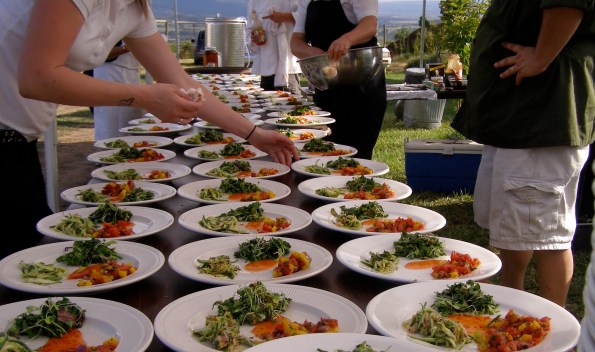
The plates nearly are ready as the staff at Stone Cottage Cellars in Paonia prepares for another memorable farm-to-table Harvest Fest dinner. Courtesy Stone Cottage Cellars
Mid-August finds us in the midst of harvest and already we’re seeing notice of the celebrations marking this busy time of year.
Plus, August is Colorado Proud month, a promotion from the Colorado Department of Agriculture commemorating the people who bring us locally grown food and agricultural products.
That includes Colorado wine, of course, and there’s no better way to mark the month than to visit your local wineries and go home with a bottle or two to enjoy with your favorite Colorado meal.
It’s all easier than you think, since many wineries somehow find the time during this busiest of all seasons to host special dinners. Here is a partial list, thanks to Jim Brett and the North Fork-based Slow Food Western Slope.
Brent and Karen Helleckson of Stone Cottage Cellars are hosting their second of the summer Fattoria Italiano winemaker’s dinner Sept. 24 as part of the Mountain Harvest Festival in the North Fork Valley.
The five-course meal features Stone Cottage Cellar wines and is the Helleckson’s North Fork homage to similar meals they enjoyed while traveling through Italy this last year.
Seating is limited so make reservation soon. Tickets are $80 per person inclusive. 527-3444.
Hopefully you didn’t miss Tuesday’s Paella Night at Leroux Creek Inn and Vineyards near Hotchkiss. Winemaker and trained chef Yvon Gros again is hosting these occasional dinners at his covered outdoor dining room with a marvelous view of the Provence-like surroundings of the North Fork Valley.
Learn about the next one (and get Yvon’s special paella recipe) here or call 872-4746.
September 10 is the tour of Redlands Mesa, including visits to farms, gardens and some of the area’s talented artisans, including Jack Rabbit Hill Farm and Peak Spirits Farm Distillery.
There also is a farm-to-table lunch and perhaps the closest view you’ll ever get of a live buffalo, thanks to Sue and Dave Whittlesey at High Wire Ranch.
Tickets for the Redland Mesa tour($5), lunch ($10) and happy hour ($15) at Jack Rabbit Hill Winery are available online through the Redlands Mesa Grange.
Winiarski: An early dream comes true as Colorado tackles learning curve

Winemaker Warren Winiarski makes a point to Colorado grape grower Kaibab Sauvage during Winiarski’s recent visit to the vinelands of western Colorado. Photos by Dave Buchanan
Making great wine, if one may paraphrase winemaker Warren Winiarski, demands much of a winemaker but nothing more important than vision and balance.
Winiarski fully comprehends the rigors of making great wine. In 1970, after prior stints for California winemakers, he built his own vineyard, converting an old prune orchard in the Napa Valley to grape vines and naming it Stag’s Leap Wine Cellars.
From those grapes Winiarski made the 1973 SLV Cabernet Sauvignon, which won the red-wine competition at the 1976 Judgment in Paris, a competition initially set up to reinforce the superiority of French wine over the upstart Americans.
Winiarski’s unexpected victory, along with the equally surprising success of the 1973 Chateau Montelena Chardonnay by winemaker Mike Grgich in the white-wine portion of the contest, focused the wine world’s attention on California wines.
But shortly before his victory in Paris, Winiarski had a brief encounter with another man of equal vision, Denver periodontal surgeon Gerald Ivancie. Read more…
Dancing to the the U-pick hustle in the West Elks AVA
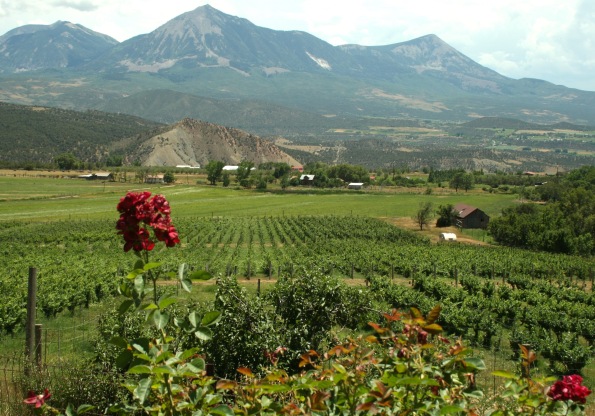
The West Elks AVA rivals anything elsewhere in the wine world.The North Fork Valley and its nine wineries roll out the red carpet during the West Elks Wine Trail, Aug. 5-7.
PAONIA – Midsummer finds us committed to the U-pick hustle, darting around the North Fork Valley and the Grand Valley seeking tree-fresh cherries, apricots and peaches available seemingly everywhere.
The early peaches (some Paul Friday varieties, if I remember correctly) are at farm stands across the area, tempting the palate as if to say,”You ain’t seen nothin’ yet,” with new varieties appearing almost weekly, each one more juicy and luscious than the last.
It’s also time for the eighth annual West Elks Wine Trail, this year on Aug. 5-7, sponsored by nine wineries in the North Fork Valley and named for the West Elks AVA, one of Colorado’s two specially designated wine-grape growing regions.
Special winemakers’ dinners, premium wine tastings and full-on open houses at the wineries make this weekend one of the more-anticipated of the summer. Each participating winery is featuring special food and wine pairings, with a focus on local foods and wines.
Several of the wineries also are hosting their ever-popular winemaker dinners, most of which fill early so reservations are a necessity. Call the wineries for reservations and more information, because what you see here is the only information supplied by the wineries. Prices, when given, are per person. All phone area codes are 970.
Aug. 5 – Leroux Creek Inn, 6:30 p.m., 872-4746; Mesa Wind Farms & Winery‘s Dine in the Orchard, 6:30 p.m., $95, 250-4788.
Aug. 6 –Alfred Eames Cellars, Uruguayan Dinner, 6 p.m. $75, 527-3269 or 527-6290; Azura Cellars & Gallery “Tapas at Twilight”, 7 p.m.; free R/C yacht racing starting at 10 a.m., 527-4251; Stone Cottage Cellars Winemaker’s Dinner at the Cellar featuring a Fattoria Italiana, 7 p.m. 527-3444, $80; Delicious Orchards BBQ from noon – 6 p.m. with live music from 4-7 p.m., no reservations needed, 527-1110. Black Bridge Winery Barrel Tasting at 1 p.m. and 4 p.m., repeats on Aug. 7, 527-6838.
The wineries in the North Fork Valley celebrating the West Elks Wine Trail include those listed above as well as Terror Creek Winery, the state’s highest vineyards (at 6,400 feet elevation) as well as one of Colorado’s first wineries, 527-3484; and 5680′ Vineyards, (no website), 314-1253. The photo above was taken at Terror Creek Winery.
When the heat is on, the wine goes cold
The heat is on, and chilled wines seem to be in order.
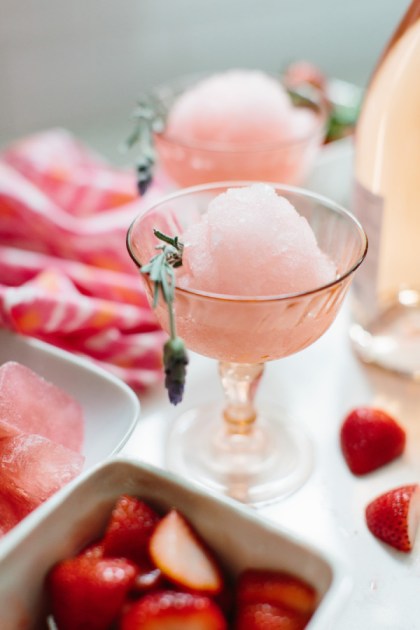
Erin McGinn/Pinterest
From icy rosé slushies to chilled medium-body reds, there’s no reason not to keep your insides cool while the outside steams.
Trends come and go (that’s why they’re called “trends”, right?) and this year one of the passing fancies is serving rosé slushies, aka “slushees.”
That’s right, the crushed ice delight which normally is the purview of blueberry and banana this summer has been taken over by the summery notes of watermelon, strawberry and raspberry in rosés.
Recipes are simple (ice, wine, some fruit juice or sorbet, a blender and garnish) and readily available online. A couple of caveats, however: The ice will dilute the alcohol and the flavors (need I remind you of this?) so steer away from the lighter, Provence-style rosés and look to something with a bit more color and hence more body.
Most rosés are made by straining off the juice of red wine grapes before too much contact with the skins. I say that because I’ve had rosés made by combining red and white wines, such as those made by Two Rivers Winery combining Riesling and Merlot.
Some rosés to experiment with include those made from Syrah, Grenache and Cinsault (Tavel from the Cotes du Rhone), Mourvédré (think Bandol) and Cabernet Sauvignon.

A chilled red wine makes an ideal match for a summer get-together. Not too cold, just slightly chilled. Dave Buchanan
Locally, Plum Creek Winery‘s Palisade Rosé (a blend, of Cabernet Franc, Cabernet Sauvignon and Petit Verdot) and Whitewater Hill Vineyard’s Melange (Shiraz, Cabernet Sauvignon and Riesling) come to mind.
However, if you really want to try a wine slushy, don’t limit yourself to rosés. You could use a fruit wine to bump up the flavors. Plus, your favorite local winery surely makes a medium-body red you can use in these summery “slurprises.”
A sweeter wine (a Moscato or dessert wine) could provide the sticky goodness normally associated with slushies, albeit with a slightly alcohol kick.
Or, you can do it without ice. A lightly chilled red wine is a great accompaniment to that summer barbecue and may surprise you how well the flavors hold up.
I recently tried two of my favorite Italian reds, lightly chilled, with a Fourth of July get-together.
The wines were the Tommasi 2013 Rafael Valpolicella Classico Superiore and the Arnaldo Caprai Collepiano Montefalco Sagrantino DOCG 2010.
My guests were surprised to see red wines being served in mid-summer and even more surprised and pleased to see how well the wines paired with the variety of grilled meats and vegetables.
Slightly chilled is the key (maybe 20 minutes in the refrigerator) because red wines served too cold lose their aromas and flavors while emphasizing the tannins and acidity.
A slight chill brings out the fruit aromas and flavors, a fact noted by writer Dave McIntyre.
“Think of how fragrant your garden is at dusk as the day’s heat fades into night,” he wrote.
West Elks Wine Trail returns – This is a highlight of the summer and this year’s edition, the eighth annual, happens Aug. 5-7, right when North Fork Valley vineyards will be at their height of green-fuse glory.
The weekend is filled with touring, wine tasting and winemakers’ dinners (which fill quickly, very quickly).
Information at www.westelksava.com.
 Wine Openers