Archive
Women make mark as head winemakers in Colorado cellars
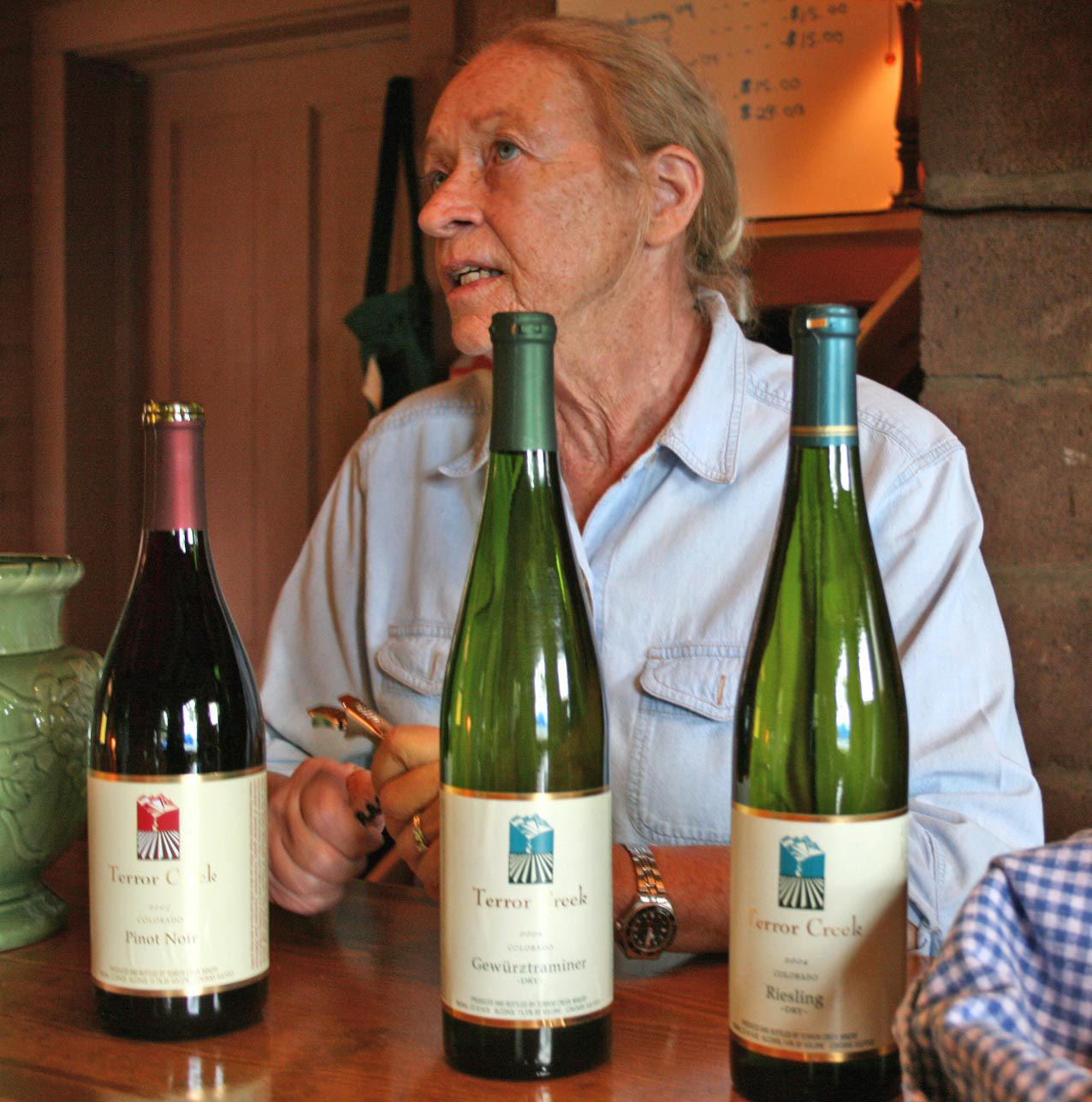
Joan Mathewson of Terror Creek Winery near Paonia planted her first vines in Colorado in 1989 and made her first Colorado wine in 1992. She received her degree in oenology from the Ecole du Vin in Changins, Switzerland.
A dust-up on the Great Northwest Wine website recently caught my eye. It seems a national travel writer unintentionally gave the impression that among Oregon’s 400 or so wineries, only six had women as their head winemakers.
It didn’t take long for people more involved with the state’s wine industry to note there are around 35 women head winemakers among Oregon’s 400 or so wineries. That’s a bit less than 10 percent, a number similar to California, where 9.8 percent of the approximately 3,400 wineries reported having a women as their lead winemaker. Washington State has 20 female head winemakers (about 6 percent) in its 350-plus wineries. Whether the percentage is high or low in what many people have long thought to be a male-dominated world isn’t clear or important, but I found myself curious how many wineries in Colorado’s fast-growing wine industry have women as head winemakers.
According to my roughhewn survey, which included calling and visiting wineries and asking other writers covering the industry, I came up with a tentative 12 women head winemakers, meaning they oversee the production from grape to glass.
That’s close to 10 percent and may not be accurate, as some wineries have closed for the winter and weren’t available while others didn’t return phone messages.
As was ably pointed out by Doug Caskey, executive director of the Colorado Wine Industry Development Board, “We have approximately 105 wineries and many of the women who own wineries with their husbands spend as much time in sticky juice as the men.”
That sharing of the workload is not unusual for an industry where most of the wineries worldwide are small production facilities in which everyone has a hand in the day-to-day chores, including the winemaking.
Many of Colorado’s wineries are true family affairs, many times starting with home winemaking. This list does not include the home winemaking years.
Whether you visit wineries in California, Italy or Colorado, it’s not uncommon to find husband and wife toiling side by side.
Maybe we’re spoiled, because Coloradans have long accepted that many of the state’s best wines are made by women and when we see a woman doing the heavy lifting — literally — it’s the normal (Colorado) state of affairs.
“I’m definitely not the assistant,” affirmed Anna Hanson, winemaker for Jack Rabbit Hill Winery on Redlands Mesa.
She and husband Lance own and operate the winery plus the James Beard award-nominated Peak Spirits Distillery, both of which rely on locally grown organic and biodynamic fruit.
There is another group of women who might be considered assistant winemakers, such as Brooke Webb of Mesa Park Vineyards, who said she shares the duties with her father Chuck Webb, listed on the winery’s website as head winemaker.
The longest-tenured among women head winemakers apparently is Padte Turley of Colorado Cellars, who said she started making wines in 1989.
“It’s cool,” said Padte of her decidedly hands-on style. “You get to know all the little vines and you know what you’ll have to work with.”
Alsatian-stylist Joan Mathewson of Terror Creek Winery, at 6,400 feet in the North Fork Valley still considered the world’s highest vineyards and winery together, was the first, and for years the only, Colorado winemaker with a degree in enology.
Jackie Thompson of Boulder Creek Winery might the state’s most-awarded woman winemaker (that’s open to debate, of course) and certainly was the first among all Colorado winemakers to win a prestigious Jefferson Cup award (2009).
I’m out of room, so here’s the list in no particular order. Share other names (and stories) if you can.
Jenne Baldwin-Eaton, Plum Creek Cellars; Diane Brown, Avant Winery; Michelle Cleveland, Creekside Cellars; Jackie Thompson, Boulder Creek Winery; Anna Hanson, Jack Rabbit Hill Winery; Joan Mathewson, Terror Creek; Padte Turley, Colorado Cellars; Linda Gubbini, Gubbini Winery; Deb Ray, Desert Moon Vineyards; Marianne “Gussie” Walter, Augustina’s Winery; Nancy Janes, Whitewater Hill Vineyards; Barb Mauer, Graystone Winery.
Bearing gifts of wine and chocolate for St. Valentine’s Day? A bit of caution is needed
Even the most preoccupied among us find it difficult to escape this month’s multitude of same-breath references to wine and Valentine.
Of course, it’s only after taking the next step of uttering wine, Valentine and chocolate that the abyss opens and we find ourselves flying or falling.
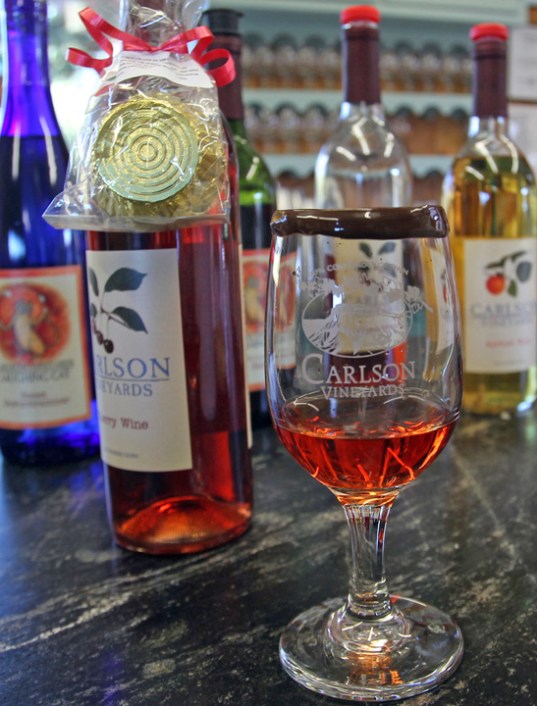
A chocolate-rimmed wine glass and a bit of Carlson Vineyard’s Cherry wine are a match made for St. Valentine’s Day. – photo by Dean Humphrey
Just as there’s considerable disagreement about the “romance” of winemaking from anyone who has spent seemingly-endless hours picking grapes or pressing those grapes or running hoses from tank to barrel, there’s some debate on whether wine and chocolate should be paired together, much less whether they should come together to highlight an ancient holiday.
Supposedly named after one or more of several early Christian martyrs, this late-winter holiday really got its earliest boost after English poet Geoffrey Chaucer tied the day to romantic love.
“For this was on Saint Valentine’s Day, when every bird cometh there to choose his mate,” wrote Chaucer in 1382 in “Parliament of Foules.”
He might have known his “foules” but Chaucer, who wrote extensively on the battles of the heart, couldn’t foresee the mass marketing efforts arising from the possibilities of tying commerce to romantic love.
But since he also wrote, “No empty-handed man can lure a bird,” he likely would have approved of today’s efforts to impress someone with gifts of wine and chocolate.
Chocolate and wine seem to be a perfect match, but before you run out to splurge, remember not all matches are made in heaven.
The best advice is to experiment, preferably before you show up at the door bearing Magi-like gifts. Think of it as being similar to pairing food and wine, since there also you deal with multiple layers of fruit, bitterness (tannins), sweetness and acidity, and your goal is to let the highlights whisper, not dominate the conversation.
“The sweetness and bitterness and acid of chocolate tends to heighten the same characteristics in the wine,” says wine educator Jonathon Cristaldi in a column by Linnea Covington on the celebrate.today.com website.
The key here is the wine should be at least as sweet as the chocolate.
Covington writes that winemaker Chris Stamp of Lakewood Vineyards in New York’s Finger Lakes wine region “has struggled” finding the right pairings for the Seneca Wine Trail’s chocolate and wine event.
“It took me a lot of long and hard searching to find these, but I have been surprised a few times that some things can go together,” he said.
Anyone sitting through a wine-and-chocolate tasting at local wine events can attest to the surprises, both pleasant and otherwise.
Just as chocolate varies (think of all the choices on the candy aisle), so do wines.
One general rule is lighter chocolates (think flavor, not color) pair better with fruitier, lighter bodied wines (Spanish sherries, Prosecco, pinot noir, merlot, riesling) while chocolates with higher cocoa content stand up better to full-bodied wines (pinot noir, merlot, zinfandel, cabernet sauvignon).
The best dark chocolate match might be Italian passitos and Port and Port-style wines, although a personal preference is Banyuls, a fortified wine from southern France.
One more item to consider is matching or contrasting the flavor nuances present in wine and chocolate.
That contrast-and-match alchemy is why Parker Carlson of Carlson Vineyards in Palisade, Colo., dips the rims of wine glasses in semi-sweet chocolate or ties a semi-sweet dark-chocolate heart to bottles of his much-in-demand cherry wine. The desert-style wine balances its sweetness against the semi-sweet chocolate, accentuating the bright fruit of the wine and the intensity and fruit of the chocolate.
It also should be noted that chocolate with a higher cocoa content has more phenylethylamine, a neurotransmitter sometimes called the “molecule of love” since it appears when people fall in love.
There’s no word if wine actually enhances the appearance of this “chocolate amphetamine,” as it’s also been called, but it might be what D.H. Lawrence meant when he wrote, “If we sip the wine, we find dreams coming upon us out of the imminent night.”
Risks of winemaking grow in the cold

Extended cold weather can damage vines, especially the less-hardy European vinifera varietals. A few Colorado winemakers are considering adding cold-hardy hybrids to their vineyards.
Doug Neam looked at the merlot vines stretching across his property on East Orchard Mesa and pondered his good fortune when he stuck his first vines in the ground.
“I planted these in 1994 because I figured merlot was a varietal in demand and I knew it did pretty good over here,” said Neam. “That first crop was really good.”
Neam soon added to his merlot and a few years later expanded to a nearby south-facing slope where he planted cabernet sauvignon and cabernet franc.
Both the latter grapes also do well in the Grand Valley, although Neam, as are many western Colorado grape growers, is learning that not all vineyard property is equal.
Like many vineyards around the valley, Neam’s vines are spread across a rolling piece of land that falls off on either side. Such hillside vineyards are considered prime lands because the slopes shed the denser cold air.
Whether he did so intentionally or fortuitously, Neam planted his first merlot on a north-facing slope that falls off to a county road winding across the expansive mesa, providing an open alley of escape for the cold air.
Air flows like water, with the coldest settling to the lowest places, like cold water in a pond or your bathtub. Anglers know that the water issuing from a dam stays around 42 degrees year round, which means in the winter that water may be warmer than the surrounding air.
But it also means trapped air, which doesn’t freeze but may well below freezing, can kill tender vines, fruit trees and other plants.
Give that air or water an escape and it flows away, letting warmer air (water) take its place.
However, Neam planted cabernet sauvignon and cabernet franc where his land dead-ends at a neighbor’s brush-choked gully, a shrub dam that stops cold air and forces it back up to almost midway on the slope.
That stagnant lake of cold air, formed during the deepest freeze earlier this month, damaged the vines to where state viticulturist Horst Caspari warned Neam he likely won’t get a crop from those vines in 2013.
“You’ve probably lost everything on that low end of the vineyard,” Caspari said during a recent visit to Neam’s vineyard. “You can see where the cold air pools and it’s like there’s a line where your vines are dead.
“Above that line, you’ll probably get some grapes.”
This cold-weather line of demarcation is a phenomenon that Caspari finds all-too-often across Orchard Mesa where the best agricultural lands often are bordered by dense jungles of growth.
Those ravines, gullies and watercourses are key to proper air drainage, and their existence is part of the reason for the many different micro-climates on Orchard Mesa and East Orchard Mesa.
On a recent tour of cold-struck vineyards from 32 Road to Palisade, Caspari time and again pointed to low spots where vines have been blackened by cold air stopped by wildland growth.
“You can almost see a circle of dead vines where the cold air sits,” he said at one stop, waving his arm to delineate an imaginary high-water line of cold air pooled along the low end of a vineyard. “I’m sure they lost everything in that circle, and the obvious thing would be to put a wind machine right there, to keep that air moving.
“But do you see any machines around here? Not one.”
Neam is fortunate, for he still has some open, south-facing acreage to plant more vines where the gentle, unclogged slope promises better air drainage.
Other landowners, particularly those late arrivals to grape growing, are not so lucky.
“I always recommend they come talk to me before they plant their vines but often that doesn’t happen,” said state enologist Steve Menke during last week’s VinCo conference sponsored by the Colorado Association of Viticulturists and Enologists and the Western Colorado Horticulture Society.
“Too many times, someone walks into my office and says, “I planted five acres of merlot but they aren’t doing very well. Can you help me?’”
Menke shrugged.
“If they had come to us before they planted, I could have helped them with site selection,” he said. “Now, I have to tell them they spent a lot of money on a site where grapes won’t grow.”
Cold spell poses big problems for grape growers and 2013 vintage
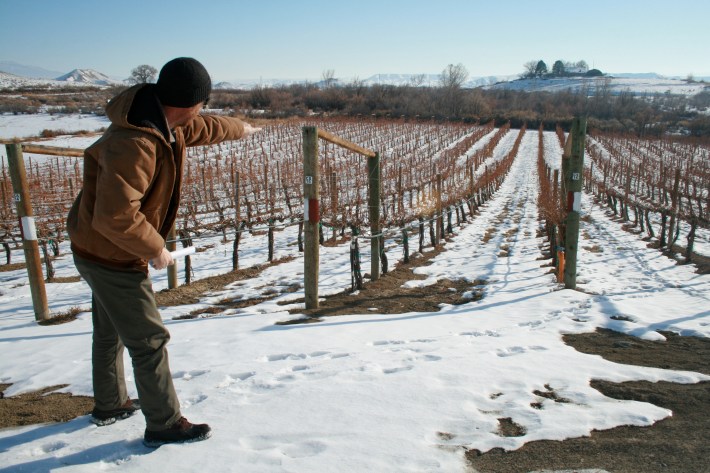
State viticulturist Horst Caspari points to where cold air pools and kills grape vines in an vineyard on East Orchard Mesa near Palisade, Colo.
EAST ORCHARD MESA – The thump of wind machines waking you last week wasn’t a dream but an attempt by grape growers to ward off the vine-killing cold.
However, it’s been grape-deathly cold in some spots for several weeks and grape growers tardy in cranking up the 30-foot high wind turbines may be too late to prevent losing part or all of next year’s crop, warned state viticulturist Horst Caspari at the Western Colorado Research Center on East Orchard Mesa.
“We have a maximum on cold-hardiness our grapes can reach and if we get below that, it’s done,” he said. “But if you have a wind machine to use and you don’t use it under the conditions we have now, we haven’t learned anything from 2009.”
That was the winter when a December deep freeze sent the temperature in western parts of the valley plunging to 22 below zero and more than 50 percent of the vines in the valley suffered extensive damage, with many growers losing most of their 2010 crop.
Temperatures this year have flirted with that low mark – a minus 18 was registered recently near Fruita – but along with temperature growers also must consider wind speed and length of exposure to the cold, Caspari said.
A few minutes at 28 degrees won’t bother most grape buds but longer exposures at the temperature can kill them as surely as 18-below.
As grapes and other fruit go dormant, their cold-resistance increases. But once the plants reach their most-dormant, temperatures below that may kill or damage the bud or vines.
Wind machines mix warmer air from 100 feet or more with frigid ground-level air trapped by inversions or pooling behind physical dams such as building or trees.
Fans may only bring a rise of 3 or 4 degrees, but that can be sufficient to save a crop.
The easternmost part of the valley benefits from a year-round breeze from DeBeque Canyon. The breeze acts as a natural wind machine, keeping that part of the valley warmer by not allowing the cold air to pool.
The cold air certainly gathers along the Colorado River, where pockets of air can be minus 8 or 10 when it’s minus 1 on East Orchard Mesa, where the cold air flows off the north-sloping fields and lands along the river.
“We didn’t run our machines (Sunday) night but we did the three previous nights,” said Galen Wallace, vineyard manager for Plum Creek Cellars’ vines on East Orchard Mesa, well above the coldest layers of air.
Still, there are enough microclimates in the gullies and ravines that monitoring the temperature is “huge in this business,” Wallace said. “We get 10 percent (bud) damage at 5-below so I watch it closely and when it gets to 1-below I’m ready” to start the wind machines.
Surprisingly, the valley’s largest grape grower hasn’t yet run his wind machines.
“No, we haven’t run our machines yet and that’s probably a mistake,” said Bruce Talbot, who farms 150 acres of grapes and 300 acres of peaches across Orchard Mesa and East Orchard Mesa.
“The peaches are just fine but we know the grapes are sensitive right now,” Talbott said. “We were told the grapes can take 10 below and if we get close to that we can sustain damage, so we try to minimize that.
“But so far, minus 2 and minus 4 are what we’ve seen in town.”
Caspari said that temperature might be misleading, since it probably measures temperate at cordon height (about 40 inches) and not at ground level, which could be several degrees colder.
“So it’s four degrees colder at snow level and where some of his vines are might be 5 degrees colder than the weather site, so that’s minus 4 and another 5, that’s 9 degrees, so it’s really 13 below right above the snow line,” Caspari estimated. “Bye, bye, it’s toast.”
More on cold and grapes next week.
A brief sampling of Lodi wines

The entertaining label from the Michael David 2010 Freakshow Cab hints that this isn’t your typical California cabernet sauvignon or typical winery, for that matter.
It’s getting late – not in the day but in the year – and I’m catching up with some of the bottles sitting empty around my place.
Winter came late for western Colorado. A couple of weeks ago it still was 50 degrees in mid-afternoon but that changed just in time for a white Christmas. As I write this, there is light snow and 11 degrees headed south to around zero.
Which means I’m looking for something a bit stouter than pinot grigio to put in my class. Not that I have anything against pinot gris/grigio; it’s a great summer/fall wine.
But it’s obviously not summer.
I recently received a some samples from Michael David Winery, the Lodi, Cal. winery named after brothers Michael J. and David J. Phillips. The Phillips family farm dates to the 1860s according to the winery website, and while it mostly grew vegetables, the operation survived Prohibition by growing “15 different wine varietals that were shipped throughout the country during Prohibition with instructions on ‘how not to have the grapes turn into wine’.”
Michael started the winery in 1984 and now he and David are the fifth generation of Phillips to farm the land. Their aim, according to the website, is “to show the world of wine drinkers that wines made from Lodi grapes can compete against wines from anywhere in the world.”
Incognito 2010 Red Wine – A complex blend of seven varietals based on syrah (40 percent), this wine offers the cherry and dark berry flavors along with a hint of spice. Medium tannins, 14.5 alcohol. $18. There also is an Incognito white blend.
Sixth Sense 2010 Syrah – Syrah is a favorite varietal at Michael David and these vines date from 1982, making them some of the oldest syrah vines in the California. Sort of named after Michael’s son Kevin, now the sixth generation of Phillips growing grapes. Syrah with some “Petite Sirah blended in,” according to the press sheet.
Big, bold and intense with dark-red cherry and plum fruit, a bit of smoke, coffee but still a balance of acid and tannins. 15.5% alcohol. 88 points from Wine Spectator, July 2012. $16.
Freakshow 2010 Cabernet Sauvignon – The only wine I can think of with a subtitle, in this case “A ‘Michael David Joint’.”
Michael David makes big wines and this is one of their biggest. Big-bodied but not overwhelming, with dark cherry, spice, blackberry, a hint of dried raisins and dark oak. Mellow tannins. Would have been great with barbecue last summer. Or next. 14.5% alc. $20.
7 Deadly Zins – The brothers Phillips call this their flagship zin and it’s lived up to that with steady consistency. It feels like a bit hotter alcohol than the 15% alcohol on the label but that’s just being picky. True to the varietal with plenty of berry fruits, pepper and spice. $16.
Colorado grape harvest in early but hot weather a concern for winemakers
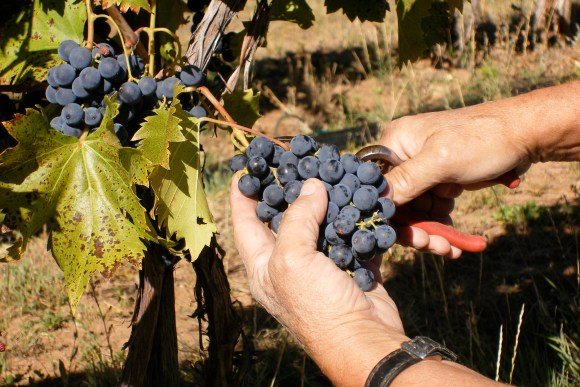
Coorado’s 2012 wine grape harvest finished a month ahead of schedule, keeping growers busy trying to enlist picking crews still busy with the local peach harvest.
Colorado’s wine grape crop came through the hot, dry summer in better condition than many people might have expected, given the long drought and its effects on western Colorado.
While there aren’t yet any numbers on the total production, comments from producers and winemakers indicate the summer growing season was short, intense and productive.
“Everything came in early,” said state viticulturist Horst Caspari of the Colorado State University Orchard Mesa Research Center. “I think everything was picked by the 20th of October this year and sometimes they pick into November.”
Parker Carlson at Carlson Vineyards said he was done a month ahead of his normal schedule. “Harvest was really good, in fact almost too good,” Parker said. “We got a lot of grapes and quality was for the most part pretty good.”
“The weather had everything ripening on top of other but this was the first time in my 24 or 25 years (of grape growing) that we were finished by end of September,” he said. “It really gave us another month of our lives back.”
Guy Drew of Guy Drew Vineyards near Cortez called the harvest “fast and furious.”
“Basically it was over in a month,” he said. “It didn’t even get into October, it was all over in September. I couldn’t go to Winefest this year because I was busy dealing with grapes.”
Caspari said the growing season started normally but a warmer-than-usual May and June pushed the crop ahead.
“We had bud break pretty much as normal but with May and June very warm and it just kept getting warmer,” Horst said. “We have never had a warmer year during our growing season, which is the first of May to the 30th of September. “So everything got ripe very early.”
Most grape varietals ripened two weeks to a month early, Caspari said. “I picked the grapes at my site (on Orchard Mesa) on the 22nd of August and I’ve never picked anything in August,” he said.
He said the crop overall was “pretty decent, probably a record for us quantity wise and maybe quality.”
But a continuous hot growing season isn’t necessarily a good thing. Unrelenting hot weather has a drawback – the hot days build sugar in the grapes but winemakers want cool nights to develop the acids that balance sugars, tannins and alcohol.
Winemakers watch grapes as carefully as a mother watches her sleeping child. Grape maturity is monitored daily, and sometimes more often, as the grapes near the level of ripeness the winemaker is seeking.
“We didn’t get the cool nights of September like usual,” Drew said. “It was so hot, we couldn’t get the acids we needed and the while the sugars stayed high, the acids are low.”
A study by climatologists Greg Jones of the University of Oregon and Robert Davis of the University of Virginia indicated (and I’m paraphrasing greatly here) that in the last two decades, grapevines in Bordeaux have seen a longer growing period, which causes Merlot and Cabernet Sauvignon varietals to have higher sugar-to-acid ratios, greater berry weights and a “greater potential wine quality.”
However, sugars and acids develop at different rates, and hot weather can cause grapes to be phenologically ripe but not evenly ripe, with sugars and acids out of balance.
Plus, more sugars equate to higher alcohol content, one reason California wines tend to have higher alcohol than French or German wines, which don’t get as ripe due to generally cooler growing conditions.
But even that is changing, as higher temperatures around the world already are having a hand in wine production, as noted many places such as here and here from the New York Times.
Without the balancing crispness of acidity, white and red wines tend to be soft and dull – “flabby” is one term used – and in years such as this it’s not unusual for winemakers to augment the acidity by adding either tartaric acid or cream of tartar, both of which occur naturally in grapes (along with malic and citric acids).
Also, it was evident early in September that picking crews were going to be doing double duty – trying to get the last of the peaches off the trees while fielding calls from grape growers.
“The fruit from down here was good early but we weren’t able to pick it when it should have been picked,” Guy said. “Most of the fruit I buy from Grand Junction comes from (grower Bruce) Talbott but his crews can only do so much.”
“When they are busy, even if you need it picked today, you aren’t going to get it done.”
Duo chef bringing new tastes to southwest Brasil
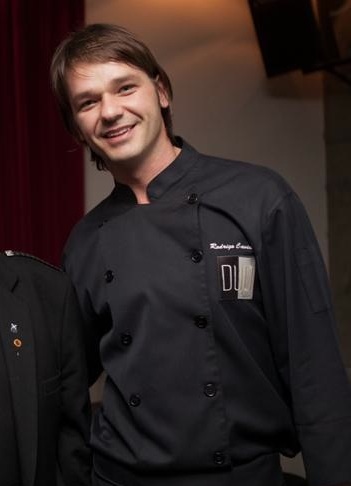
Rodrigo Cavichiolo, chef and owner of Duo Cuisine in Curitiba, Brasil
CURITIBA, Brasil – This lively, eclectic city of 2 million in southwest Brasil has much to offer the casual tourist – Lush parks and gardens scattered throughout the city, a pedestrian-friendly walk through the heart of the business/shopping center and world-famous museums, botanic gardens and historic sites dating from the indigenous inhabitants found (and subsequently disrupted) by the earliest invaders.
What this city might have in short supply are above-average dining spots. Not unlike their neighbors to the (way,way) North, Curitibanos have a fondness for unsophisticated eating, whether it’s churrasco at a small park-side restaurant or standing in line at one of the McDonald’s or Subway shops much-too common in any country with an abundance of delicious, intriguing native dishes.
One of the dining oases discovered during a recent trip was DUO Cuisine, an elegant restaurant in the Batel district on the city’s southwest side.
Chef Rodrigo Cavichiolo and business partner Marco Castro opened DUO in 2008 after deciding the city needed something new, a place where above-average food and wine merged with a warm, welcoming atmosphere.
Despite the gracious and welcoming atmosphere, the restaurant still struggles to attract the local clientele.
“It hasn’t been easy to convince the people of Curitiba,” said Rodrigo on a recent night. The restaurant, which takes up the second floor of the two-story building and offers a stunning view of the city, was about one-third full on this Thursday night.
“I have people flying in from Sao Paolo (just over 200 miles) just to eat here, but I can’t get the locals to come in,” Rodrigo lamented. “Maybe I’m a few years early.”
Cavichiolo said he’s largely self-taught but has long been fascinated by food, cooking and the intertwining of flavors.
“I love to bring out the best in my ingredients and to pair those with wines that fit the foods I prepare,” he said.
Our meal included an amusé of a small Brasilian soft-shell crab followed by two kinds of ceviche (one Peruvian, the other a Brasilian specialty) and (there were four of us) delicious entrées, including a smoked haddock, a grilled asparagus-and-brie on ciabatta and a nicely turned filet with a sauce of tomatoes and green olives (I forgot the fourth entrée).
The wine list is quite interesting, with an emphasis on Chile and Argentina to match the Brasilian appetite for beef.
We enjoyed several selections from Ventisquero, a fairly new (founded in 2000) Chilean winery with vineyards in Chile’s most-prestigious wine-growing areas, including the Coastal Maipo, Casablanca and Apalta valleys.
We had the ceviche with a Qeulat 2011 Sauvignon Blanc, followed by the Ventisquero Ramirana 2010 Sauvignon Blanc/Gewurztraminer (citrus, tropical fruits, minerality) with a shrimp risotto, and the 2010 Ventisquero Grey 2009 Merlot, another single-block wine showing spice, red fruits and a hint of pepper, paired well with the various entrées.
“I really like Ventisquero,” said Rodrigo. “Their wines are excellent for quality and value and I feel we share the same desire to prove ourselves by doing something beyond what others are doing.”
The ability to succeed by achieving and not over-reaching is a valuable facet in any endeavor. The more so when you’re a restaurant pushing the high-end envelope in a city rapidly transitioning into its role as one of the co-hosts of the 2014 World Cup and the 2016 Summer Olympic Games.
A Brush with Greatness – The 2002 Sassicaia
Sometimes the gods of fortune smile on a newspaper hack, and this past month has seen rare examples of being in the right places at the right times.
My most-recent Brush with Greatness was this past weekend in Aspen, watching the best women skiers in the world attack the gates and race courses during the Nature Valley Winternational World Cup ski races on Aspen Mountain.

While perhaps not the foremost expression of Sassicaia, the 2002 still delivers the elegance and depth of character expected of wines from Tenuta San Guido.
You will find much news about ski racing in the sports sections and here, but there’s so much excitement generated by watching those skiers it makes one (almost) willing to pay for early season skiing on man-made snow.
The first BWG I slipped into ¬– like slipping on a banana peel only to find you fall next to a $100 bill – was during a friend’s birthday party when my friend Carlos opened a bottle of the 2002 Tenuta San Guido Bolgheri Sassicaia.
A step back in time: The first 100-point wine I tasted was the 1985 Sassicaia during a tasting in at an early Food & Wine Classic in Aspen. I stumbled into this one, too, and at the time I remember thinking, “Why can’t all wines be this good?”
Actually, I probably was thinking, “I wonder how I can get the rest of this bottle out of here?”
The story of Sassicaia dates from 1944 when Mario Incisa planted cabernet sauvignon and cabernet franc vine cuttings on a steep hillside of the San Guido estate, called Castiglioncello after an 11th-century castle at the vineyard’s upper edge.
The 3.75-acre vineyard was expanded in 1965 with a second, 30-acre vineyard, planted with cuttings from the Castiglioncello parcel. This gravelly second vineyard gave the wine its name: Sassicaia, “the place of many stones”.
The wine is a field blend, using the same percentage of grapes (about 85 percent cabernet sauvignon and 15 percent cabernet franc) in the bottle as found in the vineyards.
As usual in the wine world, there are different opinions of where Sassicaia should be listed in the spectrum of great wines but the one thing on which everyone apparently agrees is that the estate was a trailblazer in the super-Tuscan movement.
Tenuta San Guido’s use of non-DOCG grapes (remember, this is wine is a child of Tuscany, but without a drop of Sangiovese) is credited with spurring the super-Tuscan movement and revitalizing Italian wine regulations across many DOCs and DOCGs in Tuscany.
The 2002 vintage isn’t considered quite as impressive as the 1985, but that’s quibbling over what’s generally thought of as the greatest Sassicaia ever and what some critics consider one of the best wines to come out of Italy.
I rarely offer tasting notes, since my description of “black plums with hints of chocolate, tobacco and leather” might mean nothing to you. However, I will offer the 2002 still was a bit restrained but eventually opened to fresh dark fruits, gravelly tannins and to what Monica Lardner of Wine Enthusiast magazine called Sassicaia’s “unmistakable elegance.”
This is a wine you let roll around in your mouth, hesitant to swallow because then it’s gone.
Being the nosy sort, I looked online for a price and saw it ranging up to $180 a bottle, although I’m sure Carlos paid much less than that in 2004.
Just as those world-class skiers paid a price for their greatness, great wine isn’t going to be inexpensive. But how often do you get an opportunity be close to greatness?
Making the best of a winter storm
After reading posts and letters from friends along the East Coast bemoaning – and deservedly so – the rash of difficult weather they’ve encountered this fall, it was Colorado’s turn this weekend. A quick-moving storm dropped 18 inches or more of snow on the mountains, which made for exciting driving down steep mountain passes.
Merely a drive-by, and not nearly as devastating as Sandy, the impacts of which I’m certainly not downplaying. I made it through Katrina and understand the difficulties facing the residents of the Atlantic states. But the weekend storm gave me the opportunity to stay home and catch up on some reading and tasting, so here goes two of the latest.
Amapola Creek 2009 Zinfandel – This Sonoma County winery scored big-time with grapes from the 100-year old, red-soil vineyards of Monte Rosso and it shows in the deep, lush flavors of backberries, dark fruit, spice and pepper. Winemaker Richard Arrowood, formerly of Chateau St. jean and his namesake Arrowood Winery, and his wife Alis founded Amapola Creek in 2005 and in that short history have made some outstanding wines, including Cabernet Sauvignon, Syrah and Zinfandel. With winter coming on, a hearty Zinfandel such as this is just what the inner fires need. 530 cases, $36 SRP.
Wild Horse 2010 Merlot – I tasted Wild Horse Winery wines last year and was impressed with their freshness and vigor and the 2010 Merlot continues in that line. Sourced from several vineyards in the Central Coast wine-growing region from Paso Robles to Monterey, this wine has bright fruit flavors and a medium-bodied intensity bolstered by its acidity and soft tannins. Great for the transition season or whenever you want an exceptional and affordable California Merlot. Forget what Miles said. 32,000 cases. $19 SRP.
Bringing the Roncha to western Colorado
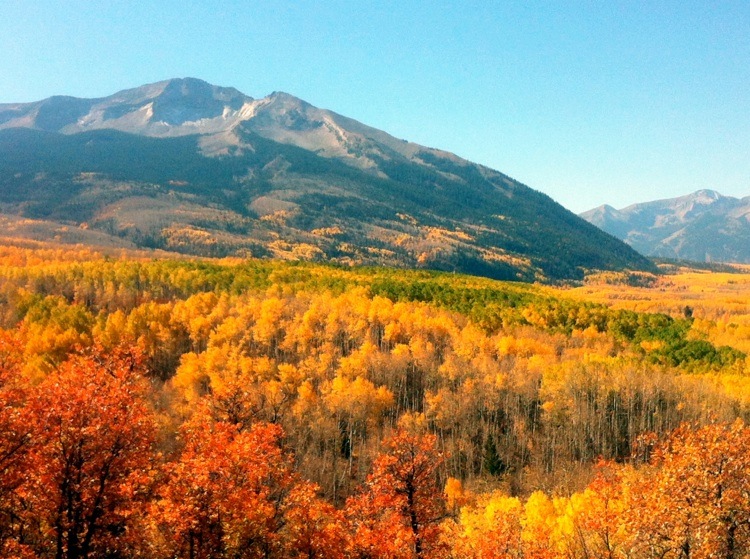
Early October finds West Beckwith Mountain (12,158 elevation) with a dusting of snow and a skirt of brilliant aspen.
An early October drive Saturday over Kebler Pass through the high country between Paonia and Crested Butte revealed the bare peaks of the West Elk Mountains skirted with aspen in a rainbow of brilliant hues ranging from emerald to russet and carmine.
It still was early when I had stopped at one of the organic roadside markets along the highway for coffee and to purchase lunch and I took the opportunity to talk with a couple of local winemakers, who said their 2012 harvest was only a few days from being over.
By mid-day I was sitting near a small pond along the gravel road, admiring the view and watching my aging four-legged friend Jack romp and splash through the water, acting like the puppy we both remember only in our dreams.
It’s definitely fall – the day was warm and bright sun but the occasional breeze carried a bit of a nip, perfect for the Fattori Roncha Bianco del Veneto IGT I was drinking with lunch.
The Roncha is 50 percent Garganega, which my friend Avvinare tells me is Italy’s sixth-most planted grape and the main grape in Soave. The Roncha is an IGT because (I think) it’s not at least 70 percent Garganega, the minimum for DOC and DOCG approval.
The wine is the yellow of October aspen leaves, with note of floral, citrus and burnt almonds, all laced with a minerality that perfectly fit the sunny day.
The Fattori family has made wine in the Terrossa hills north of Verona for three generations, and today another Antonio Fattori (his grandather, also named Antonio, founded the winery) is the winemaker. Some of the Fattori wines aren’t yet distributed in the U.S., so encourage your retailer to ask his distributor for the wines.
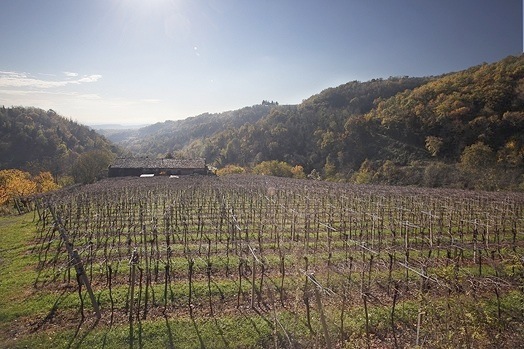
Fattori wines are grown in the volcanic hills north of Verona at altitudes ranging from 250 to 500 meters above sea level.
I thought of the following quote from the Fattori website while pondering some of the comments I’ve heard this year from winemakers who have learned new lessons from the drought gripping Colorado and much of the West.
“The world of wine is formed by seasons, situations and conditions that are never the same. No amount of experience is ever enough. The important thing is to search, to attempt with determination, humility and a little of patience.” – Antonio Fattori
 Wine Openers